Kent Manor House
HarvestKent Manor House is the residence of Charles Kent and the estate’s chief physical and administrative center, but it is no secure emblem of power. Its farm buildings burn, its upper rooms stand neglected, and its halls become places where the community confronts the consequences of violence, inheritance, and competing claims to land. The house’s diminished domestic life reflects Charles’s bereavement, while its dependence on village labor exposes the limits of ownership founded on documents alone.
Estate Center and Inherited Authority
Kent Manor House stands at the center of an estate whose ownership Charles Kent acquired through his marriage into the Jordan family. The manor came to him through the elder Edmund Jordan and his daughter, Lucy Kent, both of whom are dead. Their burial place is close to the narrator’s home, at the churchyard without a church. The estate’s documents and deeds establish Charles’s formal title, but the land is also worked and sustained by the villagers. The narrator stresses that the owner’s hands alone could not harvest the fields: the villagers’ labor is what makes the property productive.
That dependence shapes the uneasy balance between estate authority and customary rights. The villagers consider themselves possessive of the ground and of the common rights attached to it, even though they lack the written records that support Charles’s title. Their sense of belonging is not merely sentimental: it is bound to harvests, daily food, and the work required to keep households alive. When newcomers establish a dwelling on common ground, the dispute therefore reaches beyond the manor’s authority. The newcomers invoke a custom under which building a home and lighting a hearth establish a right to remain; the villagers see the settlement as a claim on an already precarious share of land and resources.
Fire and the Working Buildings
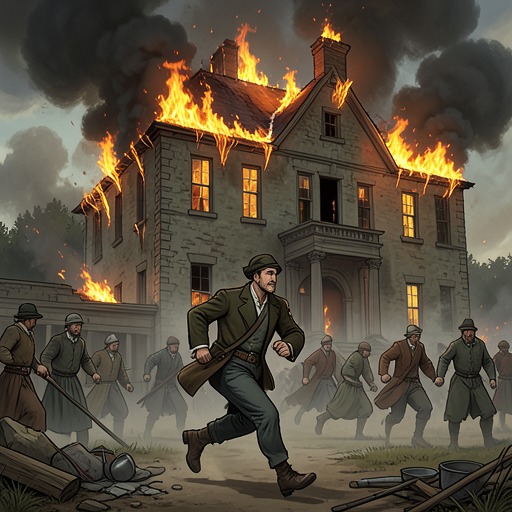
The earliest prominent crisis at Kent Manor House begins with two separate plumes of smoke. One comes from the newcomers’ hearth on the common; the other leads villagers to fear that the manor itself is burning. They find that the flames have taken the hay lofts and stable roofs, while the painted dovecote has already been destroyed. Willowjack’s alarm helps rouse the household and village. The loss is not confined to buildings: the fire also consumes stored hay and the estate’s doves, resources that belong to the working life of the property.
The fire originated when Christopher and Thomas Derby and Brooker Higgs used a moonball lantern to drive the birds from the dovecote. Their intention was not to destroy the estate buildings, but the lantern’s smoldering caught among dry nesting material and spread to the roof and hay. The three men then make conspicuous efforts to help fight the fire and encourage suspicion of the newcomers. The villagers have little appetite for exposing them, since they do not wish to sacrifice neighbors’ sons over lost property and are eager for the holiday to continue. Charles, shaken by the damage, nevertheless has to consider how justice and punishment should be handled in a remote place without a magistrate or constable.
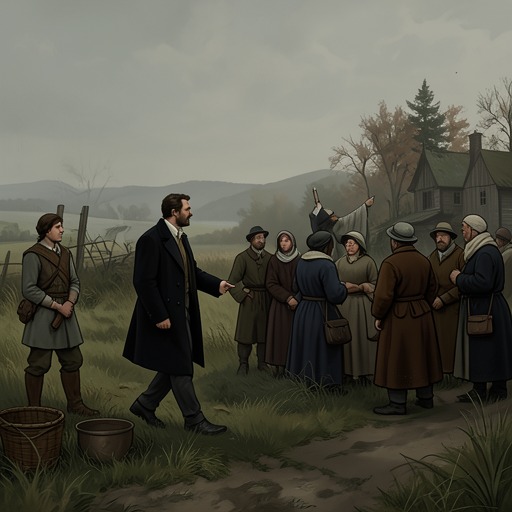
The estate’s loss is also a social event. After the flames are subdued, villagers travel from the manor toward the newcomers’ dwelling, with Charles following on Willowjack. The procession shows how quickly the house’s authority becomes entangled with communal fear and anger. Charles’s presence does not erase the villagers’ concern for customary claims, nor does ownership alone settle what should happen at the boundaries of the estate.
Domestic Rooms and Bereavement
The interior of Kent Manor House preserves signs of an earlier, more active household. When Lucy Kent was alive, rooms were regularly used and maintained; village women helped her dress and cared for the house. After her death, Charles simplifies his life, and much of the building falls out of use. The ancient gallery and upstairs sleeping rooms have been closed. Their paneling fades for want of care, while the house’s larger chambers feel melancholy in the absence of the dogs and children who might have occupied them.
Charles lives chiefly in the parlor, which serves as both retreat and bedroom. Its furnishings are useful rather than sumptuous: a bed set against the wall, a table for meals and documents, a settle against drafts, and a coffer holding papers and manuscripts. He sleeps on a chaff-stuffed mattress under coarse summer coverings, much as a cottage-dweller might. Two objects connect the room to Lucy: her small loom and her hairbrush. The narrator contrasts Charles’s greater space and possessions with the limits of his comfort, declining to equate ownership with ease. Kent Manor House thus holds the material record of a marriage and its loss, but that record is concentrated in modest personal effects rather than an actively maintained display of wealth.
The building’s architecture reinforces its age and separation from newer houses. It has recessed openings and loopholes rather than glazed windows, and closely planted beeches obscure much of the daylight. In the afternoon, its upper gallery remains dark despite the brightness outside. That darkness gives the narrator cover when he climbs the stairs and watches a conversation from behind a curtain. The manor’s layout therefore provides not only domestic space but also concealment: a place where decisions can be overheard before they are publicly presented.
Meetings, Maps, and the Future of the Estate
Kent Manor House is where Charles tries to turn the aftermath of local disorder into a plan for the estate. During a feast, he introduces Philip Earle, who is employed to map the common ground and estate land and prepare petitions for the courts. Earle’s charts translate the villagers’ familiar world into lines and squares, a view that the narrator finds lifeless. Charles presents the work as a means of organizing matters to their shared advantage, but his assurance is uncertain. The meeting makes the manor a stage on which technical and legal descriptions of land meet the lived knowledge of those who work it.
The house’s role as a place of decision becomes more precarious when Young Edmund Jordan arrives with a party of attendants. His entrance is marked not by the welcome he seems to expect, but by the sight of a recently burned barn and the body of an older newcomer being carried to the manor. Charles and Philip Earle bring the body to the porch, where Jordan encounters the consequences of the village’s recent conflict before he has even settled at the estate.
Later, in the manor’s shadowed gallery, Young Edmund Jordan considers Charles’s response to the newcomers and favors stricter enforcement of law and punishment. His position exposes a widening difference between Charles’s reluctance to punish harshly and the heir’s colder approach. The house shelters this discussion, but cannot contain its implications: estate authority may be exercised through petitions, inherited claims, local discretion, or force, and those forms of power do not necessarily protect the community that sustains the property. Kent Manor House stands at the intersection of these claims, at once Charles’s diminished home, the center of estate administration, and the setting in which the future of the land is negotiated.