The Village
HarvestThe Village is both a place of hard agricultural labor and a community organized around shared use of the land. Its inhabitants rely on common work and customary rights that are not captured by deeds, while the estate’s owners can invoke legal title to reshape the fields. As the population dwindles and harvests disappoint, that tension becomes a struggle over who may live and work there, and what the land is for.
Setting and Landholding
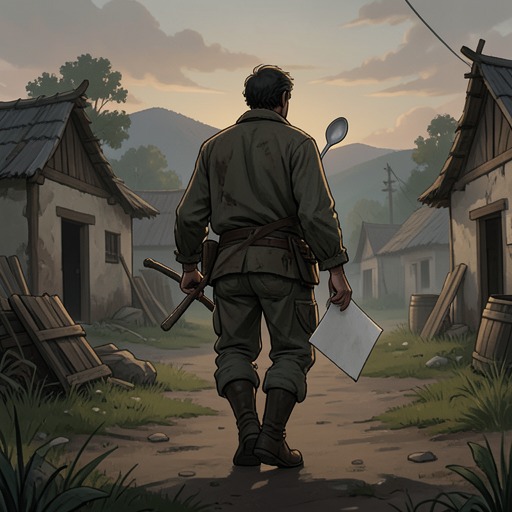
The Village has no separate name in everyday use: it is simply The Village, surrounded by The Land. Its fields are identified by direction, family, or use—East Field, West Field, South Field, John Carr’s flax garth, the Higgses’ goose pen, Hazel Wood, the Turbary, and the Warren. Even the formal records do not give the settlement an independent identity; they call it the Jordan Estate or the Property of Edmund Jordan, gentleman. The contrast between plain local names and the language of property marks two different ways of knowing the same ground.
Charles Kent holds the manor through his marriage to Lucy Kent, the only child of Edmund Jordan, who died without a son. Lucy’s inheritance passed to her male heirs by blood, and the legal claim of another Jordan makes Charles Kent’s tenure insecure. The land is therefore both a working environment and a contested inheritance. Its fields, woods, and commons carry practical value for residents even where formal ownership assigns them to the estate.
The settlement includes a churchyard without a church, and its dwellings show the effects of a declining population. Walter Thirsk surveys vacant or neglected homes: a derelict cottage beside the Carrs’ dwelling, the unkempt garden of the late Mr. Gosse, and the remains of the tenement where Cecily was raised. Cottages that once held family life have become makeshift byres, leaving space for newcomers even as residents resist admitting them. The Village’s spare housing and its suspicion of outsiders exist side by side.
Work and the Communal Year
The agricultural year binds the inhabitants together through necessity. A poor summer leaves some crops short and weak, while the higher barley field offers a more promising yield. Harvest depends on collective effort: children clear weeds, stronger workers use sickles and scythes, women and girls bind sheaves, and older men arrange the stooks. The labor is strenuous, but it gathers familiar faces in one field and gives the community a shared task and a common hope of food for the year.
Harvest custom also distributes what the work produces. The workers leave ten sheaves for the commons and one for gleaning, linking the field’s yield to communal provision and the right to collect what remains. The arrangement is not merely a division of produce; it reflects a local understanding that work and access to the land are bound together. The workday’s open conversation and joking further distinguish harvest from the more solitary pressures of ordinary labor.
That shared economy remains precarious. The narrator recalls years in which sun, rain, wind, mildew, cattle disease, or birds can undo a crop. Residents must work through the seasons without certainty that sowing will result in grain. Their livelihood depends on a productive harvest, but also on continued access to fields, commons, and the labor of neighbors. When the village’s numbers fall below sixty, the shortage of hands makes that dependence still more apparent.
Belonging and the Village Community
The Village’s social life is close-knit to the point of insularity. Families are interwoven through multiple ties of kinship, and residents are accustomed to knowing one another through those connections. Walter Thirsk describes himself as having become part of this inward-looking community, despite arriving from elsewhere. His own adaptation makes the boundary between native and newcomer complicated: he once belonged among strangers, but now recognizes the villagers’ suspicion in himself as well.
That suspicion sharpens when newcomers establish a dwelling on the land. Residents fear that outsiders may take a share of already limited resources, and they associate travelers with theft, disease, and uncertainty. The village’s declining population and empty homes make the rejection especially revealing: there is room to house newcomers, and additional workers might be useful, yet fear weighs more heavily than the practical need for help. The settlement’s common boundaries are thus social as well as physical, defining who is treated as entitled to belong.
Enclosure and a Change of Use
The proposed transformation of the estate challenges the basis of village life. Young Edmund Jordan presents sheep farming as a more predictable source of wealth than grain, arguing that wool can grow without depending on sun, rain, or seasonal conditions in the same way as crops. His projected future replaces plowing and reaping with shepherding and shearing, and imagines wool moving through weaving and cloth production toward distant consumers. The promise of steadier returns recasts the land as pasture and the inhabitants as workers in a different economy.
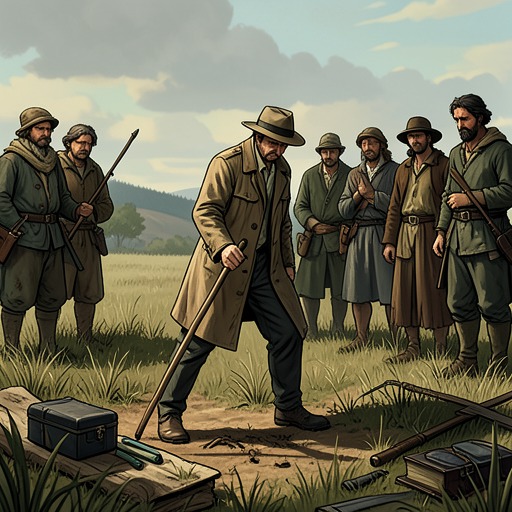
That change is to be imposed through maps and physical boundaries. Philip Earle is instructed to complete his mapmaking, while Baynham is charged with preparing the land for sheep. The plan calls for fences, dykes, and walls within the estate’s bounds, the clearing of commons for private enclosure, and the removal of trees deemed unprofitable. Charles Kent objects that the settlement has nearly sixty people to feed; Young Edmund Jordan answers that Baynham will employ only the hands he needs and that economies will be necessary. The proposal therefore offers no assurance that all current residents will retain their livelihood.
The Village’s customary claim to the commons conflicts directly with the authority of documents and mapped boundaries. Its inhabitants argue that their labor gives them a practical stake in the land, even without formal title. Enclosure would not merely alter the scenery: it would restrict access to shared resources and replace a subsistence-based community with an estate organized around sheep and wool. The change in land use makes an economic dispute inseparable from a dispute over residence and belonging.
Narrative Significance
The Village is presented neither as an untouched pastoral refuge nor simply as a collection of properties. Its natural beauty is repeatedly qualified by the demands of work: the landscape that first captivates Walter Thirsk becomes, through experience, a stern source of labor and subsistence. Fields must be harvested, land worked, and resources shared if the community is to endure. The pastoral promise of rich wool and leisure is set against the embodied effort required by farming, as well as the risks that no plan can entirely remove.
The settlement’s ordinary names, shared customs, empty dwellings, and threatened commons make its social order visible before enclosure physically changes it. The Village’s precarious strength lies in cooperation, but declining numbers and fear of outsiders weaken that arrangement from within. Against it stands a system that can record, measure, fence, and redirect the land. The conflict over the estate thus gives the place its central significance: it is where customary belonging meets formal power, and where a community’s means of survival are placed at risk by the conversion of its fields.