Jordan Estate
HarvestJordan Estate is the landholding whose fields sustain The Village and whose ownership is challenged by a blood relative of its former owners. Its significance lies in the contrast between two ways of understanding land: as a productive commons maintained through shared work and customary rights, or as a property to be mapped, enclosed, and converted into a profitable wool enterprise.
Land, Work, and the Village
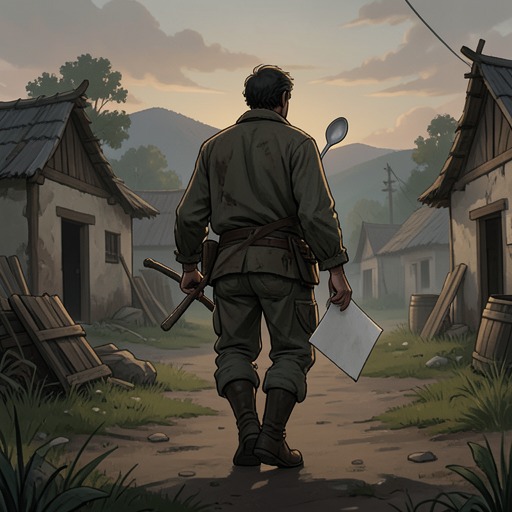
The estate is remote enough that a market square lies two days away by post-horse or three by chariot. The community has no magistrate or constable, and Charles Kent’s authority is exercised through local discretion rather than nearby legal institutions. The land is known in daily life through practical names such as East Field, West Field, South Field, Hazel Wood, and the Warren. The settlement itself is simply The Village, surrounded by The Land; estate documents instead call it the Jordan Estate or the Property of Edmund Jordan, gentleman.
The fields produce unevenly. Shaded ground near the dell and neglected stony slopes yield barley too weak to justify much reaping, while the higher field is more promising. Harvest is a collective undertaking shaped by the size of the crop and the number of people available. Children weed among the grain; stronger workers use sickles and scythes; women bind sheaves; older villagers build stooks. The harvest also sustains gleaning: sheaves are bound on the understanding that most belong to the commons and a smaller share is left for gleaning. Grain must then be threshed, separated from chaff, sieved, and stored, with what is dropped left to mice, rats, and pigs.
This work makes the estate more than a scenic landscape. Its usefulness depends on people’s coordinated labor and on the weather, soil, and harvest. A poor yield can mean that cattle eat while villagers go without. In winter, the land demands work even when it offers no certainty that crops will survive wind, mildew, disease, or birds. The beauty that newcomers may notice is therefore inseparable from the effort required to live there.
Customary Use and Competing Claims
The villagers distinguish the owner’s legal title from their own customary possession of the ground and its common rights. Their labor, in their view, is what makes the estate productive: a landowner working alone could neither reap the fields nor maintain the community’s food supply. They therefore regard the commons as part of their livelihood, even though they possess no deeds or other formal documents establishing that claim.
The estate’s ownership derives from the Jordan family. Edmund Jordan and his wife had one child, Lucy, who inherited the manor and property after her father died. She married Charles Kent, but the inheritance document directed that the estate be divided equally among her male heirs by blood when she died. Lucy died in childbirth in the spring, and her child was a girl. Since Charles is her husband rather than a blood relative, he is not the heir under that provision. A cousin, also named Edmund Jordan, claims the estate and comes to assert what he considers his entitlement.
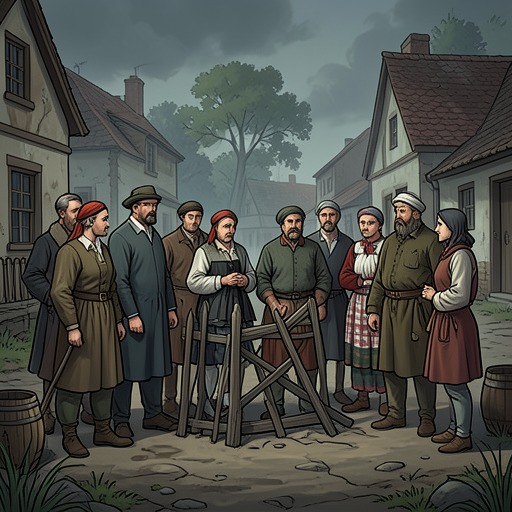
These competing claims place the community under pressure from more than one authority. The villagers’ customary rights are not the same as legal title, while Charles’s authority as landowner is vulnerable to the inheritance terms. The dispute over who owns the estate consequently also raises the question of whose understanding of its land and resources will prevail.
Enclosure and the Wool Plan
The arriving Edmund Jordan proposes a different economic future for the estate. He presents sheep raising and wool production as a way to avoid the uncertainty of harvests: wool can grow through changing seasons, while crops depend on sun and rain. In his account, villagers would tend flocks, shear them, and make cloth rather than plow and reap. The proposed transition connects the fields to a commercial chain extending from rough wool through weaving and finishing to the sale of textiles.
The plan is not merely a change of crop. Edmund directs Baynham, his steward, to use Philip Earle’s charts to study the property and prepare it for sheep. Before the first snow, Baynham is to organize the enclosed land with fences, dykes, and walls. The commons are to be cleared and privately enclosed; woodland is to be reclaimed, with trees judged by whether their timber can be traded rather than whether they provide shade or beauty. The promise of easier work and broadcloth, fustian, worsted, and twill thus accompanies the loss of shared access and the replacement of plowing with pasture.
The number of people who need to be fed makes the proposed economies consequential. Charles points out that the community numbers just under sixty souls, while Edmund replies that Baynham will employ only the hands he needs. The wool system may create work in shepherding and shearing, but its operation is designed around selective employment rather than preserving the existing community’s livelihood.
A Place Recast by Power
The estate’s fields are also sites of shared custom and collective memory. During the harvest, villagers work within common ditches and common hopes; their tools move together, and the work gives them a public setting in which to talk freely. The land’s practical names and recurring tasks record a relationship to place that is intimate but not expressed through formal maps or property papers.
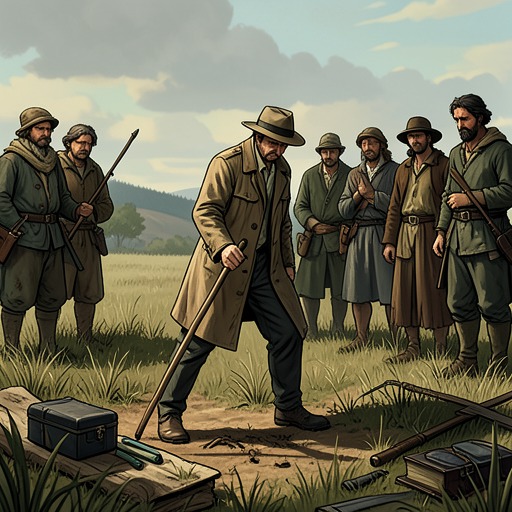
That difference becomes visible in Philip Earle’s mapping. His measured charts can represent boundaries and support the incoming Edmund Jordan’s plans, but they do not capture the labor and customary use that villagers regard as the basis of their claim. When the gleaning field is empty after the harvest, its openness becomes difficult to separate from the possibility of enclosure. Even a straight line across a field carries a different meaning when it is made by a plow for cultivation or drawn as a boundary for private pasture.
Jordan Estate therefore concentrates the novel’s conflict over land in a single place. It is at once an inherited possession, a source of food, a network of customary rights, and a prospective wool property. The proposed enclosure would not simply alter its appearance: it would reorganize access, labor, and belonging, making the land’s future depend on which kind of claim is allowed to define it.