The Unbuilt Church Ground
HarvestThe Unbuilt Church Ground is the Village’s churchyard without a church: a burial place, a site for communal rites, and the setting of the Village Pillory. Its unfinished state does not leave it empty. The villagers have made its wooden cross their gathering place for marriages, baptisms, funerals, harvest observances, and punishment; when two newcomers are locked into the pillory for seven days and the older man dies, that shared ground becomes the focus of the community’s fear and remorse.
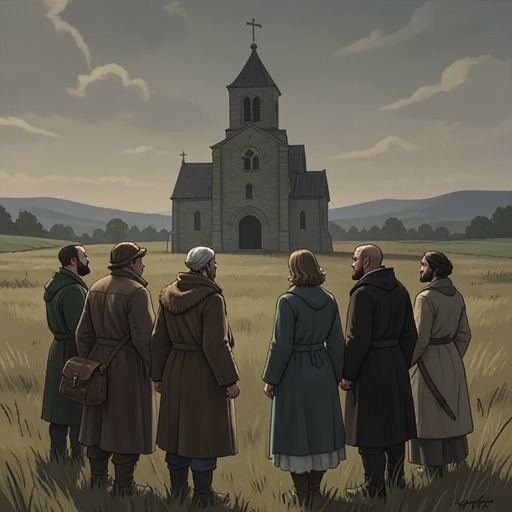
An unfinished churchyard
The ground was set aside for a church, but no building followed. There is no trench for its foundations, no flint selected for its walls, and no mortar mixed. A pile of stones intended for the project remains unlaid; a flat foundation block lies somewhere beneath bracken, sore-hocks, and willow herb. The churchyard is already crowded with graves. It is less than a hundred paces from Walter Thirsk’s home, and Lucy Kent and Cecily Thirsk are both buried there.
The absence of a church reflects the Village’s circumstances rather than a simple rejection of religion. The nearest steeple is a long day’s journey away, and the villagers cannot support a priest. They continue their own religious life without regularly dwelling on Heaven, Hell, or sin. Charles Kent performs local rites at the ground, where the dead are remembered and the living mark important passages. The place is both a cemetery and the nearest thing the community has to a church.
The cross as a communal place
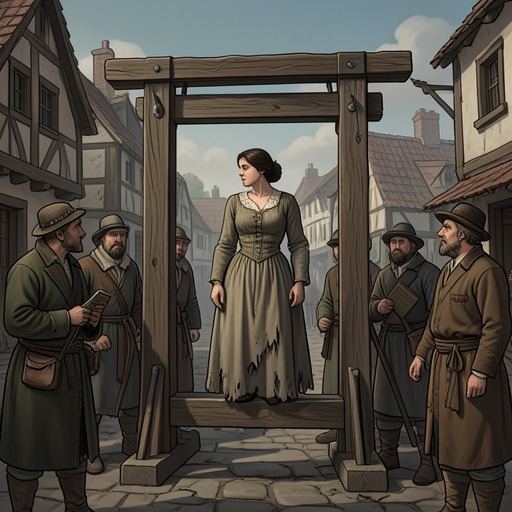
At the intended gateway to the unbuilt church stands an oak cross a little taller than a man. Its hinged crossboards extend wider and longer than the upright, forming two stations for prisoners. The openings for necks and wrists, made for confinement, also serve as spaces to hang prayer rosaries and flower chains. The structure’s uses are not separate: the same timber that can hold a person in disgrace is decorated for prayer and love.
Charles Kent conducts marriages and baptisms there, delivers eulogies, and comforts the bereaved. Walter’s wife, Cecily, and Charles’s wife, Lucy Kent, were both commemorated at the cross. The villagers also gather there to consecrate seed corn, give thanks for the harvest, and bless the plow. With no church building to distinguish sacred space from ordinary village life, the cross makes one place answer to grief, celebration, work, and discipline.
The pillory had rarely been used in recent years. Its iron-bolt key, kept by Charles Kent on a bronze chain among other keys in his parlor, was rusty, with broken wards. About ten harvests before the newcomers’ punishment, two cousins were confined there after fighting over the title to a pig. They spent one night in the pillory, then divided the pork from snout to tail, allotting two trotters apiece and carefully sharing even the liver and heart. Their quarrel became a village joke: they later claimed that the punishment itself was tolerable, unlike being stuck in one another’s company. The story gives the cross a place in local memory as well as in village practice, and shows how punishment could be followed by a negotiated settlement.
Seven days of confinement
The cross’s familiar uses change sharply when two newcomers are fastened into it for seven days. Walter first sees them from a cautious distance: their heads have been shaved, one already dark with stubble, and the shorter, older man must stand on tiptoe to keep the wooden vice from throttling him. Walter resolves to find a flat log for him to stand on when he returns. The small intended kindness makes the structure’s physical cruelty plain: the prisoner cannot comfortably stand flat, yet the pillory holds his neck and wrists in place.
During a later night of driving rain, Walter approaches the site and sees the cross’s broad outline burdened with the prisoners. Their arms are pinioned and their necks caught; he judges they cannot harm him, but remains hidden and watches. He imagines building a church gate and canopy over them to shelter them. The thought exposes the gap between the ground’s customary role as a place of care and the villagers’ present willingness to leave the men exposed. Walter recognizes that his earlier caution—letting the newcomers bear the blame—was a failure of courage and honesty.
By morning, the older man is dead. His body is brought from the pillory to the manor-house porch, where Charles Kent, Philip Earle, and Walter clean the blood, close wounds, and cover him with baling cloth. A loose pig has gnawed his foot and calf. Walter cannot establish exactly how he died: he may have slipped in the rain and broken his neck, struggled against the pig, or suffered a stopped heart. The uncertainty does not erase the conditions of his confinement. He had been left at the cross, and Walter, Charles, and Philip all appear to feel implicated in what happened.
A measure of village belonging
The Unbuilt Church Ground holds together the Village’s limited resources and its customary understanding of community. Its villagers lack deeds to the land they work, while Charles Kent possesses the legal documents to his estate; the residents nevertheless regard their common rights and their labor as grounds for belonging. Their gathering place is likewise made meaningful less by formal institutions than by repeated shared acts: burying their dead, blessing crops, marrying, remembering, and settling disputes.
The pillory’s return reveals how fragile that order is. The old pig dispute ended in a night’s confinement and a carefully divided carcass; the newcomers’ sentence lasts seven days and ends in death. In the same place where the villagers honor the dead and bless the plow, they leave a prisoner exposed to rain and injury. The cross does not change, but its meaning darkens: it remains the Village’s common landmark while registering the cost of the community’s fear and the failure of its customary care.