The Woods
HarvestThe Woods is a resource, boundary, and refuge in the village’s life, connecting familiar routines such as mushroom gathering with the escalating conflict over strangers and belonging. Its trees supply timber and its clearings accommodate temporary shelter, but the woods are never simply separate from the village: what happens there reaches the manor’s yards and fields, and the villagers repeatedly enter its margins to investigate, confront, or seek someone who has disappeared from view.
Setting and Uses
The Woods adjoin the cultivated estate and meet its fields at a boundary the villagers understand as part of their own domain. They gather there after harvest, when a pause in labor gives them time for other pursuits. In one remembered first summer, Walter Thirsk and John Carr went mushrooming in the same woods after the last sheaf had been cut. Thirsk recalls that they ate Fairy Caps, an experience that stayed with him; years later, the Derby twins and Brooker Higgs also went mushrooming there. Their outing links the woods to recreation, but also to the events that follow: the young men return with a Moonball, which becomes central to the fire at the manor’s stable and dovecote.
The woods also provide materials for habitation. The newcomers gather fallen timber there and use it to make a rough enclosure at the edge of the wood. The village regards the construction as a doubtful claim to residence rather than an established home. Its walls, roof, and limited protection make the shelter precarious, while its position at the woods’ edge leaves its occupants between the forest and the fields claimed by the village. The trees thus offer material to those seeking a place to stay without settling the question of whether they are entitled to remain.
Mushrooming and the Manor Fire
The Woods are the site of the mushroom gathering that precedes the fire, although the damage occurs in the manor’s yards. The Derby twins and Brooker Higgs return from the woods with Fairy Caps and a large Moonball. Walter Thirsk recognizes what the men have gathered and remembers his own earlier experience with Fairy Caps, but he does not intervene. He observes that the Moonball is too dry to cook and could instead carry fire from one place to another.
The men’s intended act is to drive the pigeons away, not to destroy the buildings. They take the Moonball from the woods toward the dovecote and push it into the loft before dawn, where dry nesting material catches fire. The flames spread through the dovecote and stable roofs and reach the stored hay. The chain of consequences draws the Woods into a larger village crisis: an outing among the trees becomes associated with the loss of the manor’s birds and damage to its buildings, and the resulting suspicion turns toward newcomers living near the woods.
The Newcomers at the Woodland Edge
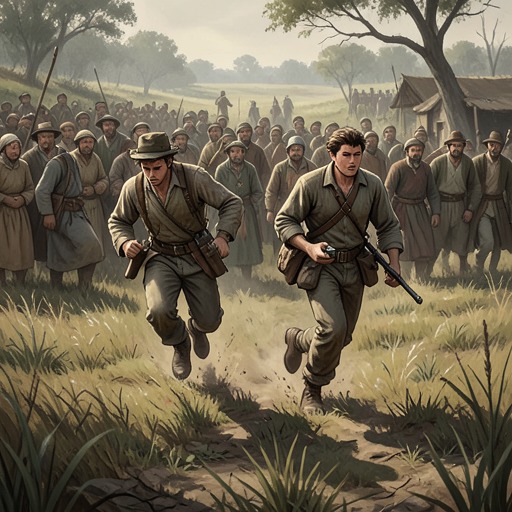
After the fire, villagers travel to the newcomers’ dwelling in a clearing near The Bottom, where the estate meets the wooded area. Charles Kent arrives with the villagers, and Mr. Quill follows with his book. The remaining ashes and the bird bones found at the site are treated as grounds for suspicion, although the bones do not establish that the strangers took one of the manor’s pigeons. The villagers nevertheless interpret the evidence in a way that reinforces their suspicion of the newcomers.
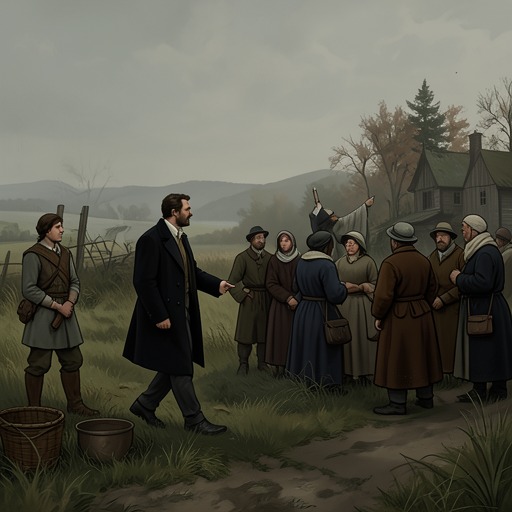
When the newcomers do not initially appear, Brooker Higgs strikes the shelter’s roof, which collapses; the hurried timber walls hold. Before the villagers can continue damaging the dwelling, two newcomers emerge from the trees with longbows. Their appearance changes the balance of the encounter: the villagers have come as a crowd, but the raised bows make the danger of further aggression immediate. The newcomers are described as seeming baffled rather than belligerent, yet the villagers’ fear and anger make the clearing a tense threshold between the woods and the settled land.
The episode also reveals how the village uses the woodland boundary to define belonging. The shelter is judged against the villagers’ assumptions about who may claim common rights, while its occupants are already labeled as outsiders and suspected of the fire. Villagers imagine walking them to the boundary and sending them away. The woods are consequently both the newcomers’ source of building material and the space through which the village can attempt to exclude them.
Refuge, Search, and Boundary
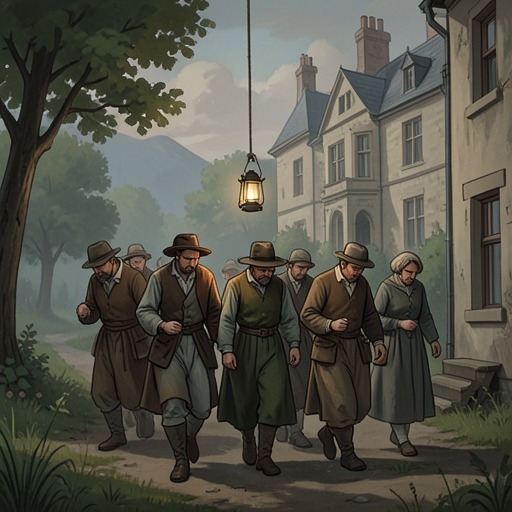
Later, during heavy rain, Walter Thirsk goes to the site of the newcomers’ den looking for Mistress Beldam. The shelter has been reduced to a pile of its former walls; he calls for her but receives no answer. The forest setting obstructs an easy search: he can make out shapes only gradually, while the weather and surrounding activity leave him unable to determine whether the movement and sounds nearby belong to people or animals. He considers that Mistress Beldam may have taken refuge elsewhere or may hear him and choose not to answer. The scene makes the woodland dwelling a temporary place of concealment, not a secure home.
The search is shaped by the danger facing Mistress Beldam if village authorities find her. After the bloodstained velvet shawl is discovered, Walter and Mr. Quill fear that the constables will search for her and find her alone. They hope she will return to the woods and make herself another shelter of logs and turf, but beyond the parish boundary, where villagers are not free to go. That proposed refuge shows how the woods can shelter someone only at the cost of moving beyond the community’s recognized limits.
Across these episodes, The Woods is not a remote backdrop but a connective space in the story’s geography. It gives villagers a place to gather mushrooms, provides the Moonball involved in the fire, supplies timber for the newcomers’ shelter, and offers a possible refuge to Mistress Beldam. Each use brings the forest into conflict with a different boundary: between work and rest, accident and responsibility, hospitality and expulsion, or village authority and escape. Its recurring role is to reveal how closely the village’s resources, suspicions, and claims of belonging are entangled.