The Gleaning Field
HarvestThe Gleaning Field is the Village’s working barley ground and the setting for its most concentrated expressions of agricultural cooperation and seasonal ritual. Its changing appearance records both the labor required to secure food and the community’s dependence on a harvest it cannot control. After the grain is cut, the field becomes the stage for gleaning, where the customary search for leftover kernels carries hope into winter. But the same acres also expose the fragility of that order: plans to replace crops with sheep pasture turn the field’s familiar abundance into a landscape imagined as empty.
Setting and the barley year
The field is uneven in quality. Its lower, shaded limits near the dell and its neglected stony slopes yield short, weak plants, while the higher ground has proved more promising. The village waits through summer as the better barley changes from green to tawny. At harvest, its dry awns rustle in the wind, and its colors and nutlike, sugary smell promise the ingredients of winter ale and porridge. This ripeness is not a pastoral abundance detached from need: the crop must be good enough to last the year, and the poor ground makes scarcity visible even before the sickles begin.
The work follows the grain’s condition and the season’s demands. Children move ahead of the reapers, removing thistles, nettles, teasels, and docks. Workers with the broadest shoulders swing sickles and scythes; wives and daughters bind sheaves, leaving a share of ten for the commons and one for gleaning; older men arrange the cut sheaves into stooks. The sun dries what the villagers have harvested. Each role contributes to the same fragile supply, and the crop becomes food only through coordinated effort.
Shared work and subsistence
Harvest draws the Village into one bounded space, where labor, conversation, and common hopes coincide. The dwindling population leaves few hands to spare: anyone able to work is expected to help earn supper. The field’s communal organization extends beyond the cutting itself. Workers hear one another’s talk, tools clack in time, and people turn together toward a sound from the woods or look up at the sun when a cloud passes over it. The shared rhythm makes the day satisfying, but it does not erase differences among neighbors; it brings people together, including those who do not entirely like one another, because the harvest cannot be completed without them.
The crop is an uncertain safeguard rather than a guarantee. The Village has known years when barley was plump and years when thin, dry grain meant surviving winter on dry bones. In the year described, the yield is adequate but not generous: the inhabitants will neither starve nor grow fat. That measure of sufficiency gives the field its social importance. The grain is not merely a crop to sell; it is the basis for household food and drink, and what is left after reaping and threshing can also feed livestock or be taken by birds and vermin.
Gleaning and the Queen
After the last sheaf is gathered, the cut field becomes the stub, reserved for the gleaning that follows. Boys keep birds away from its edges with stones, clapping-boards, and slings, but do not enter: gleaning belongs to the community’s next stage of work. Gleaning Day is recognizable in the air and in the landscape, even after a storm has washed and muddied the Village. Chaff still clings to trees, fallen bundles have left grain along the verges, and the barley ground awaits its gatherers.
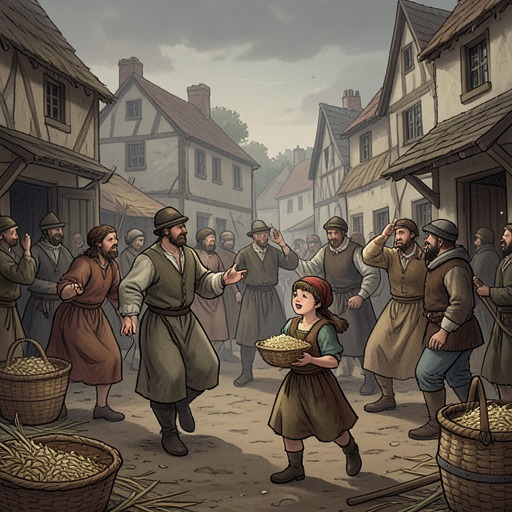
The Gleaning Queen custom gives that work a ceremonial beginning. The villagers ordinarily choose a girl whose piety and prettiness are thought especially spirited to enter the field first and begin looking for a grain. This year the previous night’s dance ends before a queen can be nominated, and the storm interrupts the celebration; the villagers gather at the field’s entrance the next morning instead. The girls dress in borrowed ribbons and garden flowers, with some applying yellow petal paste to their cheeks and arms. Charles Kent arrives wearing his high hat with two bright heirloom cloths, one lemon-yellow and one apple-green, and the choice is made there.
Philip Earle, known as Mr. Quill, selects Lizzie Carr, John Carr’s niece, who is not yet five. Her age and ungainly appearance distinguish her from the older candidates, while her especially yellow decorations make her conspicuous. She is frightened when Philip Earle approaches, so Charles Kent places the green sash on her head as a crown and helps her take her first steps. Her father and John Carr carry her on a chair made by joining their hands across their wrists to the edge of the stub. Charles Kent tells her to remove her slippers and find a single grain. She kneels, finds not just a kernel but a complete ear, separates the barleycorn from its awns, and winnows the flake by blowing across her palm. The grains displayed on her uninjured skin condense the season’s labor into a small, tangible promise of bread and drink. The ceremony turns a child’s discovery into the community’s public affirmation of its harvest.
A field under pressure
The field’s ritual meaning becomes more precarious when the prospect of sheep farming is set against the subsistence cycle. Charles Kent presents wool as less vulnerable than grain to unreliable sun and rain, wind-flattened crops, mildew, disease among cattle, or birds taking the harvest. His imagined future replaces plowing and reaping with shepherding and shearing, and household weaving with the production of cloth. To a hungry, drink-satisfied audience at the feast, the proposal can sound like a release from exhausting agricultural work. Yet its promise of leisure rests on a change in what the land produces and how the villagers live from it.
The distinction becomes stark after the gleaning rite. The field is empty; even Lizzie Carr’s green crown is gone. The remaining pickings belong to cows and visiting birds, while the narrator hears, in imagination, the bleating of sheep where the barley once stood. Later, a plowing scene makes a contrasting use of the stubble: Mistress Beldam’s husband joins the narrator in turning a narrow, deliberate length of earth, aiming toward a tapered oak beyond the hedgerow. The narrator describes the desired furrow as a straight, proud scar, though the pair can make only a small mark in a field that would normally take twelve days and a much larger team to plow. The gesture sets cultivated land and human effort against enclosure’s projected replacement of the old agricultural order.
Narrative significance
The Gleaning Field joins material necessity to collective memory. Its harvest scenes attend closely to tools, crop quality, weather, and the division of tasks; its ceremonial scenes show how those practical routines also produce belonging. The Queen’s first step is not separate from the economy of the field: her single ear of barley represents the gleanings that households will use, while the sash and communal cheering make that modest discovery publicly meaningful.
The field also makes large political change legible at human scale. A proposed sheep economy can be described as safer and easier, but here it is measured against barley that has fed the Village, against customs organized around the cut crop, and against the empty stub after the last grains have been found. Its changing surface—from standing barley, to harvested ground, to a furrow cut by a small team—holds competing futures in view without making any of them effortless. The land is not simply scenery for the Village’s history: its yield, limits, and possible conversion shape what the inhabitants can eat, what they do together, and what may disappear.