Plowing and Sowing: Resistance and the Future
HarvestPlowing and Sowing: Resistance and the Future makes agricultural work both a material necessity and a defiant claim on what comes next. As Edmund Jordan’s sheep-farming plan threatens the village’s fields and customary life, Walter Thirsk returns a plow to the soil and scatters winter wheat seed. The act cannot restore the old order: it marks only a narrow strip and takes place under an increasingly dark sky. Its significance lies instead in refusing to let the planned conversion of the land dictate that no spring, harvest, or community will follow.
Cultivation and the Cost of Survival
The resistance gains meaning from the labor that precedes it. At harvest, the village depends on the barley field’s better crop after poorer growth on shaded, stony ground has proved hardly worth reaping. Harvesting is collective and necessary: children weed among the grain, stronger workers swing sickles and scythes, women bind sheaves, and older villagers build stooks. The labor is tiring, but its shared rhythms also make room for gossip and companionship. Grain is not simply a crop; it is the work and expectation that bind households to one another and to the fields.
That communal order has little of the effortless ease promised by sheep husbandry. Jordan presents wool as more reliable than grain, since fleece does not depend on sun or rain in the same way. In his imagined future, villagers shepherd instead of plow, shear instead of reap, and weave wool into cloth at home. The prospect is made appealing through images of comfort and prosperity, from looms replacing oxen to garments reaching people far beyond the village. Yet its smooth promise conceals the decisive change: the sheaf gives way to sheep. A feast of veal and ale helps make Jordan’s announcement easier to receive, even as the villagers’ immediate satisfaction sits uneasily beside a future in which they may no longer grow their own grain.
The change also sharpens the contrast between pastoral beauty and agricultural hardship. When Walter first came to The Bottom, he delighted in its flowers, trees, and mornings, but quickly learned that the land demanded work rather than contemplation. Its seasons allow no pause for admiration: villagers must defend themselves against hunger with tools and labor. That knowledge is what makes cultivation an obligation as well as a livelihood. To leave the field unplowed and unsown would mean surrendering the next crop before winter had even passed.
From Memory to Defiance
Walter’s resolve begins in a private, uncertain moment. In the dark, he recognizes Mistress Beldam’s velvet shawl, washed but still associated with blood and with her. He holds and strokes it, seeking comfort and a sense of direction. The night’s physical cold becomes a prompt toward action: frost and furrows come together in his mind, and he understands that he must put the earth to plow, despite what the Jordans demand. The thought that the shawl might carry a message from its absent owner belongs to Walter’s experience of that lonely night; what follows is concrete, deliberate work.
His determination is shaped by a saying that gives plowing its order and its consequence. Young Beldam, the older newcomer who joins him, says, “Nose before ear,” first referring to the plow’s parts: the coulter must open the soil before the share and moldboard turn it. For Walter, the phrase also expresses a wider principle: work must proceed in the order that makes life possible. Grain cannot be reaped before land is plowed and seed sown. He treats this sequence as a sacrament and an oath to the future, because refusing to mark the soil before winter would amount to accepting that there will be no next year.
The field itself carries a record of the community’s former labor. Its stubble preserves different reaping styles: John Carr’s low, thorough cut, and Brooker Higgs’s wavering one, made while he talked. These traces make the harvested field legible as shared work rather than vacant ground. Walter remembers, too, that it had been the site of the Gleaning Queen ceremony, when the harvest’s gleanings were understood to benefit families, cattle, geese, and hogs. But the field is now meant for winter wheat, while Edmund Jordan has told the villagers they will never need a plow again. Walter’s decision answers that promise with a practical contradiction: the soil can still be turned, and seed can still be put into it.
A Narrow Furrow, a Shared Task
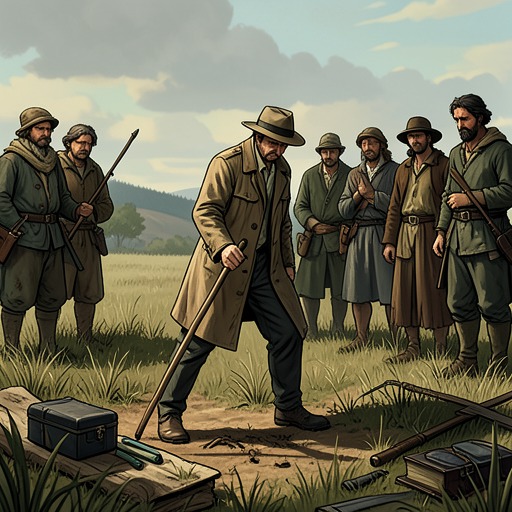
The work is deliberately modest. A normal plowing of the field would take twelve days, even with four oxen and twenty men. Walter and Young Beldam instead intend to make one day of it: a single length down the field and back, leaving one central ridge and two furrows. They aim toward a tapered oak above the dell, using its steadiness as a guide for a straight line. The scale of the task acknowledges the imbalance between their labor and the threatened transformation of the estate; the straight furrow is not a claim to have defeated that transformation, but proof that resistance can begin in the ground itself.
Young Beldam knows the work. He assembles the plow, takes its handles, and leans into the pull of the oxen, while Walter leads the animals. As they cross the field, Young Beldam whistles and Walter talks. Their intimacy comes through shared toil rather than declarations: over the oxen’s backs, the plowman who has been imprisoned in the pillory and the farmer beside him work together. Walter speaks of Cecily, Charles Kent, and Philip Earle, and contrasts the labor of oxen with the helplessness he expects from sheep. Young Beldam does not answer, but continues to whistle. The cooperation itself gives their work a communal dimension beyond the two men.
Once the plow is cleaned and put away, Walter takes up the seed alone. He brings winter wheat to the field and selects the heaviest grain for sowing. Good practice would allow the turned earth time to mellow, but there is no time: he scatters seed across the strip while the rain begins. He knows the young growth may later be crushed by rolling so that it can take a firmer hold. The image of wheat made stronger by pressure resonates with the people whose lives are also being pressed by events, without suggesting that hardship makes their situation easy or just.
Winter and the Unfinished Future
Walter understands the sowing as revenge on Edmund Jordan and the sheep scheme, but also as a farewell gift. That double meaning keeps the act from becoming a simple promise of victory. He has only the afternoon, and the strip of wheat is narrow; he is marking what he can rather than claiming control over what follows. The strengthening drizzle waters the seed as he casts it, giving the work its immediate, practical consequence even as the weather and failing light resist any triumphant ending.
The final image holds that tension in place. Light moves across the common ground, field, trees, and distant roofs before the day disappears; the plowed field is left black and shining. The work is finished for now, but its purpose points beyond the dark. “Winter will provide the spring.” The saying makes the season of apparent ending part of a cycle rather than its conclusion. Here that faith is neither a guarantee nor a pastoral consolation: it is a choice to prepare the earth for a future that the estate’s plans would close off. Plowing and sowing become Walter’s material answer to dispossession, preserving the possibility of another crop—and, with it, another claim to life on the land.