The Commons and Enclosure
HarvestThe Commons and Enclosure is the conflict between a village economy organized around shared use, customary rights, and collective labor, and a landowning project that would fence the fields and turn them into sheep pasture. The change threatens more than access to soil: it would replace the practices through which villagers secure food, distribute work, settle disputes, and recognize who belongs. The narrative sets the measured, saleable landscape of enclosure against a commons known through seasonal labor and intimate practical knowledge—and ends with a narrow act of cultivation that refuses to let the promised sheep have the final word.
The Commons as a Working System
The village commons are not presented as unused or ownerless land. They are part of a close-grained system of work and provision, in which families depend on fields, shared resources, and locally understood allocations. A poor summer yield makes that dependence immediate: the lower, shaded ground and neglected stony slopes produce weak barley, while the higher field offers the more promising crop. What the land yields is uncertain, and the effort needed to bring grain home cannot be separated from the risk of hunger.
Harvest is organized as a communal obligation. Children go ahead to remove weeds; people with the strength for it cut the stalks; wives and daughters bind sheaves; older people arrange the stooks. The customary division gives ten sheaves to the commons and one to gleaning. Gleaning is therefore not simply an informal favor granted by the owner: it is part of the community’s understood means of collecting what remains and making it usable. On Gleaning Day, Charles Kent confirms that villagers may take remaining barley for their own kitchens rather than add it to the common store. Cattle, geese, and hogs are then to use the field in turn, according to an established order of access.
These practices are collective without being frictionless. Families negotiate for additional grazing or animals when a household gains another mouth to feed; residents complain about the location of composting laystalls, and laborers dispute whether other workers arrive on time or leave too early. Such grievances are part of village life, not evidence that the commons lack rules. The arrangements distribute use and labor while leaving room for recurring argument over what counts as a fair share.
Boundaries, Knowledge, and Measurement
The village’s annual beating of its bounds renews a sense of shared territory. Children are brought to boundary stones so they will remember where they belong; the ritual can also make them taste the grass beneath them, joining knowledge of the border to knowledge of the ground. The walk is practical as well as symbolic: it is an occasion to review resources, anticipate needs, and air grievances in company and in a moderated voice.
That local survey attends to uses a map may not capture. Villagers know where pond weeds must be cleared to attract ducks, which failing oak may need to be cut, where peat and turf should be allowed to recover, where to find reeds for thatching and wood for fires, and which walls and fences need repair. This is a working inventory: land is understood through what it can provide, what condition it is in, and what labor will keep it useful. The community’s boundaries consequently define more than a line around property; they organize a body of shared practical knowledge and anticipated work.
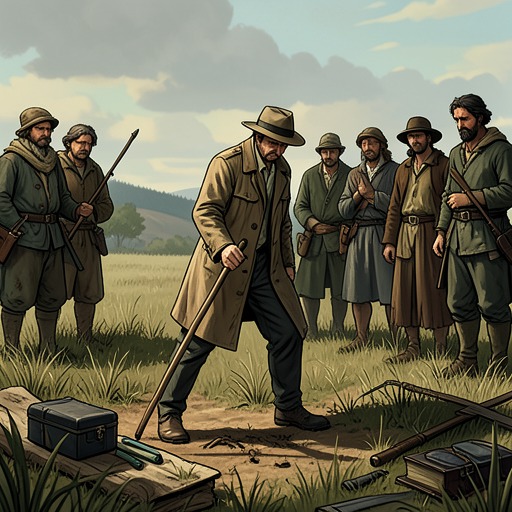
Philip Earle’s survey offers a contrasting way of seeing. Accompanying Charles Kent, he measures fields and counts the villagers, arriving at fifty-eight. From the villagers’ perspective, the count and charts make them feel measured along with the soil, and suggest that land may be prepared for sale rather than used to sustain them. Earle also records plants and views in his Natural History, but his attentive cataloguing differs from the villagers’ resource knowledge: he names and presses specimens where they must assess the land’s capacity to feed people and animals. The contrast is not merely between maps and memory. It is between a view that can describe land from outside and a communal knowledge formed by dependence on it.
Enclosure and the Promise of More
Charles Kent presents sheep farming as an answer to the insecurity of cultivation. Crops depend on sun and rain and can be flattened by wind, spoiled by mildew, or taken by birds; wool, he argues, is less vulnerable to the seasons. In his vision, villagers would tend sheep instead of plowing and reap fleece instead of grain, while textile work at home would connect the estate’s wool to finished cloth. The promise is easier labor and prosperity, but its terms transform the community’s work and diet: the sheaf gives way to sheep, and a system organized around grain, meat, and cheese becomes a wool economy.
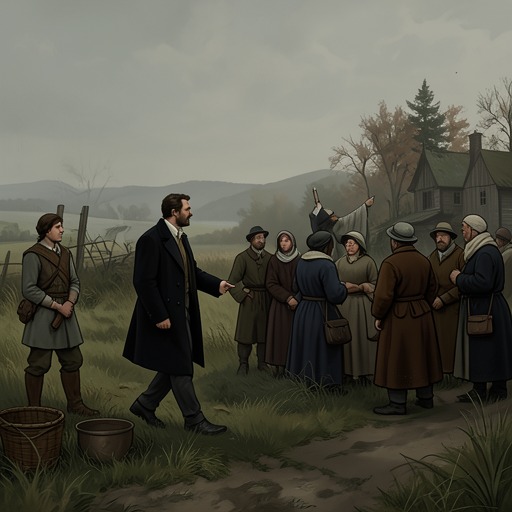
The proposal’s rhetoric of improvement is also a declaration of authority. Edmund Jordan describes the village as a place of Enough that he intends to remake as a settlement of More. His plan is to fence and quickthorn the fields, commons, and woods and make them sheep country. When villagers leave after the conflict involving his groom, he treats their departure as a return of the land to its owner and an opportunity to begin again. He also bars Rogerses, Gosses, and Carrs from his estate. In this account, the community’s customary use is not a lasting claim: access depends on the landholder’s decision, and departure can be used to justify taking the land back into his hands.
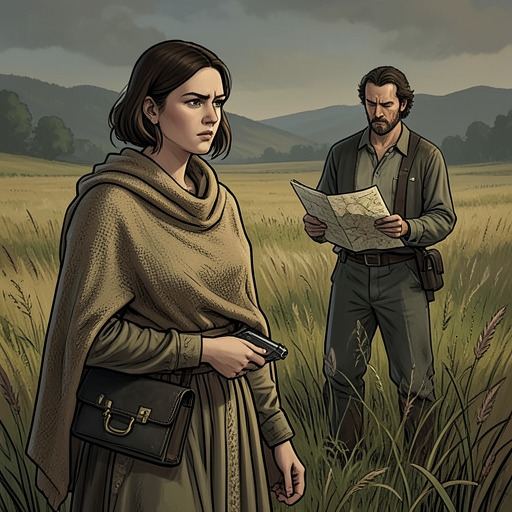
The episode involving the newcomers makes that unequal authority concrete. Philip Earle explains that they are fugitives from sheep, driven away after their own commons were fenced against their livelihoods. Their claim to a place to live is met not by recognition of need but by punishment and confinement. Edmund Jordan later agrees that the detained women and girl may be released only when they reach a marketplace three days away, and only if Charles Kent remains with them. The arrangement exposes the limits of customary claims when estate power controls access and the conditions of departure. The commons are not just contested land; they are the material basis of settlement, and losing them can make people exiles.
Cultivation as Resistance
The proposed conversion to sheep pasture carries an agricultural consequence that the harvest customs make unmistakable. At Gleaning Day, Charles Kent speaks of cattle, geese, and hogs using the stubble but omits the familiar next stage: plowing for winter wheat. The silence suggests that the barley field may not be cultivated again. Edmund Jordan makes the prospect explicit when he tells Walter Thirsk that he will never need the plow again.
Walter’s response is work rather than argument. He plows a narrow strip with Young Beldam, who takes hold of the handles while Walter leads the animals. A field that would ordinarily take twelve days, four oxen, and twenty men to plow receives only a single day’s effort from the two men. Walter chooses a tapered oak as a guide for a straight first furrow, turning the familiar skill of plowing into a deliberate mark across land slated for a different use. Once the strip is turned, he sows winter wheat, even though good practice would allow the soil to mellow before planting. He knows the timing is imperfect; the urgency is part of the gesture. He understands the seed as a farewell gift and an act of countryman’s revenge against Edmund Jordan and his sheep.
This furrow does not overturn the enclosure plan or restore the commons. Its scale makes that plain: it is a scar through a field, not a recovered landscape. Yet it joins customary knowledge to resistance. The oak, the oxen, the soil, and the wheat belong to a practice that the sheep scheme would displace; planting preserves, for the moment, the possibility of another crop and another season of cultivation. The conflict therefore remains unresolved in the act itself. Enclosure promises to make the land legible as property and profitable pasture, while the furrow insists that it is still ground to be worked, seeded, and expected to yield food.