Village Boundaries, Belonging, and Exile
HarvestVillage boundaries in the novel are not merely lines around land: they determine who belongs, who may remain, and who can be cast out. At the village edge, Walter Thirsk finds that the boundary which once promised security has become the threshold of exile. His departure turns a rule repeatedly taught by Charles Kent into a physical choice, while leaving open whether a life beyond the village can become a new form of belonging.
Boundary as Rule and Identity
The village’s outer limit is marked by a waist-high merestone, its surface vivid with orange lichen. For years, Thirsk has understood the stone as the edge of a known world and a warning against trespass. Charles Kent’s maxim, “If we stay within our bounds, there are no bounds to stay us,” makes obedience sound like freedom: remain inside the estate’s order, and there is supposedly no limit to what village life can provide. But the promise is conditional. Beyond the stone, Thirsk understands, everything he has is left behind and he is disowned.
The boundary is also taught through the body. Village children are brought to the limits as soon as they can stray, and the bounds are beaten into them as a lesson in where they do and do not fit. At the end of his own seven days, Thirsk repeats that instruction upon himself. He snaps off grass from the village side and tastes its fodder like an ox; then he grips the stone and strikes his head against it three times, hard enough to break the skin and begin a bruise. The gesture is at once an act of obedience and a deliberate acknowledgment of pain. He is the boy who needs reminding, but now he chooses to mark the lesson on his own body.
Belonging Under Suspicion
Thirsk’s precarious position at the boundary has a social history. The villagers know he witnessed the rough pulling apart of their cottages without stopping it, and they know he spent the previous evening in the widow Kitty Gosse’s bed. Some see him as a poacher; others are tied to the memory of Cecily, his dead wife, and regard his relationship with Kitty as betrayal. Envy also sharpens suspicion: men who had hoped for Kitty’s affection resent Thirsk’s success. He understands why his neighbors close ranks in anxious times, and does not claim innocence of every cause for their distrust.
He has kept secrets, including what he overheard in the manor-house gallery and what Philip Earle told him about the older Edmund Jordan’s will and its entitlements. His silence has left him divided between masters and friends, without certainty about whom he wants to please or where he wants to rest. In that uncertainty, his lack of deep local roots becomes dangerous. Unlike the Derby twins and Brooker Higgs, who are already lost to the village, Thirsk does not seem to his neighbors like a native tree grown from local soil. If someone must be offered up to the new master, he believes, his name is easier to surrender than the name of one of their own. Belonging is therefore not simply attachment: it is protection unevenly distributed, and a community under pressure can decide that one of its members can be done without.
The Crossing and Its Remnants
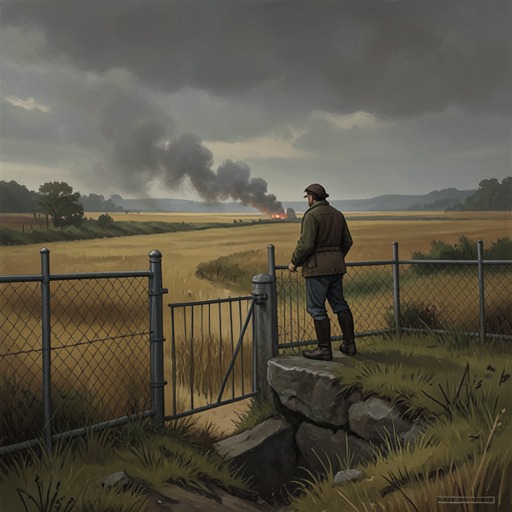
At the merestone, the physical boundary gives form to that social judgment. Thirsk says he has not been so close to the village’s edge for several years; it has always seemed too precarious. Now nothing remains to detain him or encumber his escape. He faces inward for what he knows will be the final time, looking toward the village he chose. Its silence is striking: no tools clack, no animals make themselves heard, and the manor house has stopped cracking, though smoke still stretches across blackened roofs and browning tree canopies. The quiet registers a community and estate emptied by destruction, not a settled return to safety.
His few mementos turn the crossing into a reckoning carried in skin. There is the fresh injury from striking the stone, the shiny pink burn in the middle of his palm, and a kick wound on his brow and cheek that remains faintly sore but will mend. He also keeps a piece of calfskin vellum that he made in the manor’s scullery. The sheet is unmarked: unlike the maps and charts that fixed the village, its commons, lanes, and proposed future pastures into lines and colors, it has not yet been assigned a place. Thirsk has burned those charts, along with the man who painted them, Philip Earle, but preserves the blank material that could become another kind of map—or remain open to any location.
Exile and an Unfinished Future
Beyond the stone, the landscape is less ordered. The hedges are untrimmed and spread across the lane; the Beldams’ cart has left muddy wheel ruts and broken twigs on hazel trees heavy with nuts. Thirsk reads this roughness not simply as danger but as provision. He expects to eat hazelnuts, bramble berries, elders, and sloes, trusting the countryside’s abundance to sustain him until he finds another place to rest. The contrast is pointed: village belonging has been enforced through bounded land and strict rules, while the country beyond offers food without promising shelter or a settled home.
A mouse foraging in daylight briefly occupies the lane. Thirsk startles it by kicking a curl of earth toward its hedge, and it darts into its crevice. The small encounter precedes his gathering of his modest possessions: a sturdy stick, the roll of vellum, silver, and burdens of remorse and memory. He must take the first step beyond the limits and continue alone toward whatever awaits him—and, in his phrasing, toward whatever awaits them. The destination and the identity of that plural remain unstated. The ending makes exile neither a simple liberation nor a return to a secure community: Thirsk leaves the bounded village, carrying its injuries and history, while the blank vellum and open road preserve the possibility of belonging elsewhere.