The Shift to a Wool Economy
HarvestThe Shift to a Wool Economy names a change in more than the village’s principal crop: it would reorganize land, labor, and social life around sheep, enclosure, and the sale of wool and cloth. Charles Kent initially dresses the prospect as a reassuring dream of prosperity and easier work; Edmund Jordan later states its material terms without that softness. Against both versions stands a community whose food, customs, and mutual obligations are tied to cultivation. The conversion is therefore presented as an economic plan with a human cost, not as a simple improvement in farming.
The Subsistence Economy It Would Replace
The village’s existing livelihood depends on crops and shared labor, not on a plentiful or reliable harvest. The barley yield can be meager: shaded lower ground and neglected stony slopes produce short, weak plants, while the better upper field ripens only after a season of watching and waiting. Rain may come late, wind may flatten crops, mildew may ruin them, cattle may suffer disease, and birds may take grain. Farming requires sustained work without certainty that the year’s sowing will provide enough.
Harvesting is also a collective arrangement. Children weed and clear the crop; the strongest workers cut stalks with sickles and scythes; women and girls bind sheaves; older men make stooks. The customary division reserves most of the sheaves for common use and leaves a portion for gleaning. The harvest brings familiar neighbors into one field, where work, gossip, jokes, and shared attention to weather become part of the same seasonal routine. It is a practical economy, but also a way of being together.
The Gleaning Queen custom gives that relationship a public form. After the barley is cut, a chosen girl takes the first step into the stubble and finds grain, making the coming winter’s bread and drink visible in a small handful. When the dance that should have preceded the ceremony ends abruptly, the villagers choose Lizzie Carr the following morning. Charles Kent guides her barefoot into the field, where she finds a complete ear of barley. Such rites make the standing crop and its remnants communal concerns. The wool plan threatens not only grain production but the fields in which these customs have meaning.
Charles Kent’s Dream of Easier Work
Charles Kent first introduces the change as a dream that will spare his neighbors the uncertainty and exertion of agriculture. In his account, wool is less vulnerable than crops to sun, rain, wind, seasonal change, and crows. A fleece will grow even in the dark. Instead of plowing and reaping, villagers will tend sheep and shear them; instead of working at heavy seasonal tasks, they will sit at home weaving yarn into cloth.
The dream has an appealing sequence: wool from the animals becomes broadcloth, fustian, worsted, and twill, then garments worn by people far beyond the village. It offers a route from local labor to wider prosperity, and it recasts textile work as gentle and almost playful. Yet the dream leaves its central change unnamed while its images already reveal it: the sheaf gives way to sheep. Its promise of leisure depends on a new system of land use and production, not merely on a better method of doing the village’s existing work.
The setting of the announcement complicates its reassurance. Charles Kent speaks after providing veal and ale, when the villagers are fed, drinking, and inclined to trust a master they know. He presents the future as a possibility distant by five or ten years, while the shared feast makes the immediate evening feel secure. His uncertainty and careful timing expose the distance between a comforting description and the consequences that description postpones.
Edmund Jordan’s Commercial Program
Edmund Jordan turns the softened proposal into a definite plan. He wants the fields enclosed with fences, ditches, and walls, the commons cleared and privately enclosed, and trees cut where they shade land that could be used more profitably. The village is to become pasture; plows will no longer be needed. Philip Earle’s charts are to guide the reorganization, while Jordan’s steward, Mr. Baynham, is to prepare the land for sheep and structure it before the first snow.
Jordan also describes the commercial chain beyond the estate. Rough wool will be sent to his warehouse; hired women will weave it into cloth, including worsted, twill, fustian, pickthread, and petersham; the finished goods will then enter a market where shearing, stapling, dealing, fulling, tucking, and dyeing all affect the profit. The village’s products are no longer framed chiefly as food and materials shared among neighbors, but as inputs and outputs in a trade whose accounts Jordan expects to supervise from his merchant house. He dismisses a common system that benefits commoners in good years as irrational in a modern commercial world.
The labor promise is sharply limited. Jordan says that some villagers may find places as shearers or sheep-boys, but that Mr. Baynham will employ only the hands he needs and that economies will be necessary. Charles Kent answers that there are a little fewer than sixty people to feed. Jordan does not offer employment for all of them. His reassurances about expenditure, charity, and a future church do not undo the distinction between those the new estate can use and those it may leave without work.
Land, Custom, and the Price of Improvement
Enclosure changes who can use the land as well as what grows on it. The commons are not vacant space in the villagers’ account: they belong to a shared economy of crops, animals, and customary use. Replacing them with private pasture would break access to resources on which ordinary households depend. Wool may promise a saleable product and more predictable returns, but that promise is purchased by removing the village’s established means of subsistence.
The projected church makes the transformation’s contradictions especially clear. The village has no completed church; its designated church ground holds graves, unlaid stones, and a foundation block. Its wooden cross and neglected pillory instead serve as a gathering place for marriages, baptisms, funerals, harvest thanks, and the blessing of seed corn. Jordan offers to fund a church and employ a priest, presenting religious provision as a benefit of the new order. But he also imagines the church bell summoning people to prayer and hurrying them to work, and concedes that only some will remain. The offer of a steeple accompanies, rather than resolves, the threat to village life.
The Crop Field as Counterimage
The narrative measures the wool scheme against the skill and bodily knowledge already invested in cultivation. Walter Thirsk recalls how work in the fields displaced his early wonder at wild plants: after he joined village life and husbandry, he learned that the land demanded labor and could not wait for contemplation. The new visitor’s admiration for countryside beauty seems incomplete beside the practical demands of hunger, weather, and work. In that light, a promise to make villagers leisurely does not simply remove hardship; it replaces their relation to the land with a different labor system governed by estate boundaries and commercial calculation.
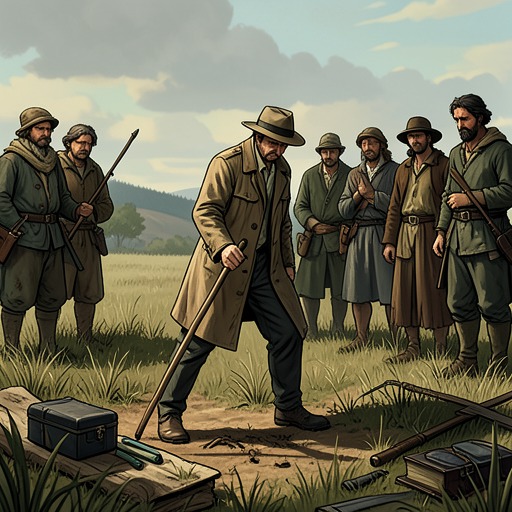
A later act of plowing supplies a pointed counterimage without proving that the wool plan has been reversed. Walter Thirsk and Mistress Beldam’s husband begin a narrow cut through a field that would ordinarily take twelve days, four oxen, and twenty men to plow. The two men aim to make a single honest scar in one day, using a tapered oak as their marker for a straight furrow. The scene gives the plow, the soil, and the practiced act of making a line a concrete presence beside the proposed fences and sheep pasture. The Shift to a Wool Economy remains a program whose advertised prosperity rests on enclosure and selective employment; the persistence of plowing keeps the older economy’s labor and claims to the land in view.