Customary Justice and Formal Law
HarvestCustomary Justice and Formal Law is the unstable system through which The Village makes claims about land, responsibility, and punishment. Local practice protects shared subsistence and favors remedies that preserve households, while Charles Kent’s authority gives those practices an imperfect local enforcer. Formal law, by contrast, appears as a distant power that can authorize settlement, impose harsher penalties, and redefine local conflicts. The novel shows these orders working alongside one another rather than forming a clean opposition: custom can shelter neighbors, but it can also deny outsiders fairness, while official authority can promise procedure and threaten devastating punishment.
Local authority and communal obligation
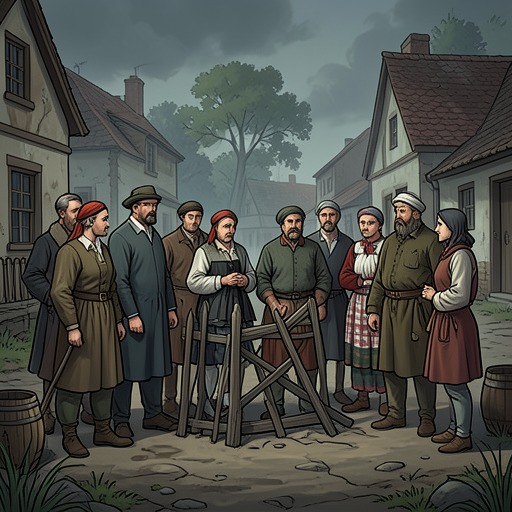
The villagers live far from a market town and have no resident magistrate or constable. Charles Kent is their landowner, but his approach to wrongdoing is shaped by personal judgment and concern for the people who work for him. The prospect of punishing an arsonist makes the limits of local authority plain: the stable and dovecote have burned, along with hay and doves, but Charles Kent would rather keep a wrongdoer among his working hands than deprive a family of its father, husband, or son. If the culprits are identified, they can expect a beating, exclusion beyond the village boundaries, and perhaps the loss of livestock in compensation; their lives, the narrator believes, will not be at risk.
This measured response is not simply leniency. It reflects a practical moral order in which a punishment must answer for material loss without destroying the household that remains part of the community. The villagers also share responsibility for how that order operates. After Christopher and Thomas Derby and Brooker Higgs set the fire, others recognize their guilt but withhold what they know. The narrator, Walter Thirsk, does not report the moonball he saw, partly because the holiday matters to him and partly because he will not value hay and doves above the sons of his neighbors. The silence allows the three men to escape immediate accountability and leaves the newcomers to bear suspicion. Customary solidarity can limit a landowner’s harshness, but it can also protect insiders at outsiders’ expense.
Land, labor, and customary rights
The village’s understanding of justice is grounded in how people make a living. At harvest, labor is shared across generations: children clear weeds, stronger workers reap, women and daughters bind sheaves, and older men build stooks. The yield is not merely a commodity; it supplies food through the year and sustains the communal division of produce. Gleaning rights give villagers a recognized claim to grain left in the fields after harvest. When Charles Kent’s white doves feed on fallen barley, the villagers see the birds as taking food that belongs to them by ancient custom. Their efforts to drive the birds away become, in their own eyes, a visible assertion of tenancy.
That customary claim differs from ownership recorded in documents. The villagers acknowledge that titles and deeds make Charles Kent the legal owner, but insist that their labor is what makes the land productive. Their customary attachment to the ground and its shared resources is not the same as possession by formal title, yet it gives them a powerful sense of entitlement and obligation. They depend on the fields, and their daily work supplies the harvest that the estate could not produce through ownership alone.
This conflict becomes sharper when a rule from outside the community is said to grant settlement rights to people who build a dwelling and light a fire on the commons. The villagers object that such a rule can transfer part of their customary share to newcomers before they can stop them. They also know that some of them, including Walter Thirsk, once arrived as outsiders themselves. Their hostility reflects changed circumstances: The Village has lost people, harvests have been poor, and winter can leave the cattle fed when the villagers are not. Custom therefore offers both a language of collective entitlement and a boundary that the settled community can use to exclude those who need the same resources.
The newcomers and the Village Pillory
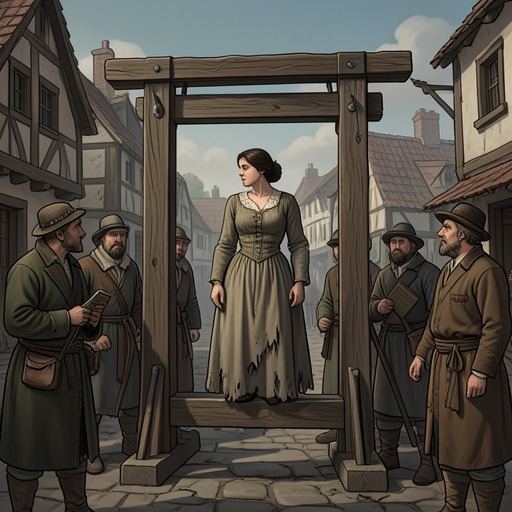
When three newcomers are accused of taking fowl, Charles Kent invokes a recognizable local punishment. He orders the two men to spend a week in the Village Pillory, has their bows broken, and requires that their heads be shaved to mark them as suspicious travelers. His decision answers an offense against property, but it also reflects the authority he exercises in the absence of local legal officials. The sentence is presented as modest beside the more severe penalties that might be applied elsewhere, yet it leaves the men confined and makes the woman’s position within the village vulnerable to the assumptions of its inhabitants.
The newcomers’ treatment is already entangled with the earlier fire. The villagers know, or strongly suspect, that the Derby brothers and Brooker Higgs caused the blaze, but they do not confess. At a harvest feast, the community considers asking Charles Kent to release the prisoners and offer them veal as an apology. No one takes that step. The narrator reasons that the newcomers may leave after their seven days and that the village has not made them welcome; he also recalls their drawn bows and their warning to the villagers. Their confinement is thus sustained by a mixture of evidence, resentment, fear, and communal self-protection, rather than by a settled inquiry into every charge.
The pillory’s history underscores how unusual and consequential the punishment has become. It has not been used for years; its key is rusty and its wards are broken. Its previous occupants, two related villagers who fought over the ownership of a pig, served only one night before settling their dispute by dividing the animal. That precedent makes the newcomers’ week-long sentence a stark contrast: the community’s familiar instrument of correction is now used against people with no local kinship or standing to help negotiate their release.
Death in custody and the limits of explanation
The elder newcomer is later found dead while confined, and his death transforms a local punishment into a question of responsibility that the village cannot resolve through ordinary procedures. Walter Thirsk and those with him attempt to tend to the body, but they have no doctor, undertaker, or legal authority to determine what happened. They cover him and Charles Kent says a prayer. The act carries a sense of shame, including the possibility that those who allowed the confinement have become parties to the death.
Walter offers a calculation rather than an established finding. The older man may have fallen from the pillory and broken his neck; rain, an attempt to resist, or a failing heart could have contributed. Walter hopes the death was sudden, but he cannot know. This uncertainty matters: the narrative does not provide a formal investigation or a conclusive account that settles blame. The absence of a magistrate has previously seemed to protect villagers from severe state penalties; now it also leaves them without an authoritative process for explaining a death in custody. Their own moral reckoning begins before any legal one can occur.
Formal law, power, and unequal remedies
Edmund Jordan brings a different conception of justice to the estate. He regards the newcomer’s death as within the law’s permitted bounds and sees the surviving man’s punishment as deserved. He argues that the younger prisoner should remain in the pillory for the full week, and proposes taking him away when the party departs rather than releasing him into a situation he considers dangerous. His reasoning treats public punishment as a defense of community order, but the prisoner has little ability to contest the account or shape what happens to him. Edmund Jordan also treats the corpse as undeserving of burial in consecrated ground and proposes leaving its disposal to the pigs. The contrast with Charles Kent’s hesitation over burial and punishment reveals not a difference between law and lawlessness, but a struggle over what authority requires and whose dignity it recognizes.
When a valuable mare is stolen, Edmund Jordan broadens the reckoning. He announces that someone among the villagers will be held responsible and warns that the culprit will face exclusion from the lanes and burial, while connecting the theft to the earlier fire and the death of the imprisoned newcomer. He also proposes formal charges of sedition and incitement against the surviving man, citing threats made against Charles Kent. Edmund Jordan declares himself the effective magistrate of the estate. In doing so, he claims the power not merely to judge a dispute but to select which incidents belong in the same case and which people will be made answerable for them.
What the competing orders reveal
The conflict is not a straightforward contest between compassionate custom and cruel law. Charles Kent’s customary discretion can prevent punishments that would break families, but his decisions still leave outsiders exposed to local prejudice and confinement. The villagers’ rights to harvest and glean express a subsistence economy that formal ownership alone does not capture; their defense of those rights, however, can become exclusionary when newcomers claim a place on the commons. Edmund Jordan’s appeal to law supplies a language of charges, public responsibility, and procedure, yet he applies that language alongside severe judgments and his own new authority.
Across these episodes, justice depends on more than the written rule. It depends on whose labor and testimony count, who belongs to the community, who controls the means of enforcement, and whether a decision can be reviewed by anyone beyond the people making it. The dead newcomer’s unresolved fate is the sharpest measure of the system’s failure: custom has not protected him, and formal law has not yet offered a process that can establish what happened. The overlapping orders make authority visible, but they do not guarantee fairness.