The Community Subsistence Economy
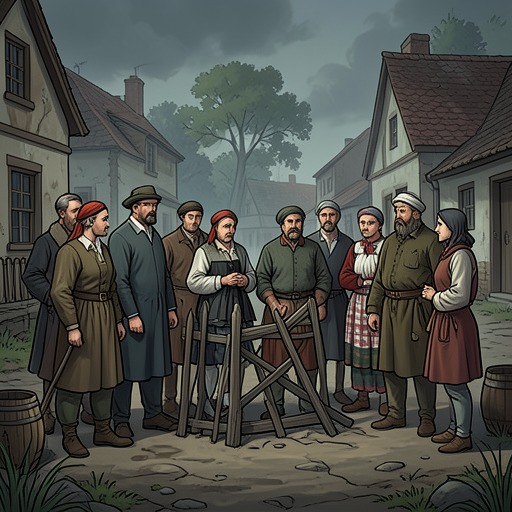
HarvestThe Community Subsistence Economy is the Village’s system for turning common land, seasonal labor, and customary sharing into food and mutual support. It is more than a way of dividing produce: its harvests, gleaning rights, work routines, and boundary customs make the villagers’ practical dependence on one another into a form of belonging. The planned enclosure of the fields threatens that order by recasting land and labor as sources of private profit and wool rather than shared subsistence.
Land, Labor, and Seasonal Need
The economy begins with the land’s uncertain yield. A poor summer can leave grain short of what is needed to last the year; shaded or stony ground produces weak crops, while the more promising barley field may offer better prospects. The people cannot separate livelihood from this variability. Their labor is directed toward securing meals and stores, and their collective knowledge includes not only when to reap but how to make different patches of ground serve the village.
Harvest is organized as a common undertaking in which nearly everyone able to work has a part. Children move ahead of the cutters to pull weeds; stronger workers use sickles and scythes; wives and daughters bind the sheaves; older people set the harvested stalks to dry. The work is demanding, but its shared character matters. People gather within the same field and ditches, labor within hearing of one another, and make the long day sociable through talk and teasing. Harvest thus produces food and renews the social ties on which future work depends.
The labor also follows a division of the crop that protects common use. The sheaves are bound according to a customary proportion: ten for the commons and one for gleaning. After the harvest, the gleaners may gather remaining barley for their own kitchens, using it for stew, beer, or animal feed rather than adding it to communal stores. The distinction between shared provision and individual gleaning is not a contradiction; it is part of the locally understood arrangement for making a crop serve different needs.
Customary Rights and Collective Belonging
The community’s claims to land are grounded in use and inherited custom as well as formal ownership. Charles Kent possesses deeds and legal title, but the villagers understand their own labor as indispensable to making the estate productive. Their customary rights attach to the fields and commons even though the villagers lack written muniments. From their perspective, ownership cannot be reduced to documents when it is their hands that harvest, plow, and maintain the ground.
Common access extends beyond crops. The villagers expect grazing and other resources to be allocated through local practice, and they discuss adjustments when household circumstances change. A family with another mouth to feed might seek the right to graze an additional pig or keep more geese. Disputes over composting places, work attendance, and access to resources are aired as part of recurring community life, not treated solely as matters for a distant authority. Such claims and complaints show that the commons depend on rules and negotiation, not on an absence of boundaries.
Those boundaries are also taught and remembered through custom. During the annual beating of the bounds, villagers review what they possess and hope to grow, and children are brought to boundary stones so that they know where they belong. The practice joins practical knowledge of land to a social map of the community. The same ground that provides fodder, fuel, peat, reeds, and places for cultivation is marked as a shared home through repeated observance.
Provision Against Scarcity
The village’s economic logic is shaped by exposure to bad seasons and limited stores. Rain, sun, wind, mildew, disease among cattle, and birds taking grain can all undermine a harvest. Charles Kent presents wool as a more reliable alternative, arguing that fleeces are not subject to the same crop failures. The villagers’ experience, however, makes reliability a question of who bears the risk and who receives the result. A marketable fleece may be steadier than grain, but it does not automatically feed the households whose labor produces it.
The difference is especially clear in the contrast between local sharing and sale. In the village, flour, meat, and cheese are portioned for household use; in the wider commercial system, goods are weighed and sized for selling. The communal arrangement may fail in a poor year, but it directs its resources toward keeping neighbors alive rather than maximizing returns. Its standard of adequacy is provision for the community, not the accumulation of a surplus for distant markets.
The declining population makes this economy more fragile and its obligations harder to meet. The villagers number only fifty-eight when Philip Earle counts them, and they have lost friends without raising enough healthy successors to replace them. They worry about winter days when cattle eat and people do not. That vulnerability helps explain their suspicion of newcomers competing for land and resources, even as the villagers’ own remembered arrival shows that belonging has not always been settled. Custom offers a basis for sharing, but scarcity can narrow its welcome.
Enclosure and the Proposed Wool Economy
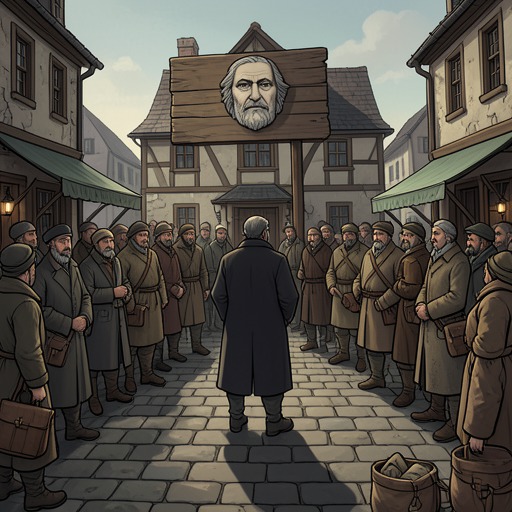
The Community Subsistence Economy is threatened when Edmund Jordan turns the estate toward enclosure and sheep raising. His plan is to divide and reshape the land with fences, ditches, and walls, clear the commons, and end the need for the plow. In place of a village economy organized around fields, livestock, and shared portions, he imagines a commercial chain: wool from the estate, cloth woven by hired workers, and profit from its sale. Baynham is to direct the preparation of the land, while employment will be offered only to the hands the new operation requires.
Charles Kent had earlier introduced the proposed transformation as a dream of easier work and shared prosperity. Sheep, shearing, and weaving would replace arduous cultivation, and wool could be made into cloth for buyers far from the estate. Yet the promise of leisure obscures the loss of the villagers’ customary access to fields and the uncertainty of who will retain work. Edmund Jordan’s account is more explicit about profit: the community’s present system benefits commoners, particularly in good years, but he regards it as economically irrational because it does not generate money for investors.
The conflict is therefore over more than a change of crops. It is a contest between two ways of deciding what land is for and what counts as a good return. Under the subsistence arrangement, shared labor, household portions, gleaning, and customary access bind production to local need. Under enclosure, land is reorganized for wool and profit, and the residents become a reduced labor force whose continued place is conditional on employment. The villagers’ later return to plowing a furrow with oxen gives fieldwork a defiant, future-facing significance: even as the estate’s plans threaten their customary economy, working the soil remains an act through which another use of the land can be asserted.