Beersheba
JudasBeersheba is the threshold between Shmuel Ash’s departure from Jerusalem and the uncharted life he hopes to begin in the desert. He reaches the city at dusk on his way to Mitzpe Ramon, only to discover that the last bus has gone; forced to wait until morning, he wanders through Beersheba’s uniform new streets, where the promise of a fresh start meets physical desolation and unanswered questions.
Transit to the Desert
Shmuel leaves Jerusalem at three in the afternoon on an Egged bus bound for Beersheba. He is heading toward Mitzpe Ramon, a new settlement being built at the edge of a crater, whose existence he had heard about only a few months earlier. He imagines finding work there—as a night watchman at the construction site, a school caretaker, or perhaps a librarian or library assistant. Surely, he thinks, even a small settlement must have a library; if not, it might have a cultural center.
The journey south brings a changing landscape past the bus window. Orchards stretch toward the mountains, and roadside eucalyptus trees conceal vehicle movements from enemy aircraft. Farther south, the new villages become fewer, the broad fields give way to low, bare hills, and winter’s temporary green gives way in Shmuel’s imagination to the coming desert dryness. The journey thus carries him from cultivated land toward a place he knows chiefly through expectation.
Arrival and Delay
At dusk, Shmuel reaches Beersheba’s station. He leaves behind the newspaper he has not read, retrieves his coat, fox-headed cane, and shapka hat from the luggage rack, drinks a glass of soda almost at a gulp, and asks when and where the bus to Mitzpe Ramon departs. The information clerk tells him that the final bus has already left and that the next one will not run until six the following morning.
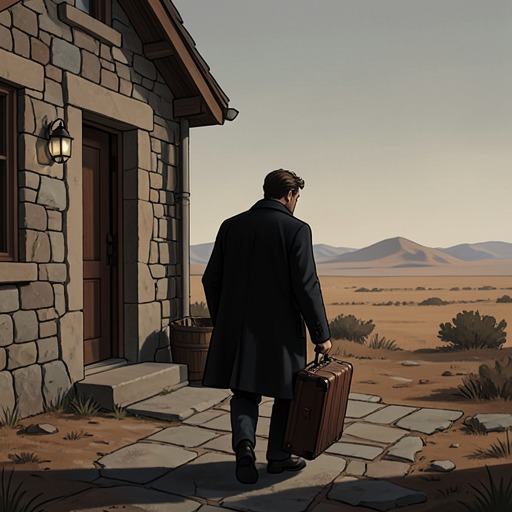
Shmuel knows he ought to ask something else, but cannot think what. Limping slightly, with his pack over his left shoulder and his coat and cane in his right hand, he leaves the station and wanders through a small city he barely knows. The missed connection turns Beersheba from a brief stop into an unplanned interval: he has a destination and tentative plans, but no immediate way to reach them and no clear next question to ask.
The New Streets
At the end of the new streets, the desert opens into low, flat sandy hills, with a few black Bedouin tents scattered across them. Inside the city, however, Shmuel encounters rows of long, identical three- or four-storey apartment blocks. Their plaster is peeling; metal junk and broken furniture clutter their yards, and open-lidded rubbish bins trail along the sidewalks. Scrub and thistles occupy vacant lots, while twisted scrap rusts nearby. Most shutters are closed, and old bicycles and children’s chairs are chained in the entrances.
In one yard, Shmuel stops beside a sickly fig tree because he likes figs and searches for a few early fruits. There can be none: it is early spring, before Passover, and fig trees do not bear fruit then. He plucks a leaf and continues slowly down the street with his load. The small encounter sharpens the gap between desire and circumstance: the tree offers neither the fruit he wants nor a place to rest, only a leaf he can carry on.
An Unanswered Approach
Children shout as they chase an orange cat through the narrow street; it disappears into the darkness beneath the heavy concrete pillars holding up the apartment blocks. From a second-floor window, a young woman in a colorful summer dress leans out to hang a wet shirt. Shmuel watches from below and thinks her pleasant, delicate, kind, and sympathetic. He decides to apologize for troubling her and ask where he can go and what he should do.
Before he finds the words, the woman finishes hanging the shirt, closes the window, and vanishes from view. Shmuel remains still in the empty street. He takes the pack from his shoulder, sets it on the dusty asphalt, and carefully places his coat, cane, and hat on top. Beersheba’s role in his journey is left unresolved: it offers the route onward but not the missed bus, a possible interlocutor but no conversation, and a place to put down his belongings without yet answering what he has come south to find.