Land of Israel
JudasThe Land of Israel is the contested home at the center of the novel’s political debate: a place where Jewish refuge, Arab fears, and competing claims to sovereignty meet. Shaltiel Abravanel imagines it as a shared home for Jews and Arabs rather than a separate Jewish state, while the divided streets and guarded boundaries of Jerusalem make the costs and limits of that hope part of everyday life.
Contested Home and Political Claims
For Abravanel, the Land of Israel could shelter Jews without dispossessing its Arab inhabitants. He believed the Jewish presence might be accepted if it did not appear to be the beginning of expansion and control. As Gershom Wald recounts his views, Abravanel argued that Arab opposition arose in large part from fear of what Jewish education, technology, and growing numbers might eventually mean for Arab political power. That fear, he thought, could still be eased through patience, sustained dialogue, shared institutions, and a willingness to relinquish the demand for a sovereign Jewish state.
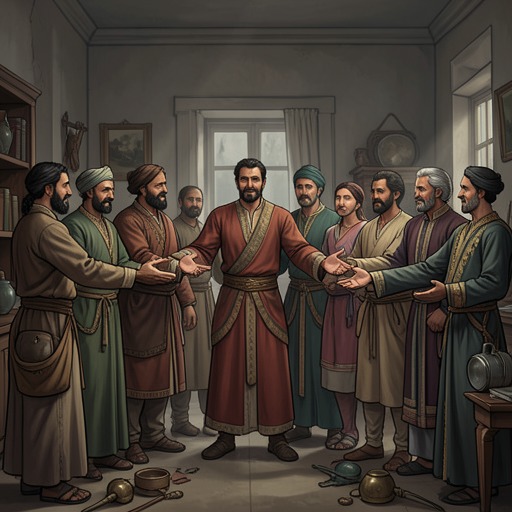
His proposal did not call for Jews to abandon their claim to a home in the land. Rather, he envisioned a home held in common, with neither a Jewish nor an Arab state imposed as the exclusive political framework. The Jewish and Arab communities would live alongside and among one another, together with the land’s Christians, Muslims, Druze, Circassians, and varied Christian communities. The envisioned society would have no separating borders; schools might teach the other community’s language or be established jointly. Abravanel believed that such everyday contact could gradually replace fear with trust and personal friendship.
His case rested partly on the claim that Jews and Arabs had both suffered under Christian Europe, though in different ways. He saw shared histories of subjection as a basis for empathy and understanding, not as a guarantee of reconciliation. In his view, the British policy of division had fostered separation, while common schools and workers’ organizations could begin to undo it. He pointed to existing professional and family relationships between Jews and Arabs in cities including Haifa, Jerusalem, Tiberias, and Jaffa as signs that coexistence was not merely abstract.
Jerusalem’s Dividing Lines
The novel gives the political argument a physical geography. Shmuel Ash’s winter wanderings bring him close to the barriers separating Israeli-held Jerusalem from Jordanian-held Jerusalem. Wire coils, warnings about mines and exposed ground, and the prospect of enemy snipers mark a boundary that is not simply a line on a map: it regulates movement and makes passage dangerous. A solitary Jordanian shot can deepen the silence of the city, while high walls and barbed wire close off neighborhoods and institutions from view.
The same geography shapes a later journey with Atalia. Their route passes an oxidized barbed-wire barrier at the edge of the Old City and follows a steep track toward Mount Zion, an Israeli-held projection surrounded on three sides by Jordanian territory. Shmuel struggles to keep up with Atalia as the path climbs beside no-man’s-land and positions exposed to enemy machine guns. The episode places ordinary movement, companionship, and vulnerability within the larger division of the city.
The house where Shmuel works repeats this pattern at a domestic scale. It stands at the end of Rabbi Elbaz Lane, beyond which the road becomes a stony path descending toward the Valley of the Cross and the remains of Sheikh Badr. Its rooms are carefully compartmentalized: Shmuel’s permitted domain is the library, the shared kitchen, and his attic room, while the bedrooms and a closed room he supposes belonged to the late Shaltiel Abravanel remain off limits. The house’s rules also forbid him from bringing visitors and require him to keep his employment secret. Physical and social boundaries thus organize who may enter, what may be seen, and how people can approach one another.
Abravanel’s Opposition and Isolation
Abravanel’s vision brought him into conflict with the Zionist leadership. He had long argued for dialogue and opposed violent methods, but in the 1940s he began voicing dissent within the Jewish Agency and the Zionist Executive. In 1947 he opposed the United Nations partition plan and Israeli independence. His colleagues called him a traitor, and he was given two hours to choose between resigning and being expelled; he resigned and then maintained silence in public.
His objections were grounded in a different reading of the danger facing the Jewish community. He argued that Arab fears of Jewish expansion could be calmed if Jewish leaders stopped pursuing a separate state, army, and exclusive sovereignty, opened settlements and institutions to Arab participation, and continued dialogue. Shmuel acknowledges the humane appeal of Abravanel’s position but considers it overly idealistic. He counters that the Arabs may have been tempted less by imagined Jewish power in the future than by Jewish weakness in the present.
Wald offers the opposing case through his admiration for David Ben-Gurion. Ben-Gurion, he says, understood that the Arabs would not willingly share territory or power, and that security could not depend on outsiders or on conciliatory words. Wald connects this argument to his son Mija, who practiced with a weapon in the woods of Tel Arza. The disagreement is therefore not only about political ideals: it bears the weight of a war in which Wald lost his only son, and of his fear that refusing to secure power would leave the Jewish community defenseless.
A Hope Confronted by War
Abravanel’s belief in a shared home deteriorates as he comes to see the two communities moving toward armed confrontation. As Wald later explains, Abravanel had once believed that Jews were building a home in the Land of Israel without displacing anyone or committing injustice. He began to doubt this in the 1920s and, by the 1930s, concluded that the two peoples were heading toward a collision in which the defeated would not be able to remain. For years he contained his doubts and continued to observe institutional discipline, occasionally calling for dialogue but attracting little interest.
During the siege of Jerusalem, the stone walls of the house protect Wald, Atalia, and the family from bullets and shells. Atalia goes out to queue for kerosene, ice, and rationed food, while the others remain inside. After the war, Abravanel withdraws further, cuts contact with the outside world, and expresses his disappointment in a new state he considers militaristic and intoxicated by national triumph. His opposition to statehood has not spared him the consequences of war; instead, the conflict leaves him isolated within the very home whose political meaning he had hoped to transform.
The Land of Israel consequently remains both a desired refuge and a contested political space. Abravanel’s borderless community proposal gives voice to the possibility of shared belonging, while Jerusalem’s barriers, the death of Mija, and the competing arguments of Abravanel and Wald show why that possibility cannot be separated from questions of power and survival. The novel sustains the tension without resolving it: the ideal of a common home persists, but its advocates must reckon with the fear, violence, and grief already shaping life on the land.