Wald and Abravanel Residence
JudasWald and Abravanel Residence is the low, secluded house at the end of Rabbi Elbaz Alley where Shmuel Ash finds work and a place to live after his studies, finances, and romantic hopes collapse. Set at Jerusalem’s edge beside fields and the remains of Sheikh Badr, it offers him an attic retreat but imposes sharp limits on movement, privacy, and disclosure. Its architecture makes the novel’s boundaries tangible: the city’s frontier, the house’s threshold, and the closed doors within it each separate one kind of life from another.
Setting and Approach
The house stands at number seventeen, where Rabbi Elbaz Alley ends and the built-up neighborhood gives way to rocky fields stretching toward the remains of the Arab village of Sheikh Badr. Beyond the last house, the damaged road becomes a stony track that winds down toward the Valley of the Cross as though reluctant to continue into desolation. The rain has stopped when Shmuel arrives; the western hills are lit by a soft evening glow, and a shepherd watches the city’s last houses from the opposite slope. This position at the city’s margin makes the residence feel neither fully urban nor wholly removed from Jerusalem.
From the alley, the building looks like a squat, broad-backed figure kneeling in the earth. It is a semi-basement set below street level, with the hillside rising almost to its windows. The old iron gate has sagged on its hinges and sunk into the ground; its two leaves leave only a narrow opening for a person to pass through. An iron arch above it bears a Star of David and the Hebrew words inviting the visitor to come to Zion. The gate is therefore both an entrance and a conspicuous emblem, while its awkward, constricted passage gives the approach a physical sense of difficulty.
The house’s exterior carries a second, more domestic set of signs. A climbing passionflower spreads over the stone façade. In the courtyard, Shmuel notices shifting patches of light on the paving and the grey veining of reddish stone. The green double door has a blind lion’s head for a knocker, and a raised inscription identifies the building as the House of Joaquín Abravanel and invokes God’s justice. Below it, a small practical note names Atalia Abravanel and Gershom Wald and warns that a step immediately inside the door is broken. The grand family inscription and the modest safety notice place inherited identity beside the everyday work of keeping the house usable.
Shmuel’s Arrival and the Attic
Shmuel comes to the house after his parents lose their savings and can no longer support him; his university career has stopped, his research is stalled, and Yardena has married her former boyfriend. He accepts a modestly paid position that includes accommodation, spending several hours a day keeping Gershom Wald company and the rest of his time at liberty. The decision turns a house he had admired into a practical refuge, but the refuge also places him within another household’s carefully maintained boundaries.
Two days after accepting the job, Shmuel leaves his rented room in Tel Arza and arrives with his possessions in five cardboard boxes and an old duffel bag. He brings clothes, books, a typewriter, a record player and records, along with rolled posters depicting Christ in his mother’s arms and heroes of Cuba’s popular revolution. He now remembers to step over the stool at the entrance rather than stumble on it. The move is modest in material terms, but it marks a decisive change: his belongings and his daily life are installed in a house that had first captured his imagination from outside.
The attic is the room that makes the arrangement attractive to him. When he first sees its small triangular dormer, with its faded tiled roof, he imagines settling there among books, red wine, a stove, a heavy blanket, a record player, and records, and withdrawing from lectures, debates, and love for the winter. Once he moves in, the attic becomes his private living space, reached by a spiral iron staircase from the kitchen. It offers seclusion, but that promise is double-edged: the household’s previous lodgers had also been drawn to the free hours upstairs, only to find that isolation could become oppressive.
House Rules and Divided Space
Atalia explains the routine that governs the residence. Shmuel is to meet Wald in the library each evening, usually from five until ten or eleven, and to prepare the kerosene stove at half past four. He must also feed the aquarium fish. Atalia expects Wald, who stays awake late and sleeps until midday, to provide conversation himself; she tells Shmuel not to fear disagreeing with him. The library is his workplace, the kitchen is shared with Atalia, and the attic is his own room. The boundaries are practical, but they also regulate who may enter, where they may spend time, and what kind of contact the household permits.
Atalia lays down rules for what happens outside the job as firmly as she specifies its duties. Shmuel may come and go beyond working hours, but he must not bring visitors, and he must not disclose details about the household or his employment, even to relatives. If he needs an explanation, he can say that he is the house’s caretaker and lives there without charge. He is to leave requests on the kitchen table rather than seek Atalia out because he is lonely; she warns that the house seems to provoke loneliness, while insisting she has nothing to offer. Even Wald’s nighttime cries, when he calls for absent people, are outside Shmuel’s paid responsibilities. The residence thus provides shelter on terms that preserve the household’s privacy and keep emotional as well as physical access under control.
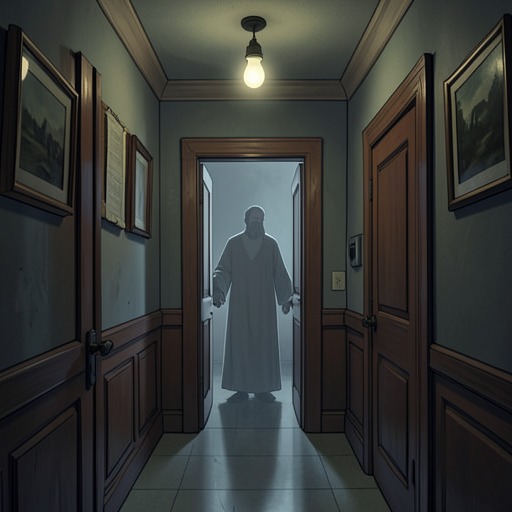
The narration stresses how carefully the ground floor is partitioned. For more than two months, Shmuel has not entered Wald’s bedroom, Atalia’s room, or the room opposite the library, which he assumes belonged to the late Shaltiel Abravanel. His permitted domain consists only of the library, kitchen, and attic. The closed door opposite the library gives the house a private history that Shmuel can infer but not yet enter; his employment grants him residence without general access to the family’s rooms.
A Home on the City’s Frontier
The house’s seclusion belongs to a wider geography of division. Jerusalem’s streets, walls, and frontier shape Shmuel’s daily life: the city is quiet in winter, while the line between Israeli and Jordanian Jerusalem is marked by minefields, barbed wire, and warnings about exposed ground and enemy snipers. During walks, he can become absorbed in the warning signs at the border, and the walls enclosing inaccessible institutions make him wonder what life is like behind them. He compares that obscurity with his own existence in the low attic at the end of Rabbi Elbaz Alley. The comparison turns the house from a simple lodging into one of several enclosed spaces through which the novel measures isolation.
The border also enters the house’s routines through the routes people take around it. On a walk with Atalia, Shmuel passes the barbed wire at the foot of the Old City walls and follows the steep path toward Mount Zion, a projection of Israeli territory surrounded on three sides by Jordanian territory. He worries that Atalia’s pace will leave him behind near the frontier and its exposed positions. The house is not directly on the dividing line, but its location at Jerusalem’s edge connects domestic movement to the city’s larger restrictions and risks.
The House as Workplace and Place of Care
The residence’s partition is temporarily altered when Wald becomes ill. A doctor diagnoses a lung infection, gives instructions for treatment, and tells Shmuel to keep the bedroom warm. For the first time, Shmuel is allowed into Wald’s private room. He stays beside the bed, reads chapters from Jeremiah until Wald falls asleep, and brings him warm tea with honey, lemon, and a little cognac when coughing wakes him. The sickroom, previously outside his remit, becomes a place of practical care, and the employment arrangement crosses a threshold it had kept closed.
This entry into the bedroom changes Shmuel’s physical relation to his employer as well as his access to the house. He has to overcome his expectation that touching Wald’s twisted, wiry body will repel him. Instead, he finds it warm and firm. While changing Wald’s pajama shirt, he rests his hands on the older man’s bare shoulder and may leave his fingertips there longer than necessary. The scene does not erase the house’s divisions, but it shows that care can create a temporary passage through them: the room becomes accessible because Wald’s illness requires Shmuel’s presence.
Wald and Abravanel Residence therefore functions at once as lodging, workplace, and an architecture of controlled intimacy. Its attic gives Shmuel a place to withdraw when his life elsewhere has stalled; its rules prevent that withdrawal from becoming unrestricted access to the people who live below. The house’s doors and rooms echo Jerusalem’s larger divisions, while the sickroom episode shows how need can open a boundary that routine keeps shut.