Negev
JudasThe Negev is the desert region that draws Shmuel Ash away from Jerusalem: first as a distant possibility of night work and escape, then as the destination of his southbound journey. The landscape he encounters is neither empty nor settled into a new life. New towns and cultivated fields give way to winter-green hills, desert scrub, and the unfinished edge of Mitzpe Ramon, making the Negev a place of tentative beginnings rather than a promised resolution.
Setting and landscape
The Negev enters Shmuel’s plans through reports of a new town being built in the desert, at the edge of the Mitzpe Ramon crater. He imagines work there as a night watchman, a storekeeper, or perhaps a caretaker or assistant in a school library. The region’s remoteness appeals to him, but his plans are practical as well as symbolic: he hopes to find a place to sleep, a job, and perhaps a library or cultural center in a settlement whose existence he has only recently heard about.
The southbound road offers a view of a country in transition. As Shmuel travels, newly established villages pass outside the bus windows, with white houses, red roofs, young cypresses, and long corrugated-metal roofs over barns and chicken coops. Orchards, wheat and barley fields, and alfalfa plots spread between the settlements. Eucalyptus trees line the road; their stated military purpose is to conceal vehicle movements from enemy aircraft. The landscape is therefore both productive and shaped by the memory of conflict.
Farther south, the settlements grow fewer. Broad fields give way to low, bare hills that have turned green after the winter rains. Shmuel knows this color will not last: within weeks the hills will be parched again, with only thorny shrubs gripping the ground against the desert wind. The temporary greenness gives the journey a fragile consolation, a brief sign of life whose eventual disappearance is already understood.
The Negev as an imagined escape
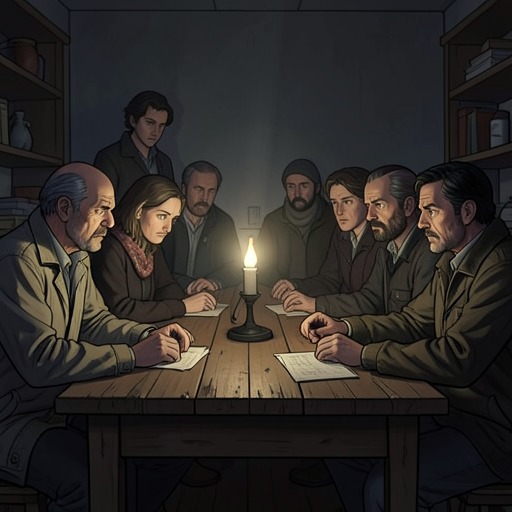
Before leaving Jerusalem, Shmuel considers taking a simple job in a remote place, perhaps as a night watchman in the Ramon mountains, where he has heard a new desert town is rising. The idea returns after an evening in the house at the end of Rabbi Elbaz Alley. There, the old man’s illness, his talk and biblical verses, and the lonely strain of the household make the house seem to Shmuel like a prison. He imagines that he could free himself by gathering his few belongings and going somewhere entirely different; the Negev offers a direction in which that departure might be possible.
The prospect is not a firm plan at first. When Gershom Wald observes that young lodgers in the attic have eventually left, he predicts that Shmuel will go too—to resume his studies, find life elsewhere, or return to his parents in Haifa. Shmuel answers that he had thought of seeking work in the new town near Mitzpe Ramon, either as a night watchman or as a storekeeper. Yet he says he will stay in the house until its residents send him away, adding that his will has faded. The exchange makes the Negev a measure of a choice he can imagine but cannot yet carry out.
Journey south
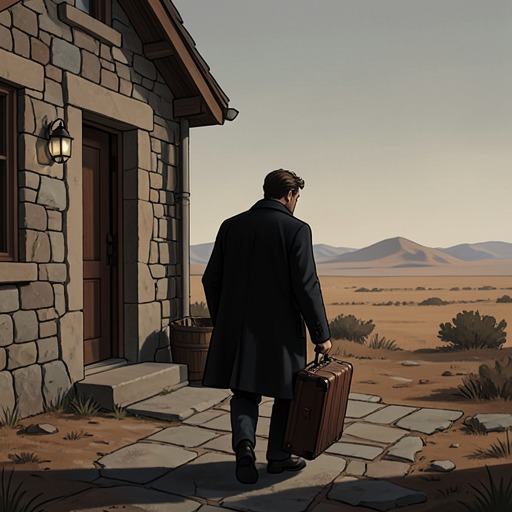
Shmuel eventually leaves Jerusalem by Eged bus at three in the afternoon, bound for Beersheba. He carries a heavy pack and a carved fox-headed cane; the coat and shapka he puts above the seats are things he expects he may forget when it is time to get off. His destination beyond Beersheba is the new town at the edge of Mitzpe Ramon. He hopes to find work on its construction sites, as a school caretaker, or in a library, and imagines writing to his parents and sister once he has found somewhere to settle. He also considers letters to Yardena and to the house in Rabbi Elbaz Alley, though he does not yet know what he would say.
At a dusty stop in Qastina, Shmuel gets off the bus and looks up to see whether the pale moon is still following him. He thinks it belongs to Jerusalem and ought to have stayed there, but it remains visible among torn clouds. Back on the bus, the orchards and fields comfort him. The journey’s movement south gradually reduces the signs of settlement, exchanging cultivated country for open hills; the landscape offers him relief without telling him what his new life will be.
Arrival and unresolved beginnings
The bus reaches Beersheba at dusk. Shmuel leaves behind the newspaper he has not read, collects his belongings, drinks a glass of soda, and asks when the next bus to Mitzpe Ramon leaves. The last bus has already departed; the next will not leave until six the following morning. He knows there is something more he should ask, but cannot think of what it is. Instead, carrying his pack and cane, he leaves the station and wanders through a town he barely knows.
At the edge of Beersheba’s new streets, he sees flat expanses of desert and low sandy hills dotted with the black tents of Bedouin shepherds. The town itself appears in rows of uniform, deteriorating apartment blocks, with peeling plaster, discarded metal, and old furniture in their yards. In one yard stands a sickly fig tree. Shmuel pauses to look for early fruit, although he knows figs cannot ripen in early spring, before Passover; he plucks a leaf and continues down the street. The small gesture links the actual desert journey to the story’s recurring fig-tree imagery while keeping his arrival firmly in the ordinary, barren world of the new settlement.
Shmuel has reached the south, but not yet Mitzpe Ramon. The missed bus leaves him waiting overnight in Beersheba, between the place he has left and the remote town he hopes will offer work and a place to begin. The Negev thus remains at once a physical region and an open-ended prospect: a destination toward which he has traveled, not an answer the narrative supplies.