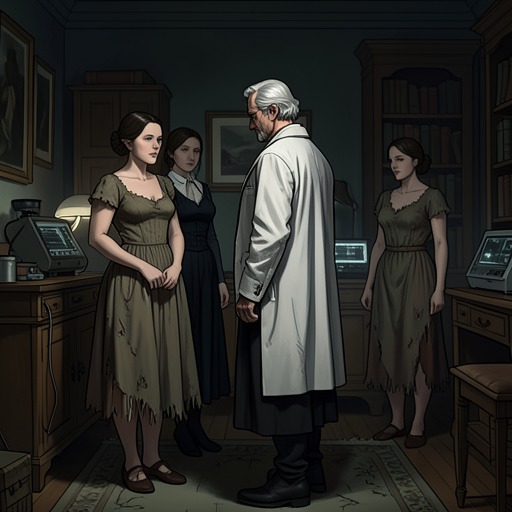
Comte de Bressac
JustineThe Comte de Bressac is a young aristocrat whose cultivated appearance masks a disposition toward cruelty and domination. He first encounters Therese as a fugitive witness and briefly spares her, but his protection becomes a means of control: he places her in his aunt’s household, expects her submission, and ultimately tries to enlist her in murder. When Therese refuses and warns the Marquise de Bressac, he treats her moral choice as betrayal and brings her back to the place where he had once threatened her life. His episode exposes the violence beneath his libertine arguments: he invokes nature and reason to excuse crime, while demanding that others accept his power as an obligation.
Identity and Character
The novel presents the Count as handsome and youthful, with features and bearing described as unusually soft and feminine. That appearance stands in pointed contrast to the cruelty, vindictiveness, atheism, and contempt for duty attributed to his character. His hatred is especially directed toward women: the account of his first meeting with Therese describes his profound aversion to her sex and the difficulty she faces in awakening any sympathy in him. His refinement is therefore not a sign of gentleness; it sharpens the contrast between social polish and moral brutality.
The Count’s outlook is a form of self-serving libertinism. He argues that killing cannot truly destroy life, since matter merely changes form within Nature, and thus claims that human violence neither harms Nature nor offends it. This reasoning turns a general speculation about natural processes into a license for personal crimes. He presents his designs as philosophically ordinary, but his conduct shows what the argument serves: the freedom to injure others without recognizing their claims upon him.
First Encounter with Therese
The Count first finds Therese hiding after she has witnessed him and another man together. She asks for compassion and explains that her presence is the consequence of misfortune rather than wrongdoing. The Count is suspicious, warning that if she has seen more than she admits, she will not leave alive. After hearing her account of her hardships, he and his companion seize her and take her into the woods.
There the Count proposes to bind Therese between four trees. His menacing display makes his power tangible, but he stops short of killing her. Instead, he orders her to dress and offers to take her to the Château de Madame de Bressac, where his aunt needs a maid. He says that he will recommend Therese on the strength of her story, yet makes the offer conditional: she must attach herself to him, submit to his intentions, and avoid betraying his confidence. He also points to the four trees as a possible grave, placing the threat alongside the supposed kindness from the outset.
The Household and the Count’s Design
At the château, the Marquise de Bressac acts generously toward Therese and helps her after her earlier conviction. The Count, however, insists that the protection is owed to him: he claims that his aunt would not have helped without his intervention and that Therese therefore owes him a different kind of service. His repeated pressure turns assistance into leverage, while leaving Therese uncertain about what he expects.
The Count’s hostility toward his aunt grows out of her attempts to restore him to virtue. In his account, her strictness only intensifies his attachment to his own inclinations and deepens his hatred of her. After Therese has spent four years in the household, he confides that he has condemned the Marquise to die and intends to use Therese’s hand to carry out the plan. Therese recoils and refuses, even when he calmly attempts to persuade her that the crime is insignificant. The contrast is central: he calls murder a philosophical trifle, while she recognizes the moral demand hidden by his abstractions.
Betrayal, Threat, and Attempted Murder
Therese does not agree to kill the Marquise. Instead, she informs her benefactress of the danger, exposing the Count’s confidence and placing herself at risk. He later arranges a meeting in the woods and guides her, without her realizing it, to the same four trees where he had threatened her years earlier. Ropes hang from one tree, and mastiffs are restrained at the others; a favorite of the Count guards them.
At that site, the Count reproaches Therese for betraying him and insists that she owed her safety and happiness to him. He accuses her of choosing the worse of two crimes, recasts her warning to the Marquise as an act of disloyalty, and blames her for endangering his freedom. He says that on his return to the château he expects a fortune, but that she must die. The scene completes the transformation of his original threat into an attempted execution: the trees that once marked a threat of future punishment now frame the immediate danger he has prepared.
Narrative Significance and Aftermath
The Count’s episode reverses the expected meaning of protection. He saves Therese from immediate death only to secure her service and make her dependent on him; when she refuses his criminal purpose, he interprets her ethical independence as ingratitude. His arguments about Nature do not restrain violence but furnish it with a rationalizing vocabulary. Against them, Therese’s refusal and warning show virtue as a practical choice made under coercion, not an abstract principle safely held at a distance.
The wider narrative continues to place Therese at the mercy of powerful offenders and compromised institutions. In a later account of her imprisonment, the Comte de Gernande threatens to bleed her repeatedly, but an interruption allows her to escape. Still later, Cardoville uses testimony from Saint-Florent to support accusations against her, while Monsieur de Corville intervenes after Therese’s reunion with Juliette and assumes responsibility for her innocence. Royal letters eventually nullify the unjust proceedings and grant her an annual income, yet Cardoville and Saint-Florent evade effective punishment through their appointments and influence. These later events are not consequences of the Comte de Bressac’s actions, but they extend the novel’s recurring pattern: Therese’s virtue exposes her to danger, while authority and social standing repeatedly shelter those who persecute her.