Rodin
JustineRodin is a wealthy surgeon and schoolmaster whose medical and educational authority conceals the exploitation of those in his care. After treating and sheltering Therese, he is exposed as an abuser of his pupils and the father of Rosalie, whom he has also victimized. When Therese tries to prevent him from killing Rosalie in the name of science, Rodin punishes her; his later elevation to First Surgeon to the Empress of Russia makes him one of the novel’s starkest examples of crime rewarded while virtue suffers.
Identity and Public Standing
Rodin is a forty-year-old surgeon living in Saint-Marcel, where his attractive house and considerable wealth place him well above the station into which he was born. He has an income of ten to twelve thousand pounds a year, and practices medicine from taste rather than necessity. After his wife’s death, he shares his household with two young female servants and his daughter, Rosalie. His professional standing is impressive: Rosalie says he has written authoritative works based on his investigations and is regarded as the most accomplished man in France. Yet the distinction between public expertise and private conduct is central to his characterization. He possesses knowledge and institutional respect, but neither makes him humane.
Rodin also keeps a school, maintaining a charter originally obtained during his wife’s lifetime. The school has fourteen girls and fourteen boys, admitted at twelve or older and dismissed upon reaching sixteen. Rodin teaches the boys; his governess oversees the girls, whom he visits after his own lessons. He chooses pupils for their appearance, finding elaborate pretexts to reject children whose looks do not suit him. The school’s small, carefully selected population is not incidental: it gives him authority over young people who depend on his household and are kept within a system he controls.
From Rescuer to Suspect
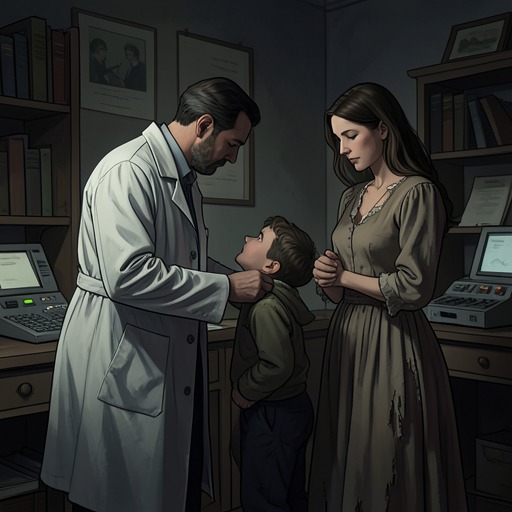
Rodin first appears to Therese as a possible benefactor. After she escapes from the Château de Madame de Bressac with injuries inflicted by Comte de Bressac’s dogs, she reaches Saint-Marcel and asks a surgeon to treat her. Rodin examines her, takes her into his own home, and cares for her during her recovery. By the thirtieth day, the wounds left by Comte de Bressac’s attack have healed. This apparent kindness gives Therese a place to recover, but her dependence on Rodin also brings her into close contact with his household.
Therese soon notices grounds for suspicion. Rodin lives with three young women, and their presence makes her question why he wants her to stay as well. She delays accepting his proposal to remain in the household, using the extra week to observe him and to grow closer to Rosalie. Her caution proves justified when Rosalie tells her that Rodin pursues medicine for the pleasure of experimentation, while the school serves his libertine appetites. Rosalie explains that pupils’ dependence leaves them exposed to his desires and that his servants are also subjected to his abuse.
The school’s routine gives Rodin opportunities to disguise abuse as discipline. On Fridays, one of the three days each week when he punishes pupils he says have misbehaved, Therese and Rosalie observe him from a closet adjoining the room. Rodin brings in a fourteen-year-old girl and then moves through several pupils, using punishment to abuse children under his supervision. He subjects both girls and boys to violations, alternating threats and punishment with forms of manipulation that reinforce his control. In the course of a single session, he abuses nine pupils: five boys and four girls. The scene changes Therese’s understanding of the school from a place of instruction to an organized setting for exploitation.
Rosalie and the Plot Against Her
Rosalie discloses that Rodin began abusing her when she was eleven. She also explains that he discourages religious practice and has limited her instruction, making it harder for the young people in his household to seek help or understand what has been done to them. Her account gives a personal history to the system Therese has witnessed: Rodin’s power reaches beyond the classroom into his daughter’s upbringing, her beliefs, and her ability to resist him.
Rodin’s colleague Rombeau becomes part of the danger. Before Rosalie disappears, he examines her and Rodin tells her to prepare for further abuse. Rodin then sends her away under an old woman’s guardianship, ostensibly to visit a relative; after nightfall, the woman brings her back. Rodin seizes Rosalie, silences her, and locks her in a cellar. When Therese discovers her there, Rosalie says Rodin had given her reason to believe he intended to marry her, and that the examination was meant to determine whether she could bear a child. The apparent journey away from the house has thus served as a cover for her return to captivity.
Therese’s suspicions become urgent when she overhears Rodin and Rombeau discussing a plan to kill Rosalie for anatomical research. They argue that the examination of a young person who has died a violent death would advance their science, and treat the prospect of killing her as permissible in pursuit of knowledge. Rodin’s reasoning turns professional ambition into a justification for murder: in his account, the harm to one person is negligible beside the supposed benefit to many. The plan exposes the moral emptiness behind his medical authority and makes Rosalie’s rescue a matter of immediate life and death.
Resistance and Retaliation
Therese hurries to the cellar and opens the door with a key she finds while trying to force it. She embraces Rosalie and urges her to flee, but Rodin and Rombeau appear before the two can escape. Rodin stops his daughter and accuses Therese of encouraging her flight; Therese answers that she had to act because Rosalie’s father was plotting against her life. Rodin recasts an attempt to save Rosalie as a servant’s offense, calling it espionage and seduction, and has both women dragged back inside.
Rodin has Rosalie tied to a bed and turns the household’s power against Therese. He and Rombeau threaten to examine Therese’s beating heart through vivisection, using the language of experiment to extend the violence she had tried to prevent. Rodin’s response establishes a pattern in his dealings with dissent: protection of a vulnerable person becomes, in his framing, a transgression against the authority of her owner or guardian. Therese’s refusal to accept that framing is ethically clear, but it offers no practical protection against his control.
Reputation and Narrative Significance
Rodin’s cruelty does not prevent professional advancement. Later, while recovering in Lyon, Therese reads that the surgeon of Saint-Michel has been appointed First Surgeon to the Empress of Russia, with substantial rewards attached to the office. The news reprises the novel’s larger contrast between virtue persecuted and vice rewarded: the man who abused children and threatened Therese with death rises to a position of honor, while his victim remains vulnerable to further exploitation and injustice.
Rodin’s violence also leaves a mark that continues to affect Therese long after she has escaped his household. When Dubois helps frame her for theft, she invokes the brand Rodin inflicted on her as evidence that her past suffering is being manipulated against her. After Monsieur de Corville and Madame de Lorsange rescue Therese, a surgeon eventually removes the mark. Its removal brings physical restoration, but it cannot undo Rodin’s role in the chain of persecution that has repeatedly left Therese exposed to powerful people. As a character, Rodin joins two forms of authority—the medical and the educational—to show how institutions and professional respectability can shelter abuse rather than prevent it; his promotion, set against Therese’s ordeals, makes that injustice part of the novel’s governing pattern.