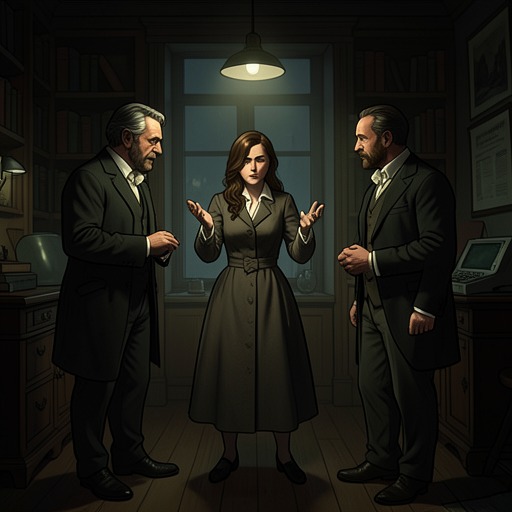
Madame Bertrand
JustineMadame Bertrand is a traveling companion who takes Thérèse with her on the road from Grenoble and whose fifteen-month-old daughter becomes the focus of Thérèse’s attempted rescue during the fire at Villefranche. Bertrand’s conduct in the emergency and her later accusations help transform Thérèse’s compassionate act into grounds for her arrest, extending the novel’s pattern in which the vulnerable are blamed while those who can command authority shape the account believed by others.
Identity and Journey
Madame Bertrand is traveling with Thérèse after Thérèse leaves Grenoble. Monsieur Valbois has restored the money Dubois stole, arranged for two complete outfits and linen, and urged Thérèse to depart that day; he persuades Bertrand to delay her own departure so Thérèse can join her. The women travel in a small covered carriage drawn by one horse, with Bertrand’s baggage and her baby, whom she is still nursing.
Their travel routine is practical and shared: each night they unload the carriage, carry their belongings into the inn, and sleep in the same room. The arrangement brings Thérèse into close contact with Bertrand and her child, even though the account gives no indication that the two women have a longstanding relationship. Thérèse becomes deeply attached to the baby during the journey, an attachment that will determine her actions in the crisis at Villefranche.
Character and Relationship with Thérèse
Thérèse describes Bertrand as unattractive, suspicious, talkative, noisy, monotonous, and dull-witted. This is Thérèse’s retrospective judgment, delivered within the account she tells Madame de Lorsange and Monsieur de Corville, rather than an independent assessment by the outer narrator. The contrast between the women is sharpened by their different responses to the child: Thérèse says she grew as attached to the baby as its mother was, yet later insists that Bertrand’s concern for her own safety eclipsed her care for the child when the inn caught fire.
The journey briefly makes Bertrand a possible source of ordinary companionship and onward travel for Thérèse, who has just received help from Valbois. But their shared lodging and destination do not develop into trust. After the fire, Bertrand becomes an accuser whose account carries practical force, while Thérèse’s efforts to contradict her are discounted.
The Fire and the Failed Rescue
The women reach Villefranche at about six in the evening, eat quickly, and retire early in hopes of traveling farther the next day. Less than two hours later, smoke wakes them. Amid the fire and the panic of people fleeing the inn, Thérèse realizes that Bertrand has not secured her daughter. Without stopping to argue, Thérèse goes back through the flames to retrieve the child, sustains burns, and carries her toward her mother.
As Thérèse crosses a partly consumed beam, she loses her footing. Her hands shoot out in an instinctive attempt to keep her balance, and the baby slips from her grasp and falls into the fire before Bertrand’s eyes. Thérèse is then seized and carried away; she does not initially know whether those around her are rescuers or another danger. The child’s death is thus presented as the unintended consequence of a rescue attempt, not as an act of violence by Thérèse. Bertrand’s presence as a witness does not lead her to support that distinction.
Accusation and Consequences
After the fire, Bertrand accuses Thérèse of setting it to steal from her, taking her money, and deliberately dropping the baby so that Bertrand would be too distressed to notice the theft. She also depicts Thérèse as morally suspect, claims she had escaped execution at Grenoble, and asserts that she had taken Thérèse in only because of excessive kindness toward a young man. These charges convert the actual circumstances of the fire into a narrative of calculated wrongdoing.
The accusations gain force in a setting already tilted against Thérèse. She is poor and unprotected, whereas Dubois presents herself as the wealthy Madame la Baronne de Fulconis, with apparent status and property. An officer treats the accusation as credible despite Thérèse’s offer to be searched for the allegedly stolen money; he dismisses her suggestion that the money would be on her person by assuming she must have passed it to accomplices. Bertrand’s testimony therefore does more than express hostility: it helps supply an official explanation for Thérèse’s arrest and compounds her exposure to wrongful punishment.
Narrative Role and Later Frame
Bertrand does not appear as an independent speaker in the surviving account of these events. The reader encounters her through Thérèse’s recollection, which later forms part of the story Thérèse tells the imprisoned girl and her listeners at Montargis. Thérèse frames the Villefranche disaster as another occasion on which her kindness and the malice of others have brought her into danger. The account of Bertrand’s accusation becomes one link in that pattern, as an act intended to save a child is recast as proof of criminal intent.
At the end of Thérèse’s recital, Madame de Lorsange recognizes her as her sister, Justine, and Monsieur de Corville undertakes to protect her and seek her exoneration. Bertrand’s role remains part of the testimony that must be weighed against Thérèse’s innocence: her charges contribute to the chain of misfortune, but the narrative presents the attempted rescue and the social credibility granted to the accuser as crucial distinctions between what happened and what the authorities believe.