Monsieur de Gernande
JustineMonsieur de Gernande is a wealthy count whose remote château becomes a site of imprisonment and systematic violence. He treats Therese’s poverty and lack of protection as permission to dominate her, and turns the recurring bloodletting of his wife into both a private regime and a threat against anyone who might resist him. His command over those confined in his house appears nearly complete, but a sudden emergency allows Therese to escape.
Identity and Arrival
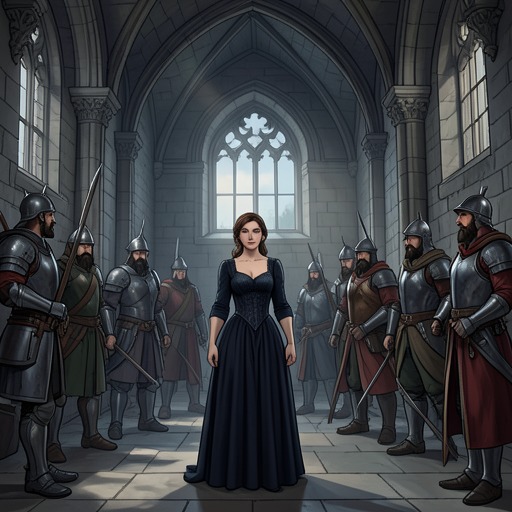
When Therese is brought to his vast, isolated château, Monsieur de Gernande is fifty years old, nearly six feet tall, and enormously fat. His appearance and manner are described as alarming; two elaborately dressed young men are with him when she arrives. He barely acknowledges her at first, then questions her age and personal history. Therese tells him about her past, including the brand inflicted by Rodin.
The Count interprets her accumulated misfortunes not as grounds for compassion but as evidence that she will be easier to control. He openly describes poor people as a subordinate class meant to serve the wealthy. This exchange establishes the social logic of his household: Therese’s vulnerability is not incidental to his authority but, in his view, a reason she should submit to it.
Captivity and the Threat of Violence
After Therese has been subjected to bloodletting, the Count explains that the ordeal was intended to acquaint her with his tastes and with the fate awaiting her if she betrays him or allies with his wife. He insists that his treatment of the Countess is driven by passion rather than hatred or revenge, and says that he takes pleasure in shedding her blood. He presents the Countess’s suffering as a fixed arrangement and warns Therese that the same power governs her own survival.
The Countess has been subjected to this treatment every four days for three years. The Count says that she is kept alive and otherwise provided for, while being confined and represented to her mother as insane. Her mother, who lives at another château six leagues away, believes this account and does not visit. The Count also says his wife had tried to reach her mother through two maids, but those attempts were discovered and the women were ruined. He now assigns Therese to look after the Countess, relying on her having no household or family able to demand an accounting for her disappearance.
He gives the regime precise terms: once every ninety-six hours, the Countess loses two bowls of blood; her resulting weakness keeps her in bed for one day out of every four. The Count claims she has become accustomed to the procedure and is in fairly good health, but acknowledges that she despises this life. He describes his wives as replaceable, saying that the Countess is his fourth and that he will soon have a fifth. The schedule, confinement, and threat of death make his household’s violence a repeated system, not an isolated outburst.
Control and Resistance
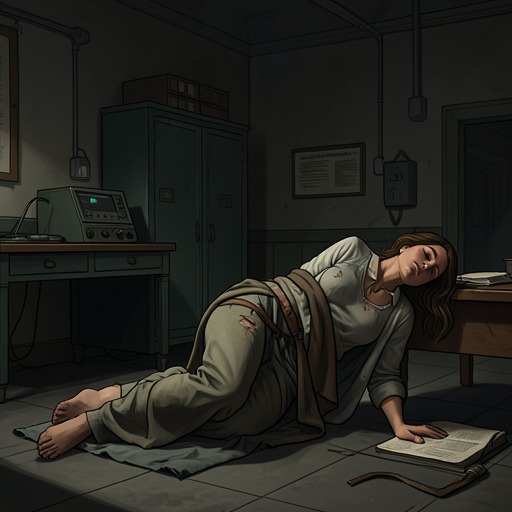
During one episode, the Count orders Therese to secure the straps holding the Countess and checks that they are tight before continuing the bloodletting. Therese complies outwardly but acts with a different aim: believing that the Count’s climax will bring the episode to an end, she tries to hasten it. She frames this conduct as a moral contradiction in which apparent participation becomes a means of helping the victim. The scene exposes how captivity forces Therese to maneuver within the Count’s commands, rather than resist openly without regard for the consequences.
Afterward, the Count turns his anger on Therese. He drags her by the hair, throws her against a wall, and threatens to kill her more horribly if he delays her death. She spends the night anticipating an ordeal whose form she cannot know. The next day, after thirty-six hours without relief, he tells her he will bleed her three times daily as an experiment in how long she can survive. He draws two bowls of blood from her arm; his announced experiment turns her body into an instrument for both revenge and curiosity.
Escape and Significance
A servant then rushes in to report that the Countess is dying and wants to speak to her husband. The Count leaves Therese’s dungeon unsecured as he hurries to his wife. Despite hunger and the blood she has lost, Therese takes advantage of the opening, crosses the court and park, and reaches the forest unseen. She finds a cottage four leagues from the château, rests, and sets out at daybreak. Rather than return to the authorities, she asks for directions to Lyon and reaches the city on the eighth day, weak but no longer pursued.
The Count’s household embodies the novel’s recurring disparity between power and justice: he can confine and threaten Therese because, as he reasons, no one will demand an explanation for her disappearance. Yet the emergency created by the Countess’s failing condition interrupts his control and enables Therese’s escape. His episode thus joins the story’s repeated pattern of aristocratic violence and precarious flight, while showing how survival depends on an opening rather than on the protection of law.