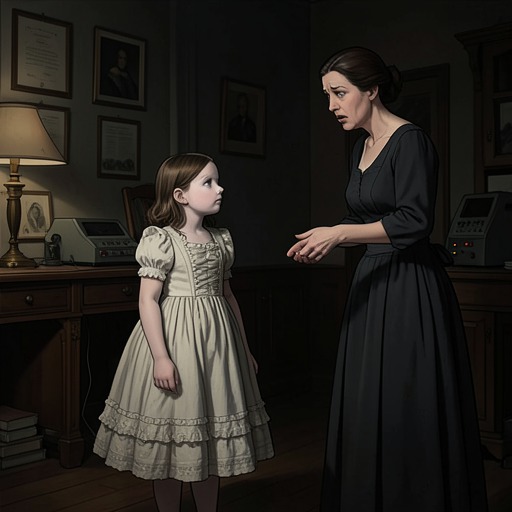
Omphale
JustineOmphale is a captive woman at the monastery of Saint Mary-in-the-Wood whose practical knowledge makes her Therese’s guide to the institution’s hidden workings. Appointed to settle and instruct the new prisoner, she explains how the monastery organizes its captives and conceals its activities; when the monks mark Omphale for dismissal, her danger strengthens Therese’s resolve to escape and help her. Therese’s flight eventually reveals further victims and the signs of a concealed burial ground, but does not establish what became of Omphale.
Identity and Role
Omphale is thirty years old when the superior assigns her to instruct Therese and settle her into her new quarters. She has already endured the monastery long enough to understand its routines, its authorities, and the difference between what newcomers are told and what the institution actually does. Her role is at once practical and compromising: she is made responsible for initiating another captive into a system designed to defeat hope of escape, even as she shares the knowledge that enables Therese to understand its dangers.
On Therese’s first night, Omphale leaves her alone to rest. The next morning she returns with advice shaped by her own experience: the beginning is terrible, she says, but a person may become accustomed to it. That counsel conveys the monastery’s corrosive effect without making Omphale simply its mouthpiece. She can describe adaptation as a fact of survival while still helping Therese see the machinery that demands it.
Instruction and Knowledge of the Monastery
Omphale gives Therese a structured account of the women’s organization. The captives are divided into four classes of four, distinguished by age and clothing: children wear white, the youthful class green, the class called the age of reason blue, and women over thirty reddish brown. The monks may mix the classes at meals or summon them separately, while the women otherwise share dormitories. Omphale presents these details as part of an instruction meant to prepare new arrivals, but also to extinguish their expectation of escape.
Her account extends from daily arrangements to the monastery’s physical concealment. Behind the altar in the sacristy, a spring opens a hidden door into a dark passage. The route descends beneath a moat thirty feet deep, then climbs and continues underground to the pavilion, a quarter league from the church. Six thick barriers of walls and closely planted trees conceal the low building, which is less than twenty-five feet high and made to look from outside like a dense stand of trees. Beneath it, the basements include two rooms used as dungeons and six for provisions; the upper rooms accommodate the monks, serving brothers, and the women assigned to them. Omphale’s precise knowledge makes clear that isolation is not incidental: the building’s design serves it.
She also describes the scale and method of recruitment. The four monks at the head of their order belong to distinguished families and possess substantial wealth. Funds from the Benedictines and the monks’ own contributions provide more than a hundred thousand crowns annually for recruitment and the house’s expenses. A dozen discreet women are employed to bring a new captive each month, aged between twelve and thirty; the recruits are selected for their qualities and, above all, high birth. The women may be abducted from far away, and the monks require that the abduction and sexual violence be forced rather than voluntary. Omphale’s account thus exposes the institution as an organized, financed system, not merely a concealed residence governed by individual whim.
Omphale explains that dismissal is announced on the same morning it is to occur. The Officer of the Day informs the woman at nine, inspects the others, and later returns to take her away. The departing captive embraces her companions, promises to expose the monastery, and is then removed without further news. On such days, the monks drink more, send the women to their chambers early, and do not take anyone to bed. These procedural details turn Omphale’s knowledge into a warning: departure is not a transparent release, and promises to report what happens inside have not, in her experience, produced protection.
Relationship with Therese
Omphale’s relationship with Therese develops from assigned instruction into mutual reliance. She warns her about the superintendent, Ursule, whose authority and ill temper make refusal dangerous. When Omphale asks permission to teach Therese, Ursule grants it on condition that Therese kiss her; Omphale therefore guides Therese within the same coercive hierarchy she is explaining. The episode shows how assistance in the monastery is constrained by the rules and power relations imposed on its captives.
Therese listens to Omphale’s account but resists accepting that the women are beyond rescue. When Omphale is selected for dismissal, Therese tells her that she intends to act and urges her to seek delay if the monks’ procedures are as cruel as they fear. She promises to try to free Omphale; Omphale, in turn, promises to aid Therese if she is released. Their exchange of promises makes their companionship more than a response to shared confinement: each woman’s possible safety becomes bound to the other’s effort.
Threatened Dismissal and Therese’s Escape
The immediate threat arrives when Severino examines the women and singles out Omphale. He then tells her that the monastery is dismissing her and orders her to be ready that afternoon. Omphale is shaken by the manner of the announcement and turns to Therese in tears. Therese reassures her that she has made up her mind and will use the opportunity to get her out if she can.
Two developments sharpen the stakes. Severino departs after being named General of the Benedictine Order, and the monks decide to dismiss another companion. Therese chooses the day of that woman’s sentence for her attempt, expecting the monks to be distracted. For two months she has prepared in secret: using dull scissors, she saws through the bars over her window, hides the opening, and makes a rope from sheets and linen long enough to descend from the pavilion. She carries her six louis concealed in her hair. Omphale is thus central to the urgency and purpose of Therese’s plan, though Therese’s escape does not bring the promised rescue to fruition within the narrated scene.
Outside the building, Therese reaches a basement window and sees Omphale stretched on a trestle table, apparently awaiting a terrible ordeal. Therese cannot intervene without abandoning her escape; she continues through the enclosures and encounters evidence that the institution holds victims unknown to the women in her dormitory. In the next ring, she finds a cadaver’s head in the earth and understands the ground to be a place where the monks have thrown their victims. She wonders whether it might belong to Omphale or Octavie, but neither identification is confirmed. Omphale’s fate therefore remains unresolved: the scene confirms the danger of her attempted dismissal, not her death.
Narrative Significance
Omphale serves as an internal witness whose detailed explanation converts a seemingly religious refuge into a comprehensible system of confinement. Her account links architectural concealment, age classification, recruitment, and the removal of women, allowing Therese—and the reader—to see how the monastery protects its operations from outside scrutiny. The orderly form of her instruction contrasts with the arbitrariness she also describes: the monks’ caprice governs the women’s lives, but that caprice is sustained by routines, money, personnel, and hidden space.
Her role also shapes the escape episode as a test of solidarity under conditions engineered to isolate the captives. Therese’s promise to help Omphale gives the attempt a purpose beyond her own survival, while the discovery of the basement victims and the apparent burial ground enlarges the danger beyond what Omphale has disclosed. The narrative does not resolve whether she survives. That silence preserves the uncertainty facing women whose removal from the monastery is presented as a procedure from which no reliable testimony returns.