Madame de Gernande
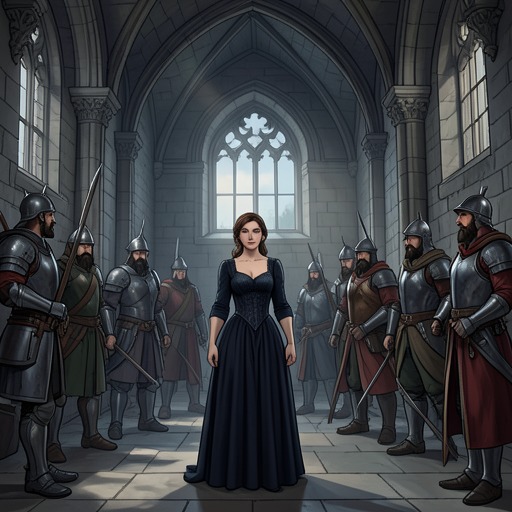
JustineMadame de Gernande is a nineteen-year-old countess held under close guard by the Comte de Gernande, who subjects her to repeated bloodletting. Her alliance with Therese briefly turns the Count’s isolated household into a site of shared resistance: the Countess helps plan an appeal to her mother, while Therese seeks a way to get them both out. The plan fails, and the Countess’s fate becomes a measure of the peril that remains even when escape seems possible.
Identity and Confinement
The Countess is introduced as the young wife of the Comte de Gernande, a prisoner within his château. He presents Therese as a new maid and warns his wife not to lead her into the misfortune that befell earlier attendants. The warning reveals the Count’s control over both women: he claims authority to punish Therese without scrutiny and makes clear that obedience is the condition of her survival.
The household’s apparent comfort conceals its coercive order. The Countess has an adjoining apartment, a terrace, attendants, and an abundant dinner, but the doors are stout, the windows double-grilled, and the grounds enclosed. The Count permits her to take the air only in the terrace garden, while cautioning Therese that its height should not encourage an escape attempt. Material provision does not lessen the confinement; it helps make the prison look like a residence.
Character and Relationship with Therese
The narrator describes the Countess as graceful and well educated, with a tender, sensitive disposition and strong religious faith. Her misfortunes have left her languid, but the account emphasizes that she retains her gentleness and capacity for human connection. She treats Therese with friendliness and invites her to share the meal, even though the Count has just installed Therese as an informant and the two women have not yet established trust.
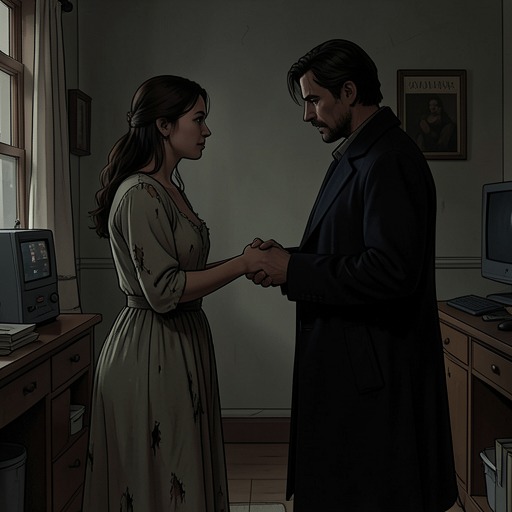
Their relationship develops cautiously under surveillance. Therese initially conceals her intention to help, telling the Countess that she will report anything said against him. This performance earns the Count’s approval and gives Therese access to the household; the Countess, unaware of her real purpose, asks only for care. Over time, Therese’s conduct convinces her of Therese’s desire to serve her, and they are able to speak openly and make plans together.
Resistance and Failed Escape Plan
After Therese has spent a year in the house, the women agree on a plan to inform the Countess’s mother and expose the Count’s conduct. The Countess writes a letter designed to persuade her mother to come to her rescue. Because the women are securely confined and closely watched, Therese undertakes the dangerous task of carrying it beyond the château walls.
At night, Therese uses the bed linen to descend from the terrace, believing that the wall will bring her to the road through the forest. Instead, she lands inside a park concealed by dense trees and surrounded by a second wall, more than forty feet high and topped with broken glass. The mistaken estimate turns the escape attempt into a trap: Therese is still enclosed, daylight is approaching, and her presence outside her room risks exposing the plan. The episode shows how the estate’s layered barriers defeat an apparently practical route to help.
The Count’s Retaliation and the Countess’s Fate
The Count responds to Therese’s attempt with violence and a threat of a more terrible death. After keeping her without relief for thirty-six hours, he tells her that she will be bled three times a day as an experiment and draws two bowls of blood from her. His treatment of Therese is presented as punishment for resistance and as an extension of the power he already exercises over his wife.
The next interruption comes when a servant reports that the Countess is dying and wishes to speak with her husband. The Count rushes away without securing Therese’s cell, and Therese uses the lapse to escape through the court and park into the forest. The Countess’s crisis thus creates Therese’s opportunity, but the account does not establish that the Countess herself escapes or survives. Her condition remains a grave and unresolved consequence of the Count’s control.
Narrative Significance
The Countess’s story joins the novel’s recurring pattern of poverty, coercion, and unreliable legal protection. Therese’s earlier account shows how an impoverished orphan can be disbelieved and imprisoned after an employer frames her; in the château, the Count likewise claims that his authority over a captive woman is beyond outside inquiry. In both situations, formal power protects the person making the accusation or wielding control, while the vulnerable woman must depend on a chance opening or another person’s intervention.
The Countess also changes the meaning of Therese’s role in the household. Therese first enters under a false show of compliance, but her contact with the Countess turns survival into a shared undertaking: the letter to the mother is an attempt to summon protection from outside the estate. Its failure, followed by the Countess’s reported decline and Therese’s escape, makes the episode’s outcome bitterly uneven. One woman reaches the forest; the other remains inside the Count’s power.