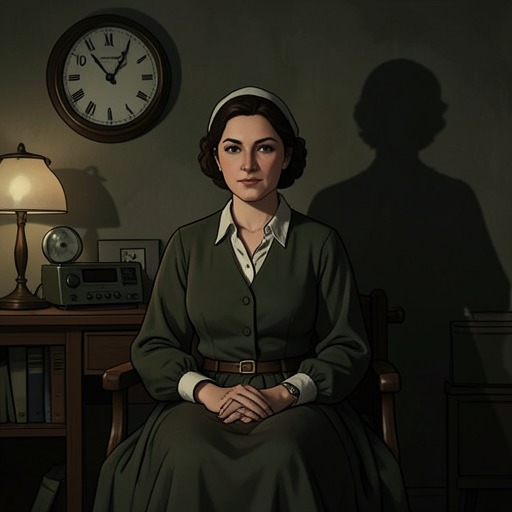
Bettina Pagan
LeilaBettina Pagan, also known as Siora Bettina and Bettina Fantuzzo, is the widowed sister-in-law of Don Tita Fantuzzo and a seasonal resident of his rectory at Velo d’Astico. Her piety is genuine, but it has been shaped into a private discipline that protects her from earthly attachments and other people’s troubles. The contrast between her charitable religious self-image and her reluctance to become involved gives her a distinctive place in the novel’s portrait of faith: she is neither simply hypocritical nor simply exemplary, but a woman whose hard-won peace depends on keeping the world at a distance.
Identity and Household
At fifty-two, after the death of her husband, a doctor, Bettina was childless and sufficiently provided for. She took an apartment in the spacious rectory at Velo d’Astico, staying there from the end of April until the beginning of November and paying rent to Don Tita. She maintained a separate kitchen and shared only the morning coffee with him. These arrangements establish her independence within a clerical household: she lives under the archpriest’s roof without merging her daily life with his.
Bettina came from a respectable family in Dolo and retained habits distinct from those of Don Tita. Though deferential toward ecclesiastics, she was protective of her own autonomy. Her daily Communion and fervent devotion belong to a religious life organized around personal discipline rather than community. In the morning gathering at the rectory, she and Don Tita drank coffee and milk from similarly chipped bowls, but hers came with the celebrated pandoli from Schio. The small difference suits the larger portrait: she shares the household’s routine while preserving her own preferences and boundaries.
Piety, Independence, and the Past
The narrator describes Bettina’s devotion as intensely self-contained. She wished and prayed that good people would remain good and bad people would convert, but did not want either kind in her home. She preferred not to become involved in disputes; what she thought of as aversion to trouble was, more precisely, bound up with a fear of doubts of conscience. Her earlier spiritual director had recommended books that intensified this scrupulousness, making even advice or practical involvement feel morally hazardous.
Her reserve has a history. In youth, Bettina had secret and dangerous imaginings, and she was frightened by the force of a temptation she had not expected to experience. She turned to fervent asceticism and outward religious practices that could provide what the narrator calls a covering and a reputation for invulnerability. Under the guidance of a rigid theologian suspicious of mysticism, she redirected earthly impulses into an ostensibly single-minded love of God; the narrator judges that the deeper object became concern for her own salvation. That account complicates her piety without reducing it to pretence: the discipline that now narrows her sympathies grew out of a sincere effort to master desires that once alarmed her.
Her charity follows the same guarded logic. Bettina could give to the poor discreetly, so that even her left hand did not know what the right was doing; yet the narrator adds that her heart, too, remained detached from the act. She imagined such giving as placing mortgages on heavenly estates. She was readier to assist Don Tita with church vestments, altar linens, sacred vessels, Masses, and funeral services than to take on works of charity directed toward her neighbors. The distinction reveals how she can be generous within established religious forms while resisting the unpredictable demands of personal contact.
Relationships and the Rectory Scene
Bettina’s differences from the two priests define her social character. Don Tita is genial and readily communicative; Don Emanuele Costi de Villata has never had a single friend and appears among cheerful company like a startled crow among noisy fowl. Bettina resembles the chaplain more than the archpriest in her reserve. She feels deep reverence and admiration for Don Emanuele, a private devotion she does not like to express, while her outward religious attention is directed chiefly toward Don Tita. She can sometimes smile when speaking of Don Tita; she cannot do so when speaking of Don Emanuele.
That division is visible when Don Tita keeps her and Don Emanuele in his study after coffee. Bettina is already uneasy at the prospect of a request: even advice might bring the kind of trouble she fears, and trouble might in turn provoke a scruple. Don Tita introduces the matter as one concerning the glory of God and the good of a neighbor. Don Emanuele then says that they must save a poor girl. The girl is the younger sister of Bettina’s maid, beset by a soldier’s advances. The charitable purpose is clear, but the scene also places Bettina’s ideal of protected devotion under pressure: someone needs help in a form that may require her to enter another person’s difficulty.
Her discomfort is also comic and revealing. When Don Tita draws her into the conversation, Bettina turns red and reaches for a book on his desk, seeming to examine it. She protests that she knows nothing, but the archpriest draws out what she has heard from the cook at the Trento household, who was connected to Bettina’s maid. The report includes the master’s and maid Teresina’s ill humor and the young woman’s crying; it also recounts how she had shut her flower-filled room and suffered such a headache that Teresina hurried to order very strong coffee. Bettina’s blush and evasion mark her reluctance to be caught up in household affairs, even as the information she has received makes her a link through which the priests can learn of distress.
Character and Narrative Significance
Bettina’s characterization rests on a tension between devotion and withdrawal. The practices that helped her find peace have also taught her to treat involvement as a possible danger to conscience. She wants the wicked converted, but not brought to her door; she gives to the poor, but prefers forms of service that do not demand a personal relationship. Her reverence for Don Emanuele suggests that she recognizes a more inward seriousness in him than in Don Tita, even though her own spiritual life remains guarded and self-protective.
The episode of the endangered girl makes that contradiction concrete. Bettina is not introduced as indifferent to religious duty: the priests appeal to the good of a neighbor, and she belongs to a household where such duty is plainly understood. Yet her first response to a proposed intervention is apprehension about the trouble and moral uncertainty it may bring. The narrator’s account of her earlier temptations explains the defensive shape of her piety without excusing its limits. Bettina’s peace is real, but it has been purchased by narrowing the circle of lives for which she is willing to assume responsibility.