Fedele Vayla di Brea
LeilaFedele Vayla di Brea is a dignified, private woman whose life is marked by a love she never acted upon and a compassion she repeatedly puts into practice. Long attached to Marcello Trento, she returns to the Astico Valley after years away and gradually becomes an important source of care for his bereaved household, especially Lelia Camin. Her generosity is not abstract: she visits the sick, shelters the vulnerable, and tries to secure Lelia’s safety even as her own health fails.
Identity and Background
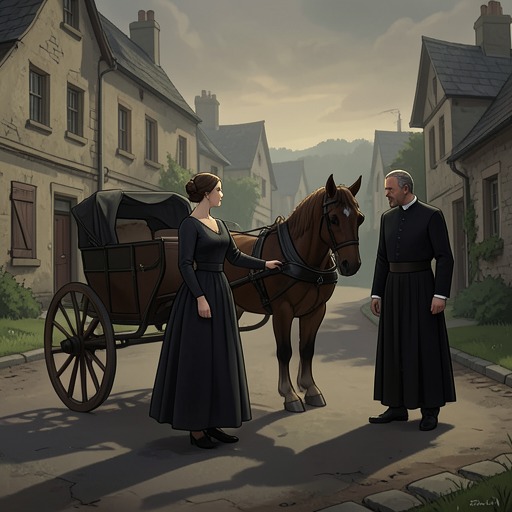
When Massimo Alberti first meets Fedele, she is between fifty and fifty-five, tall and slender, with completely white hair, a pale, almost olive complexion, and large, strikingly youthful eyes. Her manner combines gentleness with a reserved dignity; her voice is soft, and she speaks slowly. She tells Massimo that she had known his mother, Rachele, at boarding school in Milan, where she was one of the older girls and had liked to play at being a mother to her younger schoolmate. This old connection leads her to feel almost grandmotherly toward him.
Her history with Marcello began when she was a child. At about ten, she met him after her father, Colonel Vayla di Brea, bought the Villino delle Rose near Arsiero. Marcello was already over thirty. The two families spent holidays in the Astico Valley, and the child Fedele developed an unusual attachment to him. They sometimes played music together at four hands. When she was about fifteen and Marcello became engaged, she changed her manner and began avoiding him. Marcello suspected that her conduct arose from a serious youthful infatuation, and he ended their familiarity out of consideration for her.
As a young woman, Fedele resumed seeking Marcello’s company. Their glances grew more intimate, but the narrative gives their feeling its most charged expression in a brief incident rather than a declaration: separated from the rest of a party during an outing in the forest near Luserna and Monterovere, they wandered without speaking or looking at one another. As they emerged, Marcello silently offered her a cyclamen. She accepted it and kissed it, with tears in her eyes. They never again played music together, apparently by tacit agreement, but she did not forget him.
Fedele persuaded her father to leave Arsiero and the roses she had lovingly cultivated around the red villa. The family went to stay near Santhià, then spent winters in Turin. She attracted suitors and was sometimes said to have inspired passions, including one story of a rejected admirer who killed himself, but she never married. At forty-eight, after her parents had died and city life had wearied her, she returned to the Villino delle Rose. Marcello’s son Andrea Trento was already ill. Fedele visited the Montanina during the short interval between Andrea’s death and his mother’s death; her old feeling for Marcello had become a respectful deference, deepened by his losses into something close to veneration.
Care, Faith, and Public Life
Fedele’s reserve does not make her indifferent to suffering. She visits a young man from Seghe who is dying of consumption after a life of excess. Her earlier warnings had helped him recognize the condition of his life; he had sought reconciliation with God and the Church and now welcomed her visits, readings, illustrated books, and photographs. When the chaplain of Velo tells him that he cannot understand the Gospels she had given him, Fedele suppresses her anger, promises to read and explain them herself, and leaves him comforted. The incident shows both the practical form of her charity and her willingness to act when religious authority seems to discourage a sick person.
She is also closely concerned with Don Aurelio. When Massimo arrives, she explains why the priest could not host him: for two days he has been caring for Ismaele Pestagran, a Protestant Bible seller beaten by a crowd at Posina and refused lodging elsewhere. Fedele recounts the man’s comic habit of giving the people of Lago elaborate fish names, but her laughter quickly yields to pity. Later, when a letter from the archpriest of Velo raises the possibility that Don Aurelio might be expelled from Lago because of Pestagran, Fedele fears that the priest’s superiors are hostile to him. She distinguishes her own suspicions from Don Aurelio’s account: he speaks well of his superiors, while she suspects that his preaching, which critics regard as too rich in moral feeling and mysticism, has long attracted scrutiny.
Fedele’s history with Marcello also gives her a personal stake in his concern for Lelia. After Mass, he tells Don Aurelio that he fears leaving the young woman without support and worries she might refuse the inheritance he intends for her or fall under the control of her parents. He imagines that a marriage between Lelia and Massimo could protect her, while allowing him to leave her the villa. Fedele later tries to draw Massimo into a conversation about Lelia’s feelings. When he refuses to hear what she is saying and prepares to leave, she remains composed, tells him that Lelia would be pleased by his staying, and asks what he wrote to her. His insistence on catching his train prevents her from resolving the conversation with him.
Lelia Camin and the Maternal Bond
Fedele and Lelia’s closeness begins under a cloud of mutual misreading. Lelia feels an immediate, powerful sympathy for Fedele, but Fedele is unintentionally cold during an early visit, whether from distraction or a passing disturbance of mind. Lelia concludes that Fedele is proud and dislikes her. She responds with a deliberately cool manner, though her own inclination is toward warm friendship. Fedele, unaware of the reason, mistakes the coldness in turn. Their distance is therefore not a settled hostility but a bond obstructed by each woman’s inability to read the other.
Fedele later becomes alarmed by Lelia’s isolation and her talk of living with her father. Lelia has told the servant Teresina that such a life would make her hate him and lose her moral sense; she has even framed the possibility of becoming ill as obedience to God, despite the Christian prohibition of suicide. Teresina fears that Lelia is mad. Fedele instead sees a distorted religious understanding, shaped partly by ignorance, unusual habits of mind, poor instruction, and bad examples. She worries especially about Lelia’s long, dark silences and does not want her going out alone. When Massimo leaves, Fedele recognizes that Lelia’s offer to leave the villa if her presence obstructs his visit carries more feeling than its words admit. She hopes he might stay, and fears what his departure could mean for Lelia.
When Lelia’s father seeks a meeting, Fedele arranges for him to see her, despite anticipating that the encounter may be painful. Lelia receives him standing and rigid; she shudders when he kisses her cheeks, but endures it without returning his affection. The scene makes the limits of Fedele’s protection clear: she can insist on a meeting and offer advice, but she cannot erase the estrangement or decide Lelia’s future for her. She proposes taking Lelia to Turin, presenting a few days in a different environment as helpful to the young woman’s health and offering herself as a companion. Lelia’s father approves the journey, and Fedele continues to serve as the person who can make a safer alternative possible.
Illness, Inheritance, and Lelia’s Future
Fedele eventually tells Lelia that she believes she has been condemned to die soon. She has been ill for more than a year, has disliked being examined by a doctor, and now fears that it may be too late. Her suffering is both physical and moral. The disclosure is difficult for her: Lelia’s hand reaches across the bed, is drawn toward her, and touches Fedele’s lips. Fedele calls her dear and struggles to continue. The small gesture marks the intimacy that has grown between two women who once misunderstood one another.
Fedele entrusts Lelia with a private obligation concerning a man’s family. His mother and sister had been left nearly destitute and had hated Fedele, believing she had first lured him and then rejected him. His mother is dead; his sister lives alone in Turin. Fedele has secretly helped the sister, who would refuse a direct bequest from her. She asks Lelia to receive the money intended for her and continue the support without revealing its source, and, after Fedele’s death, to persuade the sister that Fedele had not deliberately lured her brother but had mistakenly believed she could return his feelings. Lelia grips Fedele’s hand and answers through tears. Fedele’s request makes the inheritance an entrusted duty: financial help must preserve the recipient’s dignity, and the dead woman’s reputation must be addressed with honesty and compassion.
When Lelia later escapes to Valsolda and reunites with Massimo, Fedele accepts that the young woman cannot remain there. She first thinks the expected reply from Lelia’s father will be negative, then revises her judgment after Massimo reports the contents of Lelia’s letter and the possibility that her father may consent. Massimo hopes to obtain a post as district doctor in Valsolda, but Fedele still considers it necessary for Lelia to leave with her. After discussion, they agree that Fedele will rest for the day, see a doctor from Cadate the next morning, and, if permitted, travel with Lelia to Turin. A cousin at Santhià is to be telegraphed to meet Lelia at the station; Eufemia will accompany her onward, and letters addressed to Lelia in San Mamette are to be forwarded to Santhià. Though she had contemplated seeking her father’s permission, Fedele yields that requirement, judging the cousin’s home safe and Lelia’s dread of returning to Velo decisive. She also asks Massimo to go back to Dasio and sets a time for him to see Lelia again in her presence.
Narrative Role and Significance
Fedele’s story links private memory to present care. Her old attachment to Marcello does not become a claim upon him; instead, it survives as reverence for a family marked by loss. Her connection to Rachele gives her a bridge to Massimo, while her response to Lelia develops from a painful misunderstanding into a maternal commitment that neither woman had initially expected. At every stage, the form of her help matters: she visits rather than judges, gives support discreetly, and makes arrangements that answer Lelia’s immediate vulnerability without pretending that affection alone can remove the constraints around her.
Her late illness sharpens the cost of that commitment. Even while suffering and conscious that time may be short, she directs attention toward Lelia’s safety and asks her to take on a responsibility to another bereaved woman. Fedele thus becomes more than Marcello’s old beloved or Lelia’s benefactor. She is the intermediary through whom remembrance becomes an obligation to the living, and through whom compassion is tested in concrete choices about shelter, money, belief, and farewell.