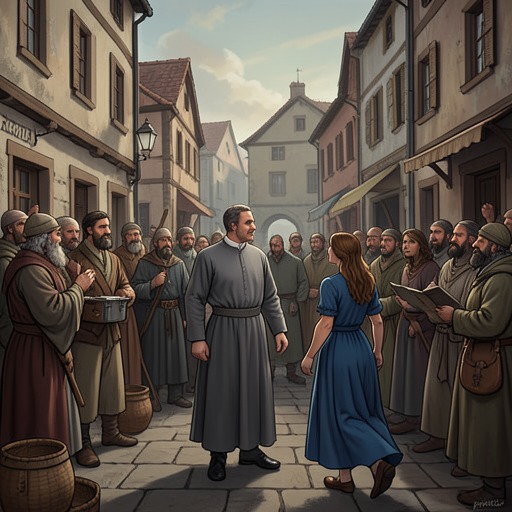
Ismaele Pestagran
LeilaIsmaele Pestagran, an itinerant seller of Protestant Bibles known in Lago as Carnesecca, arrives in the story as a sick and battered outsider whose presence tests the limits of local Christian charity. Beaten by a crowd in Posina and refused shelter elsewhere, he is taken into Don Aurelio’s home. There, his comic, theatrical manner sits uneasily beside his real vulnerability: he is ill, has recently had a fever, and soon becomes convinced that his presence has brought danger upon his host.
Identity and Arrival
Pestagran is introduced through the circumstances that have made him dependent on others. He sells Protestant Bibles and has been assaulted by a mob in Posina; no one is willing to house him until Don Aurelio takes him in. By the time Massimo Alberti hears about him, Pestagran has been in the priest’s house for two days. His welcome is therefore not merely a private kindness. It brings a religious outsider into a household whose priest is answerable to church superiors, and it makes the act of sheltering him vulnerable to suspicion and reprisal.
The local name Carnesecca reflects the gap between his identity and the community’s caricature of him. Donna Fedele Vayla explains that he often mentions Carnesecchi in his lyrical speeches, and that the people have turned this into a nickname for him. She also describes his own satirical naming of Lago’s inhabitants: he had called them fish, with a catalogue ranging from little fish and eels to minnows and, at times, crayfish; now, in his telling, they have become sharks. The exchange establishes him as a verbal improviser who answers the hostility around him with mockery, while also showing that the villagers have made him an object of local amusement.
The Patient and His Comic Manner
When Don Aurelio brings Massimo into the sickroom, Pestagran is lying under a nightcap, his old, deeply wrinkled face appearing yellow against the bedclothes. A small old woman sitting beside him rises with evident delight at the priest’s arrival. Pestagran lifts himself on one elbow and gives Don Aurelio a military salute, bringing his hand to his nightcap. Even in bed, his gestures turn the ordinary scene of a visit into a performance.
He remarks that the old woman had suffered from his natural impatience. When he notices Massimo, he salutes again and asks who the visitor is, but does not seem pleased by the stranger’s presence. Massimo understands the discomfort and starts to withdraw; Pestagran offers a brief apology. The exchange gives the sick man both comic self-consciousness and a capacity to recognize another person’s embarrassment. His manner is not simply eccentric display: it shapes how others approach him, sometimes amusing them, sometimes making him wary of company.
Donna Fedele Vayla’s account of him carries the same doubleness. She sketches his heroic-comic exploits with a quiet humor, but repeatedly checks that amusement with an expression of pity for the unfortunate man. Her walks among Lago’s poor show the practical world of care surrounding the anecdote: villagers stop her to tell her their troubles, and she speaks to them by name before returning to her account of Pestagran. The laughter at his grandiloquence is thus set against the fact that he has been injured, rejected, and left dependent on other people’s hospitality.
The Dismissal and His Departure
While Don Aurelio is celebrating Mass, the sacristan from Velo brings a letter from the provost. Lucia later tells Pestagran that his books will send him to hell and that he will make her go begging. He takes this warning as evidence that the clergy of Velo mean to drive Don Aurelio out of Lago because of him. His suspicion is not confirmed by Don Aurelio, who does not blame the Bible seller, but it is sharpened by the timing of the message and by Pestagran’s dependence on the priest’s protection.
The letter includes an official notice from the Vicenza Diocese dismissing Don Aurelio from the curacy of Lago di Velo within fifteen days. The provost asks him to clear the house of both furniture and people before the successor arrives with his mother and sister. The formal wording does not explicitly name Pestagran as the cause; nevertheless, the reference to clearing out people gives the episode a pointed ambiguity. Don Aurelio feels the bitterness of being expelled from his peaceful home and separated from his small congregation, yet his attention turns first to finding the Bible seller and preventing him from harming himself. He insists that Pestagran is not responsible, even as the circumstances make the sick man believe otherwise.
Donna Fedele Vayla learns that Pestagran has left and is dismayed that he may have gone because of the letter. Don Aurelio asks whether she saw him depart, noting that Pestagran still had a fever that morning. The priest’s concern makes the departure more than a comic exit: a man already driven from shelter by a mob has now left the one home that took him in, apparently under the mistaken conviction that his presence threatens his benefactor.
The Intended Confrontation and Narrative Role
When Don Aurelio finds him, Pestagran considers where to go and names the provost of Velo as his first destination. He presents the intended visit as respectful and meek, but immediately casts it in biblical terms: Velo becomes Jerusalem, the provost becomes Caiaphas, and Pestagran imagines himself as the Lamb’s son going to be crucified. Don Aurelio forbids him to go. The contrast is characteristic of the figure: his rhetoric magnifies a vulnerable, feverish man’s grievance into sacred drama, while the priest’s response is practical and protective.
The episode does not establish that Pestagran reaches the provost or reveal what eventually becomes of him. Its importance lies instead in the chain of consequences set in motion by his presence. His beating exposes the cruelty of the crowd; Don Aurelio’s sheltering him puts charity into conflict with ecclesiastical discipline; and Pestagran’s own suspicion turns that conflict into a personal burden he tries to carry away. He is neither simply a comic eccentric nor a confirmed cause of Don Aurelio’s dismissal. The narrative leaves that accusation unsettled, while showing the priest refusing to make an injured stranger answer for a decision made by his superiors.