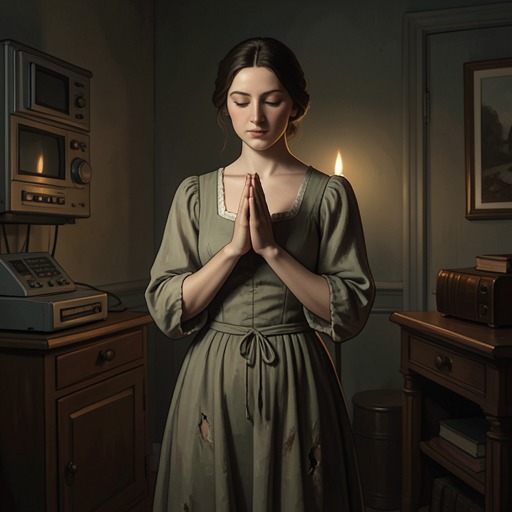
Ostia
LongingOstia is the setting of the mystical encounter between Augustine and Monica that gives the place its central significance in the account of Augustine’s spiritual life. In a borrowed country house away from Milan, mother and son briefly turn from the uncertainty of his recent conversion toward contemplation of God. Their experience of rising beyond corporeal things and touching Wisdom is at once intimate and temporary: they return to ordinary conversation, but the moment marks a lasting change in Augustine’s life.
Setting and Circumstances
Augustine and Monica were staying temporarily in Ostia, in a country house lent to them by a friend. They stood together at a window overlooking the garden. The move away from Milan offered them space to think through the consequences of Augustine’s sudden change in direction. He had been an accomplished teacher of rhetoric, but after his conversion he had resigned his professorship. The questions before them were practical as well as spiritual: whether he would continue in his former profession, whether his new life would require a different course, and whether this resolution would endure.
Their conversation carried the weight of a long family history. Monica, a devout Christian, had wanted her son to embrace the Church, while Augustine had resisted her repeated appeals. He had read philosophy and joined the Manichaeans, whose account of human life as a struggle between evil flesh and good spirit eventually left him unsatisfied. The preaching of a Catholic bishop had opened another path, and Augustine’s conversion followed with intense emotion. At Ostia, mother and son were trying to understand what this new beginning meant for his life.
The Encounter at the Window
The experience began in conversation but carried the pair beyond its immediate subject. Augustine described himself and Monica rising in their minds above corporeal things, then ascending through the heavens and beyond their own minds as they considered God and God’s works. For a brief moment, they touched Wisdom with the effort of their hearts. The account presents their ascent not as a journey through a visible landscape but as a movement of contemplation beyond the physical and mental limits of ordinary experience.
The moment did not last. Augustine and Monica descended from their contemplation and returned to the sound of their conversation. Its brevity is part of its meaning: the experience offered a moment of contact, not a permanent escape from ordinary life. The chapter places it within a pattern of mystical experience that can rise to extraordinary intensity and then recede, leaving both the memory of divine presence and the ache of its absence.
Augustine and Monica
At Ostia, the spiritual change in Augustine becomes a shared subject between mother and son. Monica’s hopes for his Christian life had met years of resistance; now, after his conversion and resignation from his teaching post, the two could reflect together on what might follow. The scene does not erase the questions about his future. Instead, it places those unresolved decisions beside an experience they had undergone together.
Monica died soon afterward, satisfied that her desires for her son had been fulfilled. The account thus gives the encounter a particular poignancy: it is a moment of communion between them near the end of her life, as well as a turning point in Augustine’s understanding. Ostia holds both the intimacy of their shared contemplation and the finality of their separation.
Place in Augustine’s Spiritual Narrative
Augustine’s Confessions made the Ostia experience a defining episode in the story of his religious life. The book presents the encounter as evidence that human beings can experience God directly and, for a time, touch Wisdom beyond ordinary perception. Its importance lies not in spectacle but in the union of intellectual ascent, shared attention, and the recognition of a presence that cannot be held permanently.
The scene also gives concrete form to the account’s recurring movement between spiritual height and return. Augustine and Monica rise beyond corporeal things, briefly reach toward divine Wisdom, and then resume their conversation. Ostia is therefore more than a setting for Augustine’s recollection: it is the place where his conversion is contemplated with his mother and where a momentary mystical experience becomes part of the lasting narrative of his faith.