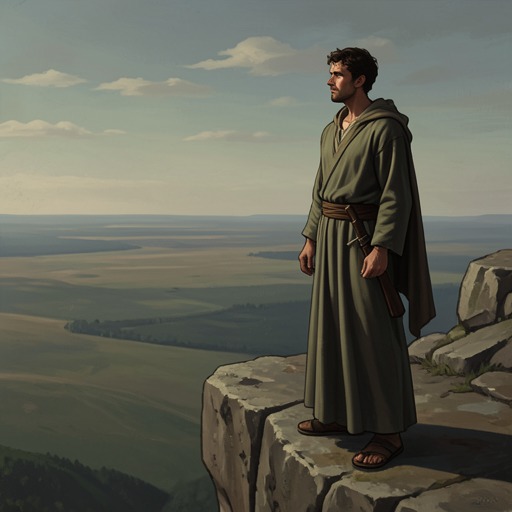
Tagaste
LongingTagaste, known today as Souk Ahras, was both Augustine’s birthplace and, after his conversion and baptism, the site of a monastery he founded with friends. The book presents it as a small North African town shaped by farming, economic decline, and the weakening Roman Empire—a local setting from which Augustine’s life eventually carried him into the wider history of Christian spirituality.
Setting and Historical Context
Augustine was born in Tagaste in 354. The town lay about sixty miles inland from the Mediterranean Sea, on the southern edge of the Roman Empire. It had a population of a few thousand, most of whom lived from the land. Its Roman infrastructure included roads, amphitheaters, and aqueducts, but its civic amenities stood against a backdrop of material hardship.
Tagaste belonged to Numida, described as Rome’s granary, and was administered from Carthage, far to the east. The region had once been prosperous, but by Augustine’s time it was in economic decline. Although some families were wealthy, most people faced labor and deprivation. A peasant revolt in the south had taken place ten years before his birth, while the empire’s frontiers were under pressure from invading groups. The account places Augustine’s hometown within these larger strains without suggesting that they alone determined his later choices.
Augustine’s Early Life and Return
The account identifies Tagaste as the starting point of Augustine’s life, but not as the setting of his entire religious development. He was raised in a Roman Catholic area and was nominally Christian in his early years: he sometimes attended church, was not baptized, and found the institution unsatisfying. He read parts of the Bible but judged it inferior to Greek and Roman classics. These details establish an early distance between his cultural setting and the faith that would later become central to him.
After Monica died, Augustine was baptized with his son Adeodatus and his friend Alypius. He soon returned to North Africa and established a monastery at Tagaste with several friends. The town thus reappears in his story not only as his place of birth but as the location of an early communal, contemplative undertaking after his conversion. The evidence does not describe the monastery’s buildings or daily arrangements, but it makes clear that Augustine chose Tagaste as the place to begin this new life with companions.
Place in the Narrative
Tagaste links Augustine’s personal beginnings to the broader historical world in which his life unfolded. Its agricultural livelihood and economic hardship give the account a concrete social setting, while its Roman roads, aqueducts, and amphitheater mark it as a town integrated into imperial life. The contrast between those civic structures and widespread deprivation keeps the portrait from reducing the place to a picturesque birthplace.
Its significance in Augustine’s story rests on two distinct moments: birth in 354 and the later foundation of a monastery after baptism. The second return gives the place renewed meaning. Tagaste is presented as a setting where a changed religious commitment took communal form, even as Augustine’s subsequent career would carry him beyond it.