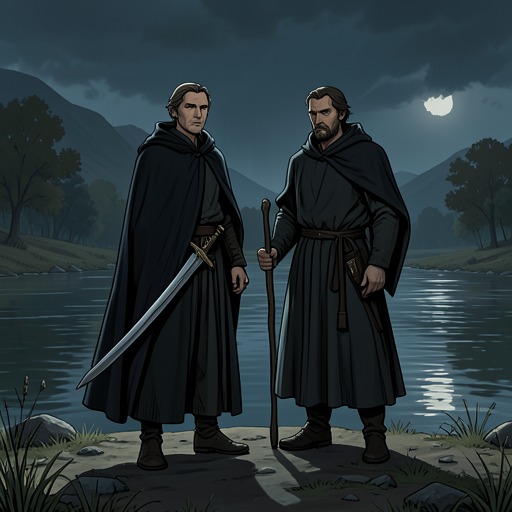
Arawn and Havgan’s struggle for kingship
MabinogionArawn and Havgan’s struggle for kingship is a contest over rule in Annwvyn that turns on a single decisive blow—and on whether the victor will obey the limit that Arawn himself once failed to observe. Arawn delegates the decisive encounter to Pwyll, whose victory ends Havgan’s resistance and brings the two kingdoms under one king’s authority.
Origins and Stakes
Arawn describes Havgan as the ruler of dominions opposite his own, a king who is continually at war with him. Their conflict is therefore not a single dispute but a continuing contest for land and sovereignty. Arawn asks Pwyll to rid him of this oppression in return for friendship, and proposes that Pwyll take his place in Annwvyn for a year while Arawn rules in Pwyll’s stead.
The substitution makes the contest possible without exposing Pwyll’s identity. Arawn gives him his own form and appearance, and promises that the people of Annwvyn will not recognize the difference. During the year, Pwyll inhabits Arawn’s court and shares its hunting, feasting, music, and company; the appointed meeting at the ford is the culmination of this borrowed kingship.
The One-Blow Contest
Arawn sets a precise condition for the encounter: Pwyll, in Arawn’s likeness, must meet Havgan at the ford and strike him once. He must not deliver a second blow, however much Havgan pleads. Arawn explains the reason through his own earlier failure: when he once spared Havgan after striking him down, Havgan fought him again the next day as vigorously as before. The rule turns restraint, rather than force alone, into the means of victory.
At the appointed meeting, a knight declares that the dispute is between the two kings alone and calls on their followers to stand aside. The rulers meet in the middle of the ford. Pwyll’s first thrust splits the boss of Havgan’s shield, breaks his armour, and throws him from his horse with a mortal wound. Havgan asks Pwyll to finish what he has begun, but Pwyll refuses to strike again, keeping to Arawn’s instruction even as his defeated opponent pleads for the final blow.
Homage and the Transfer of Power
Mortally wounded, Havgan tells his lords that he can no longer uphold them and has them carry him away. Pwyll then asks the nobles who should be his subjects. They answer that all should be, since no other king rules all of Annwvyn. His response distinguishes between willing submission and resistance: the humble are to be received graciously, while those who refuse obedience will be compelled by the sword.
The nobles’ recognition turns the duel’s personal result into a political settlement. Pwyll receives their homage and begins conquering the country; by noon the following day, both kingdoms are in his power. Havgan’s death thus ends his claim and removes the rival sovereignty that had sustained the war.
Restoration and Significance
After securing the victory, Pwyll goes to the appointed tryst at Glyn Cuch, where Arawn is waiting. Arawn rejoices in their reunion and thanks Pwyll for his friendship, having heard of what he has done. The two restore their proper forms to one another: Pwyll returns as Prince of Dyved, while Arawn resumes his own identity and goes back to his court in Annwvyn.
The struggle is resolved through delegated action, but its outcome depends on Pwyll’s judgment at the ford. He wins the kingship contest by carrying out Arawn’s plan and refusing the extra violence that had previously allowed Havgan to recover. The restored identities close the exchange of rule, while the transfer of allegiance in Annwvyn marks the lasting consequence of the victory.