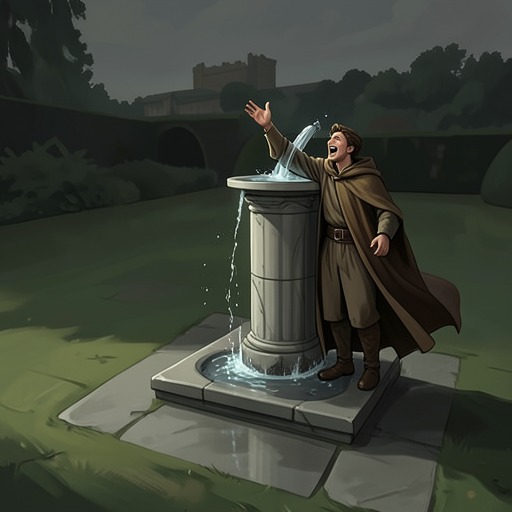
Owain and the Countess of the Fountain
MabinogionOwain son of Urien and the Countess of the Fountain form a marriage out of mourning, military necessity, and prolonged separation. Their relationship begins when Owain has killed the Countess’s husband, but develops into a political partnership in which he defends her lands and earns the devotion of her people. Its central rupture comes when Owain leaves her to visit Arthur’s court and stays away for three years beyond the agreed period; after a public rebuke and a period of wandering, he returns to the Countess, who remains his wife for life.
A Meeting in Mourning
The Countess first appears in a funeral procession, following the bier of her husband, the knight whom Owain has slain. Her yellow satin dress is torn, her hair is stained with blood, and she cries out amid the armed crowd and the singing ecclesiastics. Owain watches from the castle and is immediately overcome by love for her. The beginning of their bond is therefore marked by an extreme asymmetry: for Owain, the bereaved woman becomes the object of love; for the Countess, he is first the killer of her husband and the stranger who may be able to protect her inheritance.
Luned, the Countess’s attendant, makes the connection between them possible. She urges the Countess to find a defender, arguing that the Fountain and the surrounding dominions cannot be maintained without a knight capable of arms. Only a knight of Arthur’s household, she says, can defend the Fountain. Luned then presents Owain as the champion who can take the place of the slain lord. Her matchmaking is also a response to political danger: the Countess’s earldom is vulnerable unless its ruler has effective military protection.
The Countess recognizes Owain as the man who killed her husband when Luned brings him before her. Luned does not deny the death; she turns the fact into an argument for Owain’s suitability, reasoning that he could not have killed the former defender unless he were stronger. The Countess withdraws to consider the matter rather than immediately accepting him. When she consults her assembled subjects, she offers them a choice: one of them may marry her, or they may consent to her taking a husband from elsewhere who can defend the dominions. They agree to the latter, and bishops and archbishops celebrate her marriage to Owain. The union thus joins personal attraction, the Countess’s need for protection, and the public consent of her people.
Marriage and Rule at the Fountain
Owain’s marriage becomes a practical alliance. He defends the Fountain with lance and sword, defeating each knight who comes against it. The gains from these encounters are shared with his barons and knights, and the narrative links his generosity and effective defense to his popularity among his subjects: no man in the world, it says, could be more beloved by them. For three years, the Countess’s lands have a capable defender and Owain has a settled place within her dominion.
The marriage also enters the life of Arthur’s court through Owain’s absence. When Arthur grieves that he has not seen Owain for three years, Gwalchmai proposes that Arthur and his household go to find him. Owain and Gwalchmai meet in combat before recognizing one another; once they do, Owain embraces Arthur and the gathered company. He objects when Arthur prepares to depart, explaining that he has spent the three years preparing a banquet because he expected Arthur to come seeking him. The banquet, prepared over three years, is consumed in three months.
Arthur then asks the Countess to allow Owain to accompany him for three months, so that the nobles and ladies of the island may see him again. The Countess consents, though the separation is painful to her. The request sets a clear limit on Owain’s absence and gives the departure the character of a temporary visit, not an abandonment. But once back among his kindred and friends, Owain remains for three years rather than three months. The discrepancy transforms a permitted leave into a failure to return when promised.
The Broken Promise and Its Sign
The rupture is announced at a meal in Caerlleon upon Usk. A damsel arrives on a foam-covered bay horse, takes the ring from Owain’s hand, and publicly calls him a deceiver, traitor, faithless, disgraced, and beardless. The sharpness of the accusation makes the ring-taking a visible judgment: Owain’s past adventure returns to him not as a private memory but as a charge made before the court. He recalls what has happened and is overcome with sorrow.
Owain does not answer the accusation with an explanation or return immediately to the Countess. Instead, he prepares that night and leaves the next day, wandering into remote regions and uncultivated mountains. His clothes wear out, his body is wasted, and his hair grows long; he lives among wild beasts until he can no longer bear their company. The tale makes the cost of his prolonged absence bodily and public. The knight who had defended a court and delighted in feasting is reduced to isolation, while the relation he neglected is carried forward through the emblem of the removed ring and the accusation of faithlessness.
Return and Lasting Union
Owain’s path back toward the Countess’s world runs through the rescue of Luned. When he learns that she is about to be burned because Owain failed to come to her aid, he offers to fight in Owain’s place. With help from the lion that accompanies him, he defeats the two youths holding her. This episode gives his return a concrete act of restored loyalty: having failed to answer Luned’s earlier service, he now risks himself to save her.
After rescuing Luned, Owain returns with her to the Countess’s dominions. He takes the Countess with him to Arthur’s court, and the narrative states that she is his wife for as long as she lives. It does not stage a detailed reconciliation or report the Countess’s response to his return; the lasting marriage is given as the outcome. The relationship’s arc therefore closes by affirming the bond without erasing its breach: the woman whose husband Owain killed becomes his wife, shares three years of rule with him, suffers his prolonged absence, and is ultimately joined to him again for life.