Pryderi and Teirnyon’s adoptive father-son relationship
MabinogionTeirnyon Twryv Vliant’s relationship with Pryderi begins not in a household’s ordinary succession but in a nighttime rescue. Teirnyon and his wife find the child on the same May night that their mare foals, and they raise him as their own son before learning that he is the missing child of Pwyll and Rhiannon. Their eventual choice to return him does not erase the bond they have formed: Pwyll explicitly makes Teirnyon and Pendaran Dyved the boy’s foster-fathers, giving the relationship a continuing place in Pryderi’s family and upbringing.
The child found on May night
Teirnyon is lord of Gwent Is Coed and owner of a mare whose foals disappear every year on the first of May. Determined to discover what happens, he has the mare brought indoors and keeps watch. When a colt is born, a great disturbance follows and a claw reaches through the window to seize it. Teirnyon intervenes, and the colt remains inside. In the darkness outside, he cannot see what caused the tumult, but when he returns to the open doorway he finds an infant wrapped in a satin mantle. The child is unusually strong for his age.
The simultaneous arrival of colt and child gives the two discoveries an immediate connection in Teirnyon’s household. His wife has never had a child, and he offers the boy to her as a son. She notices the satin mantle and takes it as a sign of gentle lineage. At her suggestion, she tells her women that she has given birth; the child is baptized and named Gwri Wallt Euryn for the golden color of his hair. Teirnyon’s role thus begins as rescuer, but quickly becomes parental: he and his wife take responsibility for the infant’s care and present him within their household as their own.
Raising Pryderi
The child grows with striking speed. By the end of his first year he walks firmly and is larger than a notably big three-year-old; in his second year he is the size of a six-year-old. Before the end of his fourth year he is eager to take horses to water and persuades the grooms to let him do so. These details mark the time Teirnyon’s household spends raising him, while also making the child’s exceptional nature visible in the life of the court.
Teirnyon’s wife connects the boy’s future to the colt rescued on the night he was found. She asks Teirnyon to have the animal broken in for the child, noting that colt and boy came into their care together. Teirnyon agrees, and she instructs the grooms to prepare the horse so that it will be ready when the boy can ride. The gift makes their care concrete: Teirnyon’s household is not merely sheltering the child but equipping him for the next stage of his life. The boy’s early closeness to the horses also grows from the daily opportunities his foster household provides.
Recognition and return
News eventually reaches Teirnyon of Rhiannon’s punishment for the supposed killing of her son. She has chosen penance rather than dispute with her accusers and must remain at Narberth for seven years, sitting beside a horse-block and offering to carry visitors into the palace. Teirnyon hears the account from people who come to his court. The story troubles him, and, as he looks at the boy, he recognizes a remarkable resemblance to Pwyll, whose appearance he knows from having once been among his followers.
That recognition changes how Teirnyon understands his own place in the child’s life. He concludes that it is wrong to keep with him a boy who is Pwyll’s son while Rhiannon suffers on his account. His wife agrees to send the child back. She identifies three reasons for doing so: they may help end Rhiannon’s punishment, Pwyll may thank them for bringing up his son, and, if the boy proves gentle in nature, he may remain their foster-son and repay their care with goodwill. Their decision therefore combines the duty of returning a child to his parents with the hope that fosterage will continue as a real relationship, not disappear with the journey home.
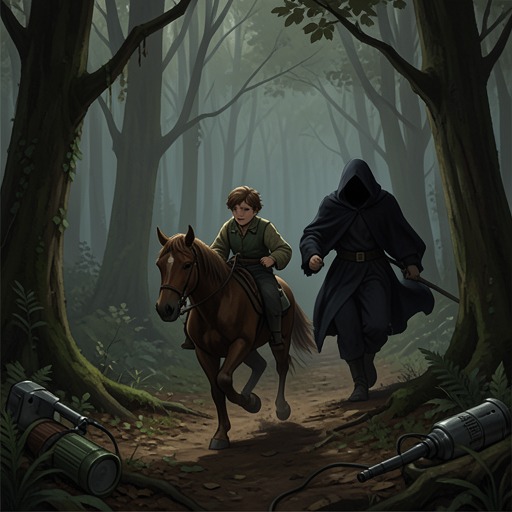
Teirnyon sets out the next day with two knights, taking the boy as a fourth member of the party. The child rides the colt given to him, so the two May-night discoveries travel together toward Narberth. They find Rhiannon sitting by the horse-block. She offers to carry the party, as her penance requires, and explains that she is being punished for killing and devouring her son. Teirnyon and the boy refuse to accept this service and continue to the palace, where Pwyll has returned from the borders of Dyved. At the ensuing feast, Teirnyon recounts how he found and raised the child. The company recognizes the boy’s resemblance to Pwyll, and Rhiannon understands that her ordeal is over.
Fosterage after the reunion
The reunion restores the child to Pwyll and Rhiannon, but the household that raised him remains part of his family history. Pendaran Dyved proposes the name Pryderi, while Pwyll prefers a name drawn from Rhiannon’s words when she receives the joyful news. The name Pryderi is accepted. His change of name marks his return to his birth family, while his earlier name, Gwri Wallt Euryn, recalls the identity given by Teirnyon and his wife.
Pwyll thanks Teirnyon for raising the boy and offers to support Teirnyon and his possessions as long as he can preserve his own. He adds that Pryderi, when able, will be better placed to maintain them. Teirnyon answers that his wife nursed the child and is deeply afflicted at parting with him; he asks that Pryderi remember what they have done for him. Pwyll agrees to that lasting obligation and proposes that Pendaran raise the boy from then on, while Teirnyon and Pendaran are both to be his foster-fathers. The arrangement gives the child more than one line of care: he returns to his parents, enters Pendaran’s upbringing, and retains the claim on Teirnyon’s household that its years of nurture have created.
Teirnyon departs with affection rather than accepting the jewels, horses, and choice dogs offered to him. His refusal sets his conduct apart from a transaction: he has returned Pryderi because the boy belongs with his parents and because Rhiannon should not continue to suffer, not simply to secure a reward. Pryderi is thereafter brought up carefully and becomes an accomplished and comely youth. The relationship’s significance lies in that balance of separation and continuity: Teirnyon gives up the daily upbringing of the child, but the foster-father bond is explicitly preserved in Pwyll’s settlement and in the expectation that Pryderi will remember and support those who raised him.