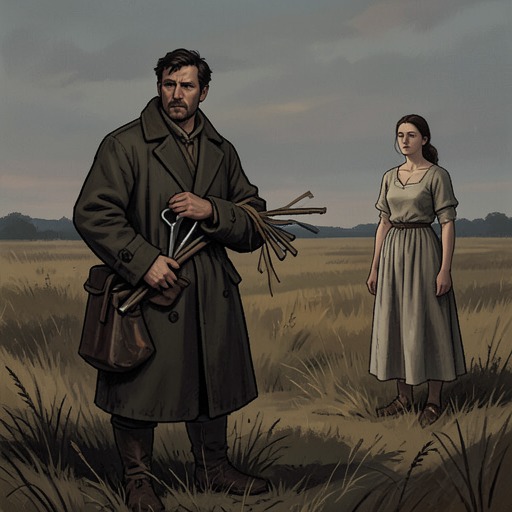
Maxen Wledig and Helen Luyddawc’s marriage
MabinogionMaxen Wledig and Helen Luyddawc’s marriage turns an emperor’s dream into a journey of conquest and a lasting reshaping of the Island of Britain. Maxen first sees Helen in sleep, loves her before he knows who she is, and sends messengers across the world to find her; when they locate her at Aber Sain, she insists that he come in person. Their wedding follows his arrival with an army, while Helen’s marriage portion establishes her father’s authority over a large part of the island and gives her a central role in its building and connection.
Helen and the Dream
Helen first enters Maxen’s story not through an introduction at court but as the focus of a vivid dream. While hunting with his retinue and two-and-thirty crowned kings, Maxen falls asleep in the heat, shielded from the sun by his attendants. In the dream he travels from a river valley over the highest mountain in the world, crosses an extraordinary land, and reaches a great river mouth, city, and castle. The sequence brings him through a splendid hall, where two youths play chess and an old man carves chess pieces, to Helen seated in a chair of ruddy gold.
The dream gives Helen an elaborately adorned presence: white silk and gold tissue, a golden frontlet set with jewels, and a girdle of gold. Its force is measured by what happens when Maxen wakes. His attendants’ noise breaks the scene just as he embraces her, and he returns to Rome bereft of the dream’s company. For a week he withdraws from meals, songs, and tales, sleeping in the hope of seeing her again. The narrative makes the marriage’s starting point an attachment formed at a distance: Helen is already the woman he loves most, although he has not yet learned her name or location.
The Search and the Meeting at Aber Sain
When Maxen finally tells Rome’s wise men why he is sorrowful, they advise him to send messengers through the three parts of the world for three years. Their first year of searching yields no information. A Roman king then recommends that Maxen retrace the route of his dream, and the emperor sets out by the river where he remembers beginning his journey.
The messengers eventually identify the dream’s landmarks in the Island of Britain. They pass Snowdon, recognize Anglesey and Arvon, and find the open castle at Aber Sain. Inside, they see the chess-playing youths and the old man carving pieces, then recognize Helen as the maiden from the dream. They kneel and address her as Rome’s empress, explaining that Maxen has been left without life or spirit by his love for her. Helen does not reject the proposal, but neither does she simply depart with the envoys: she says that if the emperor loves her, he should come to seek her himself. Her answer sets the terms of their first meeting and makes Maxen’s journey, rather than a delegation’s, the proof of his commitment.
Conquest, Recognition, and Marriage
The messengers return to Rome at speed, changing horses when theirs fail, and report that they know Helen’s name, kinship, and people. Maxen immediately takes an army across the sea to the Island of Britain, conquers it from Beli son of Manogan and his sons, and advances to Arvon. The expedition thus joins the search for Helen to a military campaign: the emperor does not merely follow the geography of his dream but arrives as a ruler who has displaced the island’s existing rulers.
At Aber Sain, the real hall confirms the details Maxen remembers. Kynan and Adeon, Helen’s brothers, are playing chess; their father, Eudav son of Caradawc, sits in an ivory chair carving chess pieces; and Helen sits in a golden chair. Maxen recognizes the people and setting from his dream, greets Helen as Rome’s empress, and embraces her. That night she becomes his bride. The repeated chess scene and the matching chairs make recognition the hinge between dream and waking action: the vision’s seemingly remote court becomes the place where the emperor’s desire acquires a political and marital reality.
Helen’s Marriage Portion and the Island’s Roads
The morning after the wedding, Helen asks for her maiden portion and is invited to name what she wishes. She asks for the Island of Britain, from the Channel to the Irish Sea, together with three adjacent islands, to be held for her father under the empress of Rome. Her request gives her father a defined territorial authority within the new imperial settlement and makes the marriage a negotiation over land as well as a personal union.
Helen also chooses the sites for three principal castles. The highest is to be at Arvon; the other two are Caerlleon upon Usk and Caermarthen. Earth is brought from Rome for the castle at Arvon so that it will be more healthful for Maxen to sleep, sit, and walk there. At Caermarthen, Maxen later hunts as far as the summit of Brevi Vawr, where he pitches his tent; the encampment is called Cadeir Maxen. The narrative preserves these place-making details alongside Helen’s choice of the sites, tying the couple’s marriage to the creation and naming of built landmarks.
Helen then conceives the roads linking one castle to another across the island, and the roads are made. They are called the roads of Helen Luyddawc because she is said to have sprung from a native of the island, and the island’s people would not have built such great roads for anyone else. The account therefore associates her name not only with a marriage portion and castles but with infrastructure that joins those strongholds. Maxen’s imperial authority and Helen’s local lineage meet in a material legacy across the landscape.
The Seven-Year Limit
Maxen remains in the Island of Britain for seven years. The account then supplies a Roman custom with direct bearing on the marriage’s political circumstances: an emperor who stays in foreign lands for more than seven years is understood to remain there to his own overthrow and never return to Rome. The passage establishes this rule as a limit on Maxen’s continued presence, immediately after describing a marriage and building program that have rooted him in Britain. It does not, in this episode, state how the rule is resolved; instead, it leaves the union poised between the island Helen has helped shape and the Roman power Maxen has left behind.