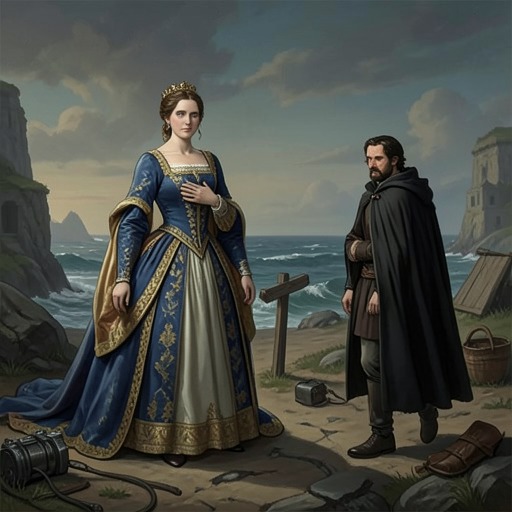
Branwen and Bendigeid Fran’s sibling relationship
MabinogionBranwen and Bendigeid Fran’s sibling relationship is the human bond at the center of a conflict between kingdoms. When Branwen is mistreated in Ireland during Branwen’s war, she reaches her brother by secretly sending word of her suffering; Bendigeid Fran responds by summoning a vast host and crossing the sea. His rescue does not restore what the war destroys. On the return journey, Branwen looks back toward both islands, mourns their ruin, and dies of grief.
Kinship and the proposed alliance
Bendigeid Fran, son of Llyr and crowned king of the Island of Britain, is at Harlech with his brother Manawyddan and other members of his court when Matholwch, king of Ireland during Branwen’s war, arrives with thirteen ships. Matholwch seeks Branwen’s hand, proposing an alliance between the two realms. Bendigeid Fran receives him and agrees to the marriage after taking counsel. The match is therefore introduced not only as Branwen’s marriage but as a political bond negotiated by her brother, who has the authority to welcome the suitor and grant the request.
The marriage feast at Aberffraw makes the family and political arrangement visible. Bendigeid Fran and Manawyddan sit on one side, Matholwch on the other, with Branwen beside her new husband. The company feasts beneath tents because no house can contain Bendigeid Fran. This detail sets the scale of the king’s presence against the intimate change being marked: Branwen leaves her brother’s court to become queen in another kingdom, while her marriage is expected to join the powers represented by the two men beside her.
Separation and the secret message
That alliance fails to protect Branwen. In the second year, anger in Ireland over the insult Matholwch suffered in Cambria turns against her. His foster-brothers and closest followers blame him for accepting compensation, and the punishment they impose falls on Branwen: she is removed from Matholwch’s chamber, made to cook for the court, and struck on the ear each day by the butcher after he cuts up the meat. The account gives the siblings no direct conversation during this separation. Instead, the distance between them becomes the means by which the story measures the failure of the marriage settlement to secure Branwen’s safety.
Her route back to Bendigeid Fran is a small, deliberate act of communication against enforced isolation. Branwen raises a starling in the kneading-trough cover and teaches it to speak, including what sort of man her brother is. She writes a letter describing her woes and the contemptuous treatment she has endured, binds it to the root of the bird’s wing, and sends it toward Britain. The message reaches Bendigeid Fran at Caer Seiont in Arvon while he is conferring there. The bird’s familiar, domestic upbringing helps make the concealed letter visible: it settles on his shoulder and ruffles its feathers, revealing what Branwen has sent.
The brother’s response
Reading the letter, Bendigeid Fran grieves at the news and acts immediately. He sends messengers to summon the island, gathers sevenscore and four countries, and personally tells them of his sister’s suffering. The assembly decides to go to Ireland. Seven men are left in charge at home, with Caradawc the son of Bran as their chief, while Bendigeid Fran leads the expedition across the sea. Branwen’s message has transformed private abuse into a cause that mobilizes the king and his people; the narrative makes the chain of action plain, from the letter’s arrival to the gathering of the host.
On the Irish shore, Branwen recognizes her brother before his force has been explained to the people who see it. Matholwch’s swineherds report a moving forest and mountain in the sea. Asked to interpret the signs, Branwen identifies the forest as the ships’ yards and masts and the mountain as Bendigeid Fran, whose size is such that no ship can contain him. She explains his angry eyes as the two lakes beside the ridge of his nose. Her interpretation makes the rescue party legible through the sister’s knowledge of her brother: the advancing army is at once a fleet, a giant presence, and an expression of his anger at what has happened to her.
When the Irish break down the bridge over the Linon, Bendigeid Fran answers by lying across the river so his host can pass over him. The act carries his intervention beyond command: the king makes his own body the bridge that allows the army to advance. It is a striking image of the scale of the response called forth by Branwen’s letter, although the campaign that follows brings neither sibling a safe return to their former lives.
Return, grief, and the bond’s cost
After the war, Bendigeid Fran commands the surviving men to cut off his head and carry it to the White Mount in London, facing France. He gives instructions for the journey, including seven years of feasting at Harlech and a later stay at Gwales. Branwen is the eighth person in the company that bears the head. At Aber Alaw in Talebolyon, she looks toward Ireland and the Island of Britain and laments that both islands have been destroyed because of her. She groans, her heart breaks, and the others bury her in a four-sided grave on the banks of the Alaw River.
The ending gives the sibling bond a tragic shape. Bendigeid Fran’s response to Branwen’s suffering is immediate and immense, but the narrative does not present that response as a simple restoration: the expedition ends in devastation, his head must be carried away for burial, and Branwen dies while mourning the destruction on both sides of the sea. Her initial marriage had been intended to join kingdoms; her letter reunites brother and sister only through a campaign whose consequences outlast their meeting. The relationship matters to the plot because it connects private kinship, political obligation, and collective catastrophe without suggesting that rescue can undo the harm that has already been done.