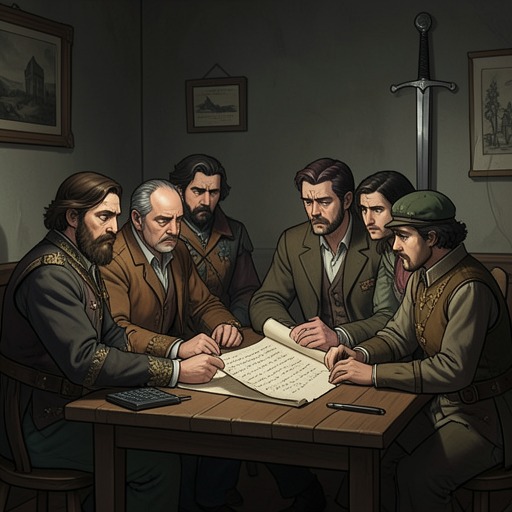
Pwyll and Rhiannon’s marriage
MabinogionPwyll and Rhiannon’s marriage grows from a meeting in which each chooses the other, but its course is shaped by public obligation as much as affection. After Rhiannon secures their union against an unwanted suitor, they rule together in Dyved and have a son; the child’s disappearance then brings Rhiannon’s marriage and reputation under a false accusation. The account later places her in a second marriage, to Manawyddan, without explaining the intervening change in her circumstances.
Meeting and mutual choice
Pwyll first sees Rhiannon riding along the road from the mound. His horse cannot catch her, though she does not increase her pace; only when he calls on her to stop for the sake of the person she loves does she agree. The strange pursuit gives way to a direct declaration: Rhiannon says that she came seeking him, and that she had refused the husband chosen for her because she loved Pwyll. Her choice is explicit, as is her condition: she will have no other husband unless Pwyll rejects her.
Pwyll answers that he would choose her above every other woman. Rhiannon then asks him to meet her at her father Heveydd Hen’s palace one year later, before she can be given to another. He promises to keep the tryst wherever she names. Their courtship thus rests not on a prolonged negotiation between strangers but on a mutual commitment, fixed by a place and a date. Pwyll returns to his household but turns aside questions about the woman he has met, keeping the promise private until the appointed time.
The rival’s claim and the wedding
At the end of the year, Pwyll arrives at Heveydd Hen’s palace with a hundred knights. The court welcomes him, and he is seated beside Rhiannon at the feast. Their anticipated union is interrupted when Gwawl enters and asks Pwyll for a boon. Pwyll has promised to grant what he can, and Gwawl uses that open-ended pledge to demand the woman he loves, along with the feast prepared there. Rhiannon identifies him as the man whom she had been compelled to consider marrying and warns Pwyll that his careless promise has given Gwawl a claim.
Rhiannon does not abandon the marriage she chose. Instead, she advises Pwyll on how to resolve the crisis without surrendering her to Gwawl: Gwawl must provide for the suitors and minstrels in Pwyll’s place and give a pledge that he will not seek revenge for what has happened. He accepts the settlement, and Heveydd provides sureties until Gwawl’s own men can answer for him. The resolution turns Pwyll’s general promise into a bounded obligation, while allowing Rhiannon’s original choice to stand. The next night, the hall is arranged as it had been the year before, and Pwyll and Rhiannon go together to their chamber.
Household, rule, and the birth of their son
The morning after the feast, Rhiannon directs Pwyll to distribute gifts to the minstrels and other claimants to his bounty. He agrees to give freely for the duration of the feast. When it ends, he tells Heveydd that he intends to return to Dyved and insists that Rhiannon travel with him rather than follow later. At Narberth, she gives rich presents—bracelets, rings, and precious stones—to the leading men and noblewomen who come to welcome them. The couple rule prosperously for the following year and the year after it.
In their third year together, the nobles of Dyved raise the question of an heir. They fear that Pwyll may remain without a child and urge him to take another wife. He asks them to wait one more year, and they agree. Before that year ends, Rhiannon gives birth to a son at Narberth. Six women are assigned to watch mother and child, but they fall asleep; by morning the infant is gone. Fearing punishment, the attendants kill some puppies, smear their blood on Rhiannon, and leave bones as false evidence, then accuse her of having devoured her son. Rhiannon denies the charge, but the women repeat it. Their deception turns the birth that should have secured the family’s future into a public crisis for Pwyll’s wife.
The child’s return and Rhiannon’s later marriage
The child is eventually raised in the household of Teirnyon Twryv Vliant and his wife, who call him Gwri Wallt Euryn. On the night he is found, Teirnyon has been watching a mare whose foals have repeatedly vanished. After the mare gives birth, a claw reaches through the window and takes the colt; Teirnyon intervenes, and when he returns to the house he finds the infant outside the door. He and his wife raise the boy as their own, and Teirnyon gives him the colt born that same night.
When Teirnyon hears of Rhiannon’s punishment, the boy’s likeness to Pwyll leads him to conclude that the child is Pwyll’s son. He and his wife decide that keeping the boy would leave Rhiannon suffering for a supposed crime she did not commit. Teirnyon brings the child to Narberth and explains how he found and fostered him. The gathered company recognizes the boy as Pwyll’s son, and Rhiannon says that, if this is true, her trouble has ended. The episode restores the child to the royal household and clears the accusation that had marked Rhiannon’s life as a mother and wife.
In a later part of the narrative, after the burial of Bendigeid Fran’s head in London, Pryderi offers Manawyddan his inheritance of seven cantrefs in Dyved and offers Rhiannon as his wife. Manawyddan accepts after speaking with her, and Rhiannon says she is glad to abide by the arrangement. The account presents this marriage as a new alliance grounded in Pryderi’s friendship and her own consent. It does not recount what became of Pwyll or explain the interval between the two marriages; it does, however, retain Dyved as the central setting of Rhiannon’s household and relationships.