Arthur and Owain
MabinogionArthur and Owain son of Urien are joined by a bond of affection and loyalty that the narrative measures against three years of absence. When Arthur learns how long Owain has been away, he fears losing him altogether and leads a search to bring him home. Their reunion is not a simple return to court: it comes through a fierce encounter with Gwalchmai, a recognition between kinsmen, and Arthur’s effort to reconcile Owain’s renewed place among his friends with the life he has made beside the Countess of the Fountain.
A Bond Tested by Absence
Owain’s absence grows out of his life at the Fountain. He defends it with lance and sword, defeating each knight who comes there; the gains from these encounters he distributes among his barons and knights. His subjects love him, and he holds this role for three years. The same period that gives him a settled place and duties elsewhere becomes, from Arthur’s perspective, a long and painful separation from his former companions.
Arthur’s concern surfaces while he is out with Gwalchmai. Seeing Arthur sorrowful, Gwalchmai asks what has happened. Arthur explains that he grieves for Owain, whom he has lost for three years, and fears that he will die if a fourth year passes without seeing him. He also connects the separation to the account Kynon son of Clydno had related: Arthur believes that hearing Kynon’s tale led him to lose Owain. The passage presents this absence not as indifference or a settled break, but as a loss that Arthur has carried and now feels urgently.
Gwalchmai proposes a focused response rather than a general summons to arms. Arthur and his household, he argues, can avenge Owain if he has been slain, free him if he is imprisoned, or bring him back if he is alive. Arthur accepts this plan. The alternatives make the search’s stakes explicit: the expedition is at once a rescue, a possible act of vengeance, and an attempt to restore a living companion to the group.
The Search and the Test at the Fountain
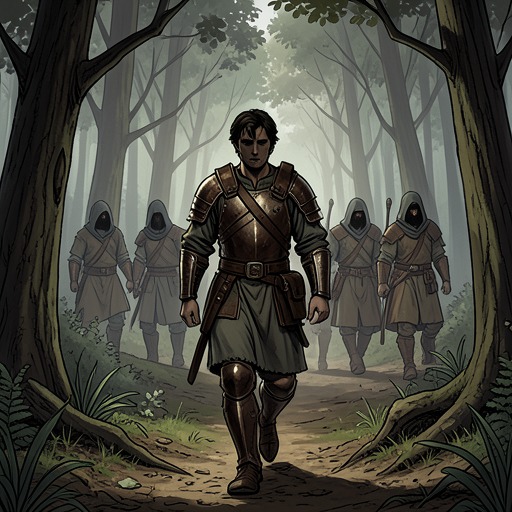
Arthur and his household set out with three thousand men, besides their attendants, and Kynon serves as their guide. They revisit the castle Kynon had previously encountered. Its welcome is lavish: the maidens attend to the company, and even the pages responsible for the horses receive service worthy of Arthur himself. The scale and ease of this hospitality contrast with the uncertainty that has brought the company there; the search party is received generously, but it has not yet found Owain.
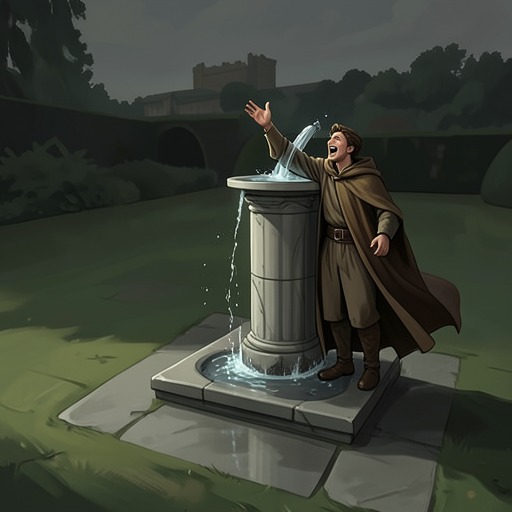
The next morning Kynon leads Arthur onward, past the black man and through the valley to the green tree, where the party sees the fountain, bowl, and slab. Kai asks permission to cast water onto the slab and face whatever adventure follows, and Arthur grants it. The ensuing challenge draws Arthur’s household into combat with the Knight. One after another they are overthrown, until only Arthur and Gwalchmai remain. Arthur prepares to fight, but allows Gwalchmai to go first at his request.
Gwalchmai meets the Knight in a satin robe of honour sent by the daughter of the Earl of Rhangyw; because of the robe, the host does not recognize him. Their contest lasts three days. They fight on the first day until evening without either unhorsing the other, and the next day’s combat with strong lances likewise produces no victor. On the third day the struggle intensifies: their horses’ girths break under the shock of their charges, both men fall, and they continue on foot with swords. The crowd witnesses a combat so evenly matched that neither warrior can prevail.
Recognition and Reconciliation
A blow from the Knight turns Gwalchmai’s helmet from his face, revealing his identity. The Knight is Owain son of Urien, who says he did not recognize his cousin beneath the robe. Gwalchmai offers his sword and acknowledges Owain as victor; Owain, in turn, says Gwalchmai has beaten him and refuses to take the offered arms. Their refusal to claim an individual victory turns the encounter from a contest into a recognition scene: each gives precedence to the other rather than treating the fight as a settled defeat.
Arthur approaches when he sees them speaking and resolves the dispute by asking for both swords, so that neither man is declared victor over the other. Owain puts his arms around Arthur’s neck, and the two embrace. The gathered host rushes forward to see and embrace Owain as well; the crowd presses so fiercely that lives are nearly lost. The reunion therefore belongs not only to Arthur and Owain but to the whole company whose affection has accumulated during the years of separation. The combat that might have ended in the injury of either man instead brings Owain back into the circle of his former companions.
A Return Shared Between Two Courts
The next day Arthur prepares to depart, but Owain objects that he has been absent from Arthur for three years and has spent that whole time preparing a banquet, knowing Arthur would come in search of him. He asks Arthur and the attendants to remain until they have recovered from the journey and been anointed. Arthur agrees to go to the Countess of the Fountain’s castle, where the banquet prepared over three years is consumed over three months. The extended feast gives the reunion a form of hospitality and recovery rather than making it a brief encounter on the road.
When Arthur is ready to leave, he sends an embassy to ask the Countess to let Owain accompany him for three months, so that Arthur can show him to the nobles and fair dames of the Island of Britain. She consents, though the separation is painful to her. The arrangement reveals a tension within the reconciliation: Arthur can bring Owain back among his kindred and friends, but Owain now also belongs to a household and a relationship beyond Arthur’s court. The requested three months become three years, as Owain remains with his kin instead of returning on the agreed schedule.
That renewed stay does not erase Owain’s other commitments. While he is at meat in Caerlleon upon Usk, a damsel arrives on a foam-covered bay horse, takes the ring from his hand, and condemns him as faithless and disgraced. The rebuke recalls his adventure; Owain leaves court the next day and wanders into the wilderness. This later departure shows the limit of Arthur’s successful search: he can recover Owain’s company and welcome him among his friends, but their reunion cannot by itself settle the claims of the life Owain left at the Fountain. Their relationship is marked by genuine attachment, yet also by repeated separation and return.