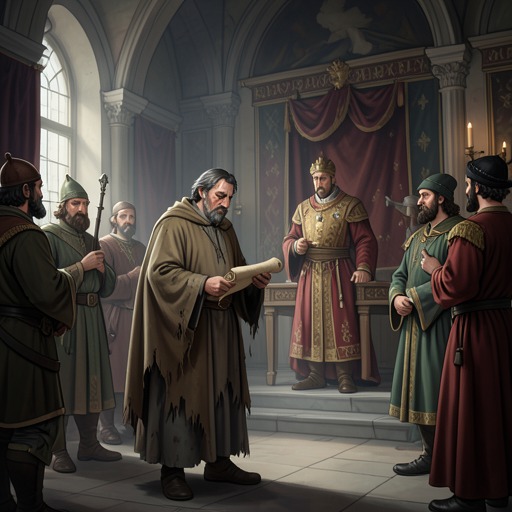
Culhwck’s courtship of Olwen
MabinogionCulhwck’s courtship of Olwen is presented first as a marriage condition and then as an undertaking that tests the obligations of kinship and Arthur’s court. Before Culhwck has met Olwen, his stepmother names her as the woman he must obtain, and he is moved by love for her despite never having seen her. The relationship therefore begins not with an exchange between the prospective couple but with a declaration, a request for aid, and a search that gathers the king’s warriors around the promise of marriage.
The Marriage Condition
Culhwck’s father summons him to court, where his stepmother advises him that he ought to marry and offers her own daughter, a woman sought by notable men. Culhwck replies that he is not yet of an age to wed. His stepmother then sets a different condition: he will find no wife until he obtains Olwen, daughter of Yspaddaden Penkawr. The narrative makes the declaration the turning point. Culhwck blushes, and love for Olwen takes hold of him although he has never met her. His desire is thus immediate, but it is founded on a name and a stated obstacle, not on any account of Olwen’s own choice or feelings.
The condition also shapes what “courtship” means in the evidence. Culhwck does not begin by approaching Olwen or exchanging messages with her. The task is framed as obtaining her, and the narrative’s attention turns at once to the support and action required to reach her. The distinction matters: the relationship is established as Culhwck’s pursuit of a marriage, while Olwen remains absent from the scenes in which that pursuit is initiated and organized.
A Request to Arthur
Culhwck’s father directs him to Arthur, his cousin, to ask for a boon. Culhwck rides to Arthur’s court with costly equipment and makes clear that he has come to seek a favor rather than to enjoy the king’s hospitality. Arthur promises to grant his request within broad limits. Before naming it, Culhwck asks Arthur to bless his hair; Arthur combs it with a golden comb and cuts it with scissors whose loops are silver. When Arthur asks who he is, Culhwck identifies himself as the son of Kilydd and Goleuddydd, and Arthur recognizes him as a cousin.
That recognition turns the request into an obligation grounded in kinship. Arthur renews his pledge, and Culhwck asks him to obtain Olwen, daughter of Yspaddaden Penkawr, with the assistance of Arthur’s warriors. His appeal therefore extends beyond the king: the marriage quest is made a collective undertaking of the court. Culhwck names many companions from whom he seeks aid, but the request’s central purpose remains specific—finding Olwen and securing the match imposed as his condition for marriage.
The Search and Its Obstacle
Arthur initially has no knowledge of Olwen or her family. He sends messengers throughout his dominions, but after a year they return without learning anything more about her than they knew at the outset. Culhwck points out that others have received their boons while his remains unfulfilled, and threatens to leave and carry Arthur’s dishonor with him. The delay makes the courtship a measure of the court’s capacity to keep its promises as well as Culhwck’s determination to pursue the match.
Kai responds by joining the search, promising that the companions will not part until they either establish that the maiden does not exist or obtain her. Their expedition eventually reaches a vast open plain and a castle identified as Yspaddaden Penkawr’s. The approach is marked by distance and scale: for three days the travelers make little apparent progress toward the castle, and nearby is an immense flock of sheep guarded by Custennin. Custennin identifies himself as Yspaddaden’s brother and says that Yspaddaden oppressed him over his possessions. This encounter supplies a concrete setting for the obstacle behind Culhwck’s request: Olwen is the daughter of a powerful man whose household and territory are not readily reached.
What the Evidence Establishes
The supplied episodes establish the beginning and terms of Culhwck’s pursuit, Arthur’s promise to assist, a year-long failure to find Olwen, and the companions’ arrival at her father’s castle. They do not show Culhwck speaking with Olwen, disclose her view of the proposed marriage, or establish the outcome of the courtship. Within this evidence, the relation is consequently defined by Culhwck’s declared love, the condition placed upon his marriage, and the quest through which he seeks to fulfill it. The gap between his immediate attachment and Olwen’s absence gives the episode its particular shape: a personal desire becomes a public undertaking, supported by family ties and the pledged service of a royal court.