Darius Blank
Mickey7Darius Blank is the creditor whose claim over Mickey Barnes converts a gambling loss into a threat of forced labor and bodily violence. He is not shown directly confronting Mickey in the available account; instead, his power is made tangible through Mickey’s debt, the expectations Mickey forms about repayment, and an unnamed assailant who announces that they will work together until the balance is cleared.
Identity and Position
Darius Blank enters the story as the person to whom Mickey Barnes owes money after a chain of gambling losses. The debt has grown so large that Mickey believes even an unlikely paying job would leave him struggling for years to repay it. Blank’s importance is therefore practical before it is personal: his claim reaches into Mickey’s future, shaping what work seems available and how freely Mickey can refuse an offer.
The account places this danger alongside Mickey’s decision, nine years earlier, to give Gwen Johansen his DNA and sign away his life in exchange for a form of immortality. After leaving Gwen’s office, Mickey cannot simply go home and reconsider. He has already landed on Darius Blank’s bad side and sees no reasonable way to get out of it. The juxtaposition makes the choice feel less like a free-standing bargain than a decision made under pressure: Mickey has accepted one dangerous arrangement while another debt has narrowed his alternatives.
The Debt and Mickey’s Expectations
Mickey traces the root of his predicament to Berto Gomez, his old friend and the only person aboard the Drakkar whom he knew before signing with Gwen. Their friendship began at school, where they bonded over a flight simulator and a shared dislike of the administrators. Berto mastered the simulator quickly; Mickey kept crashing. That history matters because the later financial trouble grows out of a relationship Mickey values, not an impersonal wager detached from his life.
After Berto wins a tournament, Mickey is left badly in debt from repeatedly doubling down. Darius Blank is identified as the person he owes. Mickey does not initially expect Blank to kill him. He reasons that a dead debtor would be harder to collect from, and imagines instead that Blank might garnish his subsidy or make him work as a valet. The speculation is grim, but it also shows Mickey trying to make the danger legible as an economic arrangement: Blank needs him alive, so even an unpleasant form of repayment ought to leave him enough to survive.
Berto tries to convince Mickey that his assumptions about Blank are mistaken and feels responsible for the cost of his tournament win. He proposes that Mickey sign on to the Drakkar as a way of making amends. The proposal arises while Mickey is already caught between the debt and his belief that he has few routes back to financial security. The account does not establish that Blank arranged Mickey’s enlistment; it shows the debt as the pressure under which Berto’s offer becomes consequential.
Collection and Coercion
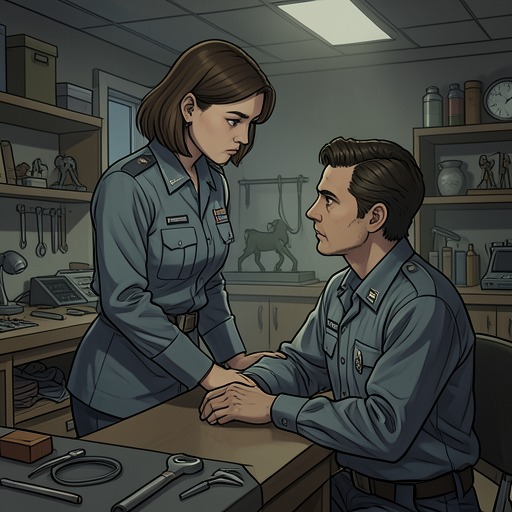
Mickey’s expectation of a manageable repayment is shattered when he returns to his apartment. As he lets himself in, the door still swinging shut behind him, his legs stop working and he falls face-first. An unseen voice greets him. Mickey tries to answer, but his mouth will not work; all he can produce is a low moan. The voice tells him to relax and says the ordeal will not take long, while something presses against the back of his neck.
The narration records the attack through its effects rather than identifying its method. After thirty seconds, Mickey is astonished to find himself alive, but he is sobbing, paralyzed, and has soiled himself. A hand pats his shoulder. The voice calls the experience enjoyable and says that the two of them will work together until Mickey is square with Darius Blank, promising to see him the next day. The assailant leaves without closing the door. Mickey remains unable to move for about an hour before he can get up, clean himself in the bathroom, and cry.
The distinction between creditor and collector is important: the account names Darius Blank as the person owed, but does not identify the person who enters the apartment or say that Blank personally carried out the assault. What it does establish is that the violence is presented as debt enforcement. The collector connects the coercion directly to the outstanding balance and sets its continuation according to whether Mickey has paid it off. Blank’s power operates even without a face-to-face appearance.
Narrative Role and Significance
Mickey initially interprets debt collection as a calculation: killing him would prevent repayment, so Blank would presumably choose a subsidy deduction or service instead. The assault exposes the weakness in that reassurance. Mickey’s reasoning may account for the creditor’s interest in collecting, but it does not protect him from being brutalized in the process. The difference between surviving a debt and being safe from the people enforcing it becomes suddenly physical.
Blank’s characterization in these passages is consequently mediated and bounded. Mickey understands him as someone chiefly concerned with collecting what is owed, and the unnamed voice makes that concern a concrete demand for Mickey’s labor. Yet the scene does not supply Blank’s personal perspective, explain how the debt was originally negotiated, or establish that he ordered this particular attack. Its force comes instead from the gap between the ordinary language of being square with a creditor and the bodily helplessness through which Mickey is told what repayment will mean. Darius Blank stands at the center of that gap: absent from the apartment, but present in the debt that gives the violence its stated purpose.