Hieronymus Marshall
Mickey7Hieronymus Marshall commands the Niflheim expedition as its designated ground commander, but he arrives at Himmel Station with more authority in appearance than he has been able to exercise during the journey. Once the colonists reach the surface, he tries to make command mean order: ration cards can be docked, work reassigned, and dangerous information demanded. Yet the colony’s shrinking population and narrow margin for survival repeatedly restrict what punishment he can impose. His authority is real, but never independent of the emergency it is meant to control.
Identity and Command
Marshall first presents himself to the arriving colonists as a military commander in free fall: close-cropped black hair, a clenched jaw, and a posture so rigid that he seems to carry a metal rod in his spine. Waiting in the lounge above Midgard, he lets the shuttle’s dozen prospective colonists drift in before addressing them. He introduces himself as the person in charge, welcomes them to Himmel Station, and asks who has previously left the planet—and who is trying not to vomit. His dry, unsentimental response to the motion-sick newcomers establishes a command style that mixes ceremony with blunt practicality.
The narrator’s later reassessment complicates that first impression. After three years and two reincarnations, Mickey Barnes concludes that only part of Marshall’s imposing manner is genuine priggishness; insecurity and overcompensation account for most of it. As designated ground commander, Marshall had spent the transit with little meaningful command to exercise, effectively treated as cargo. The contrast helps explain why his bearing can seem almost like a performance: the posture of authority is conspicuous even when circumstances leave him powerless.
That performance becomes personal when Marshall asks Mickey Barnes to identify his function. Mickey Barnes answers that he is the expedition’s Expendable. Marshall does not share his grin. His expression turns to disgust, and he leaves the conversation with a controlled, almost athletic glide through the lounge. The exchange establishes a persistent divide: Mickey Barnes treats his role with mordant humor, while Marshall regards it as a distasteful fact of command.
Discipline Under Scarcity
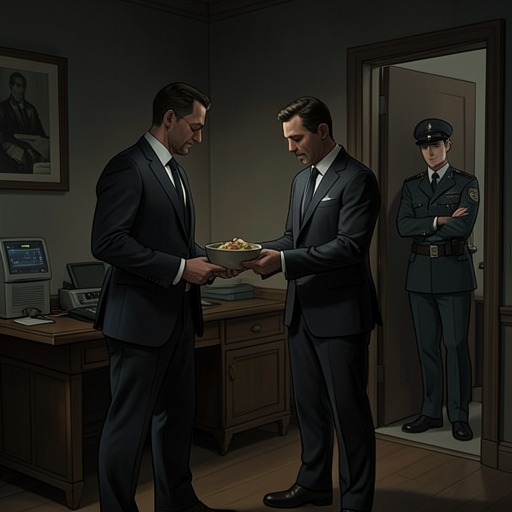
Marshall’s punishments are shaped by the colony’s most immediate constraint: food. Summoning Mickey Barnes and Berto Gomez to his office, he explains that the Agriculture Section has been unable to grow much in the local environment and that the colony is operating on a thin calorie margin. Their activities have removed nearly 300,000 kilocalories from the energy budget. Until agriculture can reach full production, he argues, the resulting loss requires a further ration reduction; he permanently docks both men’s ration cards by 20 percent. The decision makes discipline collective and material: their conduct is charged directly against the colony’s food supply.
Marshall’s response to the failed expedition shows the same arithmetic applied to human lives. He confronts Mickey Barnes after several people have died in a short period, counting three losses in the preceding two hours and then adding Gallaher and Torricelli to reach five. Mickey Barnes answers with an apology for having survived. Marshall does not treat survival as a joke. He tells Mickey Barnes and Cat Chen that the expedition began with 198 people, made landfall with 180, and has fallen to 175. A beachhead colony is approaching the lower limit at which it can remain viable, so Marshall says he cannot put either of them down the corpse hole or punish them in a meaningful way, however much he might wish to.
The inability to punish does not mean that Marshall trusts them. He suspects Mickey Barnes knows more about the creepers than he has disclosed and warns that the colony’s collapse could leave him facing his final days alongside many copies of himself. He separately tells Cat Chen that he suspects she may have had a prior relationship with Mickey Barnes and should have disclosed any personal issue that might compromise a mission. When Cat Chen begins to respond, he cuts her off and sends both of them away. His questioning turns operational uncertainty into a demand for disclosure, while his treatment of Cat Chen reveals how quickly he interprets personal attachment as a command problem.
Control, Work, and Rations
Marshall’s discipline of Berto Gomez follows the same pattern but is tailored to the colony’s shortage of personnel and equipment. After a risky stunt associated with a wager, he asks why Berto Gomez endangered his own life and 2,000 kilograms of irreplaceable metal and electronics. He knows about the wager and says there is little point in reciting regulations Berto Gomez has repeatedly violated. Grounding him would be deserved, but Marshall cannot afford to lose his labor; flogging, meanwhile, is not permitted under standard Union guidelines.
Instead, Marshall makes the punishment consume Berto Gomez’s time and food. He assigns him Nasha Adjaya’s shifts aloft as well as his own for five days, cuts his rations by another 10 percent, and blocks him from accepting transfers from other personnel. The measures are practical in a narrow sense: they keep him working, reduce what he can eat, and close off one means of obtaining more. They also expose a commander forced to improvise because the conventional sanction he considers most appropriate would remove a needed worker from duty.
The colony’s famine reaches even Marshall’s insistence on physical fitness. A workout center, unusual equipment for a beachhead colony, exists because he believes physical fitness contributes to moral and ethical fitness. Yet the gym is reliably empty: with food scarce, exercise is the last thing most colonists want. Mickey Barnes has to consult a map on his ocular to find it, down the corridor from the cycler. The distance between Marshall’s ideal and the empty room is a small but telling measure of how little the colony’s circumstances yield to his preferred standards.
The Duplicate Crisis and the Creepers
When Marshall learns that two instances of Mickey Barnes exist, his response is immediate condemnation. He cites the 70 kilograms of vital calcium and proteins taken from a starving colony and insists that one instance should have returned to the cycler as soon as the duplication was discovered. He is also enraged by the fact that the two Mickeys have had relations with one another. After losing control of the confrontation, he settles into a low, even voice and declares that both are going into the cycler. The questions he says remain are whether there will ever be a ninth iteration and whether Nasha Adjaya should be sent down the corpse hole with them.
The scene places the colony’s taboo against multiple instances beside its resource crisis. For Marshall, duplication is not an abstract dispute about identity: it has consumed scarce biological material, violated the expected procedure, and raised the prospect of another iteration. His language turns Mickey Barnes and Mickey8 into an emergency to be disposed of, while the proposed punishment for Nasha Adjaya shows that he is considering consequences beyond the two duplicated individuals. The evidence here establishes the threat he makes, not its final outcome.
Later, Marshall asks Mickey Barnes directly what he knows about the creepers. Berto Gomez’s account has changed across several reports: at first Mickey Barnes was said to have been killed by the creatures, then to have died in a fall, and finally to have fallen through the ice into a tunnel or cave system while still alive when Berto Gomez left him. Marshall repeats the sequence, estimates the possible depth at as much as 100 meters, and concludes that Mickey Barnes found a way back out. His questioning shows him revisiting a disputed report rather than accepting the original explanation. In the available scenes, Marshall’s command is still trying to convert contradictory accounts into information it can act on.
Limits and Narrative Role
Marshall’s defining tension is the gap between the command he projects and the options the colony leaves him. He can impose permanent ration cuts, redistribute shifts, and threaten the cycler, but he cannot freely dismiss workers or spend lives without worsening a demographic crisis. The same scarcity that makes him severe also makes him dependent on people whose actions he distrusts. His authority therefore operates through calculation as much as force: every proposed sanction is measured against calories, population, labor, and irreplaceable equipment.
Through Mickey Barnes’s sardonic perspective, Marshall is neither simply a caricature of military rigidity nor an unconstrained tyrant. His fixation on order and fitness is repeatedly set against famine, deaths, and a hostile environment that defeats tidy plans. The empty gym, the ration cards, and the changing reports about the tunnels each show a different limit on his control. The available evidence ends with Marshall demanding the truth about the creepers; it does not resolve how his command will respond to what Mickey Barnes knows.