Jemma
Mickey7Jemma is the station instructor who prepares Mickey Barnes for service as the Drakkar’s Expendable. Her training moves between engine systems, emergency procedures, and the meaning assigned to death and regeneration. She is at once an attentive teacher and the person who makes plain that the mission expects Mickey’s body to be spent; that tension comes to a head when she presents his graduation as a test of whether he understands the role.
Identity and Introduction
Jemma first appears on Himmel Station while Mickey is asleep in a sling among the other new arrivals. A hard, pointed object digs into his ribs; when he bats at it, the sling spins, and she reaches out, braces her feet against the floor, and stops him. Tall, dark-skinned, hairless, and dressed in the shapeless gray jumpsuit worn by permanent station personnel, she identifies herself and tells him it is time to work. The practical abruptness of the encounter sets the pace of his new life: his settling-in period is over, and the assignment for which he has been brought aboard is beginning.
During almost all of Mickey’s stay on the station, he likes her. That response grows from repeated acts of consideration rather than from a single display of warmth. She brings him hot chai for morning sessions; when he cannot grasp something, she slows down, starts again, and repeats the explanation until she is satisfied he understands. If she thinks him dim-witted, she does not let that judgment show. Her humor and kindness make demanding instruction feel less like a trial, even though the work she is preparing him to do is explicitly dangerous.
Training for the Drakkar
On Mickey’s first day, Jemma starts with the Drakkar’s engine schematics. She shows him where the antimatter is stored, how it is contained, where the reactants are kept, and how the components are brought together. Just as important, she emphasizes what could happen if any part failed. When she describes a failure of antimatter containment as a problem that would resolve itself, the grim understatement points toward the lethal consequences behind what might otherwise look like technical orientation.
She clarifies the reason for teaching an inexperienced recruit these systems: the Drakkar will have redundant propulsion specialists, but an emergency could leave little time for them to explain what needs doing. A malfunction in the combustion chamber could leave neutron flux high enough, an hour after shutdown, to give a lethal dose through full combat armor in less than sixty seconds. Mickey would not be wearing that armor, which is expensive. Drones fare no better in a stream of high-energy particles and can shut down in under a minute; a human can remain useful for longer, and a damaged drone would be harder to replace once the ship is away from Midgard’s industrial base. Jemma states the implication directly: his official title is Mission Expendable, and her task is to make sure he understands what it means.
The curriculum is not limited to engine failure. Jemma teaches him the basics of the linear accelerator through a realistic simulation in which he fights space zombies; he cannot fire a real accelerator on the station. She also shows him how to get in and out of a vacuum suit and assemble combat armor. On Day Six, she takes him outside to work along the station’s hull. For an hour, they use recoilless wrenches to tighten and loosen bolts. The lesson gives Mickey practical familiarity with work in a suit, but it also places him beside Jemma beneath the station, looking up at the night side of Midgard as it rolls past.
Regeneration and the Ship of Theseus
Jemma’s preparation includes an argument about identity as well as a technical account of danger. When she asks whether it makes a difference for someone to replace every component of a ship one at a time or all at once, Mickey has no answer. She turns the Ship of Theseus into a way of thinking about the Expendable’s return from the regeneration tank: a living body is already being rebuilt over time, since none of her cells—or his—were part of them ten years earlier. A tank, she argues, carries out that remodeling in one go. If memory is preserved, she presents the result not as death but as unusually rapid reconstruction.
The analogy supplies a rationale for accepting the job, and Jemma identifies it as central to doing so. It connects the training’s physical danger to its psychological demand: Mickey must not only learn what to do in a lethal environment but also understand regeneration in terms that let him imagine survival across bodily replacement. Her lesson does not erase the peril she has described. Instead, it places continuity of memory beside the expendability of the body and asks Mickey to treat those facts as compatible.
Graduation and Significance
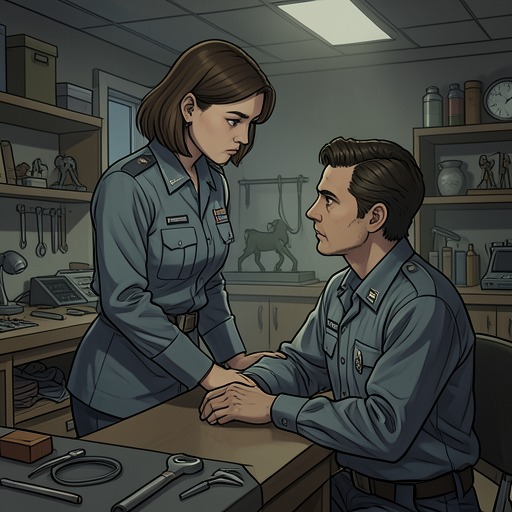
At the end of the training sequence, Jemma tells Mickey that his graduation is the time to prove he understands what it means to be an Expendable. He is holding a weapon and has just shown confusion; when she gives him a sad look, he understands what the moment signifies and objects that she cannot be serious. The evidence establishes the graduation’s demand and Mickey’s recognition of its gravity, without resolving the result of the test.
Jemma’s role is defined by the contrast between how she teaches and what she teaches. She takes care to make difficult material understandable, attends to Mickey’s uncertainty, and shares moments of work and wonder with him; she also equips him to enter a reactor crisis because the human expendable can outlast the machine. Her kindness does not cancel the institution’s calculation, and her candor does not make that calculation humane. The graduation brings those strands together: the instructor who has patiently built Mickey’s competence asks him to demonstrate that he has accepted the lethal purpose for which it was built.