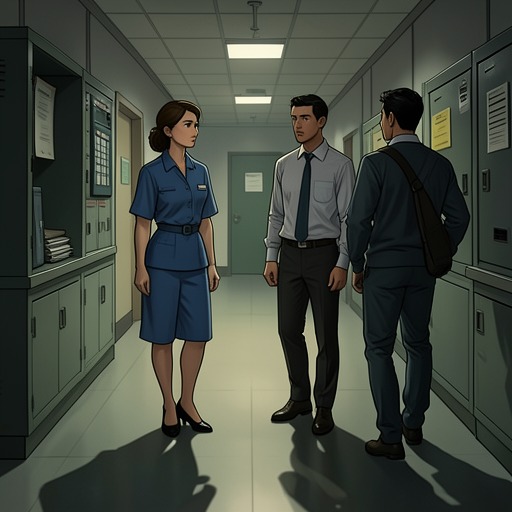
Nasha Adjaya
Mickey7Nasha Adjaya is a combat pilot aboard the Drakkar whose life on the mission is shaped by two urgent commitments: reaching a world she might finally call home and caring for Mickey Barnes through the deaths and returns built into his role as an Expendable. Her story joins practical skill to intimate loyalty, while the discovery of Mickey8 places that loyalty inside a conflict with the colony’s command and its rules about multiple instances.
Identity and Background
The account places Nasha’s birth around the point when it turns to her history, but offers no date or detailed biography. She reveals little about her childhood, though the fragments she shares indicate that it was difficult. What she does explain clearly is why she learned to fly: she had known since she was young that the mission was coming and wanted to take part.
The paths she hoped for were not open to her. She could not enter the academic track that might have led to a doctorate in exobiology, and she lacked the connections that could have secured a place in Security or Command. Learning to pilot a combat skimmer was a route she could pursue. Her blunt view that the people from New Hope were good at killing things casts the choice in the light of the culture around her, but also of a young person making a place for herself within the opportunities available.
For Nasha, Midgard was not a home she expected to return to or claim. She distinguishes it from the destination: the place they are travelling toward carries the possibility of belonging. Mickey Barnes answers her hope with an imagined picture of warm breezes, white sand, and a world without predators. The scene’s irony is supplied by the story’s later events, not by any certainty Nasha has at the time: the planet will not offer the uncomplicated refuge in that vision.
Meeting Mickey Barnes
Nasha and Mickey Barnes properly meet about a year after a collision that killed the earlier instances called One and Two. They are travelling aboard the Drakkar during its long coast through space, at just under 0.9 c, under short rations and with little to break the monotony. Although Mickey Barnes had seen Nasha before, going back to Himmel Station, neither had made a real approach. He had kept apart from people who wanted nothing to do with him, and from those he assumed would not welcome him.
Before they met, Mickey Barnes had spiralled for much of a month after reading about another doomed expedition. Nasha is what brings him out of that spiral. The account does not describe her as solving the questions that troubled him; her importance is more immediate. Her presence interrupts his isolation and gives the retrospective narrative a personal turning point amid the ship’s confinement, boredom, and grief.
When she introduces herself, she identifies herself as Nasha Adjaya and a combat pilot. Mickey Barnes responds by connecting her profession with Berto Gomez, another pilot. The exchange establishes an easy, lightly teasing mode between them, rather than presenting their relationship first through a formal declaration. Their intimacy develops in the constrained life of the voyage, where duty cycles, short rations, and the shared wait for landfall provide its everyday setting.
A Relationship Measured Against Death
By the time Nasha and Mickey Barnes have been together for eight years, his repeated mortality is not an abstract feature of his job. She has known since their first kiss that one day she would have to watch him die, but the prospect becomes immediate when he is confined behind a window during a medical procedure. She stays there for four hours and talks to him: about the planet on the viewscreens, an irritating fellow colonist named Arkady, a drama she has been watching about a wealthy family on Midgard, and things they might do together after Mickey Barnes comes back out of the tank.
The hope in those future plans persists while his condition worsens. He develops a fever, then begins coughing, and eventually brings up blood. Nasha grows quieter but does not leave; she watches him through the glass with one hand pressed against it. Her vigil makes the cost of the Expendable system personal and visible: a procedure intended to allow Mickey Barnes to return also requires the person who loves him to confront what appears, in the moment, to be his death.
When Mickey Barnes tries to spare her from having to watch him die again, Nasha supplies the word he cannot bring himself to say. After eight years together, it is the first time either of them has said that they love the other. The timing gives the admission unusual weight. It is not a beginning for the couple, but a belated naming of a bond already lived through years of closeness and the expectation of repeated loss.
Protection and the Mickey8 Crisis
Nasha also acts as a defender of Mickey Barnes when Cat Chen raises what Hieronymus Marshall had threatened to do to him after the initial landing. Nasha shakes her head and puts a hand at the small of Mickey Barnes’s back, telling Cat that she cannot know what he has been through. When Cat asks whether she means his medical experiences, Nasha confirms that this is what she means. The exchange does not disclose the details of those experiences, but it shows Nasha challenging the assumption that a threat which might frighten someone else should frighten him, given what he has already endured.
Her loyalty is tested in the crisis involving Mickey8. Mickey Barnes tells Hieronymus Marshall that Nasha did not know about the two instances until he walked in on her with Mickey8, shortly before Security arrived to take them away. He tries to keep her from being blamed. Hieronymus Marshall reports a different account: Nasha had told him that she realized two days earlier that something was wrong. The discrepancy remains unresolved in the exchange, which distinguishes Mickey Barnes’s attempt to protect her from Marshall’s account of what she knew.
Marshall also says that Nasha rejected his attempt to make her intimate life a matter of command authority, and that he would have dismissed her if she were not one of the colony’s two qualified combat pilots and if the colony were not facing possible combat with hostile native sentients. Her professional value therefore affects how Marshall treats her during the emergency, even as he considers her private conduct a disciplinary issue. The same encounter reveals that the specimen brought back from the recent snipe hunt is not fully biological but appears to be hybrid military technology. With the colony on a war footing, Nasha’s role as a combat pilot becomes especially consequential.
Narrative Role
Nasha’s characterization is built from a small number of decisive choices and gestures rather than a full account of her past. She chooses the flight training that can put her on the mission; she treats the destination as a possible home; she stays at Mickey Barnes’s window when his body begins to fail; and she speaks up when his suffering is being minimized. Each action connects her professional life to her private attachment without reducing one to the other.
Her relationship with Mickey Barnes also gives emotional scale to the story’s repeated-death premise. The tank may make return possible, but it does not make watching a loved one die easy, nor does the promise of coming back erase the uncertainty and fear of the present. At the same time, the Mickey8 crisis refuses to make Nasha’s loyalties simple: Mickey Barnes defends her, Marshall reports that she knew more than Mickey Barnes says she did, and the surrounding military threat limits Marshall’s response. Nasha remains both a person with intimate commitments and a trained pilot whom the colony may need. The tension between those positions defines her place in the story.