Dugan
Mickey7Dugan is a biologist in the Niflheim colony, introduced as both a newcomer adjusting to its conditions and a researcher seeking reliable information about the native creepers. His brief but consequential arc connects the colony’s shortage of scientific knowledge to the violence of its first attempts to study the creatures: the expedition sent to obtain a specimen becomes one of the episodes in which the creatures’ danger is demonstrated at human cost.
Identity and Arrival
Dugan appears among the colonists during an early gathering led by Hieronymus Marshall. He is one of the people suffering from vomiting, and asks when their personal effects will be transferred from the shuttle. Marshall explains that the colony has forbidden bringing those items because mass is a concern on the journey, and promises that the settlers will be supplied with what they need. The exchange establishes Dugan as a colonist still adjusting to the practical losses and bodily discomforts of arrival; his request for familiar belongings is met not with accommodation but with the requirements of the settlement.
His professional identity becomes clearer later. Dugan is associated with the Biology Section, and his questions are not merely about what the creepers look like: he wants the colony to gather the evidence needed to understand them. That scientific role places him between the creatures themselves and a colony increasingly inclined to treat them as an immediate security problem.
The Need for Evidence
Dugan tells Mickey Barnes that the colonists have almost no hard data about the creepers. The available records amount to a couple of descriptions in picket reports from Berto Gomez and Nasha Adjaya. Dugan explains that this gap is why Mickey has been called in. Mickey’s personal experience of the creatures, and Hieronymus Marshall’s decision to send him out to observe them, make him a source of knowledge the biologists do not yet possess in formal records.
Dugan also recognizes the practical stakes of the research. If the creatures begin making holes in the dome, he warns, the colony will be finished. His request for more information therefore sits at the intersection of scientific inquiry and survival: the colonists need to know what the creatures are, but they need that knowledge because they fear what the creatures might do to their shelter. The information deficit is not abstract. It helps prompt a mission in which observation, specimen collection, and armed removal of the threat are combined.
The Snipe Hunt
Hieronymus Marshall orders a broad sweep around the dome, with Gomez and Nasha Adjaya providing air cover and ground-penetrating radar used to locate the creatures as far as two thousand meters beyond the perimeter. He also directs that the field be cleared of them for at least a kilometer once the missing people have been extracted. Dugan is told that, to develop an understanding of the creatures, he needs a specimen in his lab. Marshall frames the assignment as a snipe hunt, but its purpose is more dangerous than the dismissive phrase suggests: the team is to learn about the creatures while operating against them as an armed threat.
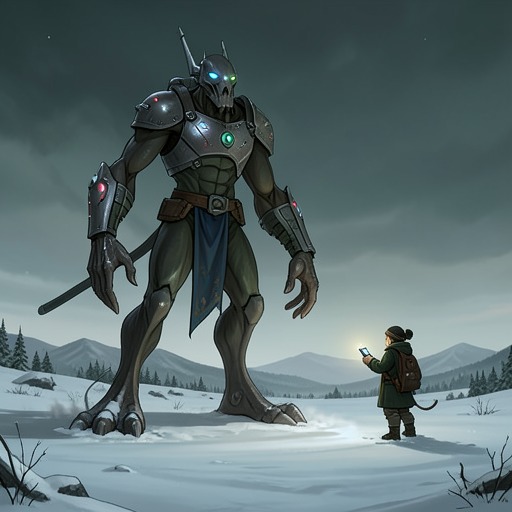
During the expedition, one of the small creepers is found clinging to Dugan’s right leg. Its pointed feet have dug into the armor, and its mandibles are working at the seam behind his knee. Two men nearby turn their burners on it. At first, Dugan appears to encourage them, but the heated armor begins to glow while the creature continues chewing and drives its legs deeper into the softened material. Steam rises from the snow; Dugan’s yelling becomes screaming and then a wordless shriek. The scene offers no calm opportunity to observe or collect a specimen. Instead, the creature’s tenacity and the danger of trying to remove it become immediate, bodily facts.
Consequences and Significance
After the mission, Berto Gomez nudges the remains of a creeper in the aircraft cabin; its legs spasm, and the carcass vibrates when touched. The moment underscores how little the expedition’s participants can assume about the creatures, even after one has been killed. Hieronymus Marshall then confronts Mickey Barnes over the personnel lost in the preceding hours, naming Dugan among them. The account establishes Dugan’s place among the operation’s losses, though it does not separately narrate his final moments.
Dugan’s fate also acquires significance as the colony’s understanding of the creatures changes. Later, Mickey describes the smaller creatures as ancillaries: not independent intelligent beings, but parts of a communal intelligence. That explanation is Mickey’s, not a conclusion attributed to Dugan. It nevertheless reframes the kind of biological problem Dugan was asked to investigate. The colony had approached the creatures as specimens to capture and threats to eliminate; Mickey’s account suggests that their behavior belongs to a larger collective the humans have misunderstood. Dugan’s field mission thus marks the cost of trying to obtain knowledge under military pressure, before the colony has learned how radically its categories may differ from those of Niflheim’s native life.