Mickey Barnes
Mickey7Mickey Barnes is the Niflheim colony’s Expendable, a worker expected to die in hazardous situations because a new body can be made from his stored template and memories. That arrangement makes him at once indispensable and replaceable: he remembers the lives of earlier Mickeys as his own, yet cannot know whether any reconstructed version continues the consciousness that came before. His story turns that uncertainty from a grim occupational fact into a crisis of identity, then tests whether a person treated as expendable can refuse an order on moral grounds.
Identity and the Expendable role
Mickey’s work is to go where the colony needs information or action and where death is an accepted risk. He is sent into reactor trouble, used to test a questionable vaccine, and even volunteered to sample homemade absinthe. His compact account of the arrangement is that if he dies, another him can be made. The colony’s confidence in reconstruction does not make the experience painless: Mickey describes himself as a poor kind of immortal, because memory gives him a sense of having been his predecessors without preserving their final moments.
That distinction shapes how he understands his past. Mickey1 died after a hull breach during transit; Mickey2 woke hours later on Midgard, convinced he was thirty-one and had been born there. Mickey cannot establish whether the first Mickey’s consciousness continued into the second, or whether each new instance merely inherits memories and conviction. He likewise imagines that dying in the cavern might mean waking as Mickey8, but doubts that such a continuation would make the present death less real. The question is not simply whether a copy remembers; it is whether memory can prove that the person who remembers is the same person who lived.
Repeated deaths and accumulated memory
Mickey has died six times in eight years. Of those deaths, one was a surprise, one occurred in an emergency, and one incarnation failed to upload before dying; the remaining three were planned. Standard procedure places the upload as close as possible to termination so the next iteration can learn what happened and, ideally, avoid the same fate. Mickey remembers only what is uploaded. For the deaths he cannot recall directly, he relies on what Nasha and Berto Gomez told him and on surveillance recordings. Repetition therefore makes him experienced in the aftermath of death, but does not give him complete knowledge of the lives that ended.
The first death remains especially present to him. Mickey says it took time to recover from what happened to Mickey1; the trauma of that original body’s death stayed with him even though later versions inherited it as memory. Mickey2 was his shortest-lived instantiation, while Mickey3 lasted the longest. The second death also burdened Mickey3: although Mickey did not remember being Mickey2, he knew the ending had been bad enough for explosive decompression to seem preferable. In the first weeks as Mickey3, that knowledge left him moping, startled by loud noises, and waiting for another disaster. The expected catastrophe did not arrive. Weeks became months and then most of a year, and even the constant expectation of violent death grew boring. His attention turned toward the histories of failed colonies, a subject that complicated the triumphal account of humanity’s Diaspora he had received in school.
Survival, relationships, and bodily vulnerability
Mickey’s reconstructed life depends on other people as well as machinery. After emerging from the tunnels, he tries to contact Nasha and Berto Gomez but receives no response. He wonders whether Berto has already reported him killed and how quickly the colony might reconstruct him. Rather than leave a message, Mickey decides to keep his survival to himself for the moment. The uncertainty is practical as well as philosophical: being presumed dead could set the reconstruction process in motion while he is still alive.
His body also remains subject to ordinary vulnerability. When a doctor advises him to have his malfunctioning ocular examined, Mickey says he will consider it, though internally he has already decided against pursuing treatment. Ocular implants are interwoven with the optic nerves and connected to the brain at several points; replacing one would require difficult microsurgery. He suspects the colony would not devote that effort to him and would instead send him to the tank. The scene makes the logic of expendability intimate: even a repair that another colonist might receive as a matter of care appears to Mickey as a calculation about whether his current body is worth saving.
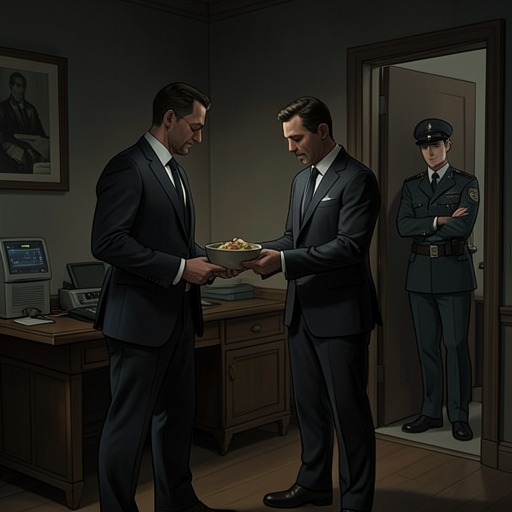
Mickey’s exchanges with Cat Chen offer a more ordinary counterpoint to the colony’s lethal routines. During a late-shift dinner after five deaths in a day, colonists gather in small groups and talk about the recently dead partly to reassure themselves that the same fate will not be theirs. Mickey jokes that Marshall did not actually murder them and calls that a win. Cat is eating roasted tomatoes and a rabbit haunch; Mickey works through a half-full, hundred-kilocalorie mug of cycler paste, despite having promised the rest of his ration to Mickey8. He reasons that nearly dying should count for something. When he asks whether Marshall thinks they are having sex, Cat responds with anger at Marshall. Their exchange locates Mickey amid both the colony’s rationing and its personal tensions, without making survival the only subject of conversation.
Mickey8 and the question of personal identity
The arrival of Mickey8 turns Mickey’s abstract doubts into a direct conflict. When Mickey8 argues that memory and other people’s recognition make a successor the same person, Mickey rejects that certainty. He insists that he and Mickey8 are not one person and treats their recent lives as finite, rather than as mere intervals in an immortal existence. If another version is produced after his death, that version may use his bed and belongings, but it will still be someone else. For Mickey, continuity of memory does not erase the distinctness of the living person who is about to die.
Mickey8 offers the opposing case through the Ship of Theseus and the teachings Jemma gave them at Himmel Station: if the successor believes himself to be Mickey and everyone around him accepts that identity, there is no practical way to prove otherwise. Mickey sees the ban on Multiples differently. He attributes it not to a philosophical concern about identity but to Alan Manikova’s attempt to take over the universe. The argument matters because both Mickeys must act while the question remains unresolved; their disagreement is not a seminar detached from danger, but a dispute over which of two living instances will be allowed to continue.
When Marshall confronts them, Mickey8 describes years of dying for him and recognizes that Marshall is not simply a villain, despite his present conduct. He tells Marshall to choose one of them to kill, or kill both and make a new one. Marshall answers that both deaths would mean the end of the personality and body template, not another trip to the tank. Mickey8 counters that the colony has only 176 people left and is preparing for war, making its sole Expendable too valuable to discard. The exchange exposes the contradiction in Mickey’s status: the colony can call him replaceable, yet its survival may depend on retaining him.
Refusal, diplomacy, and the meaning of survival
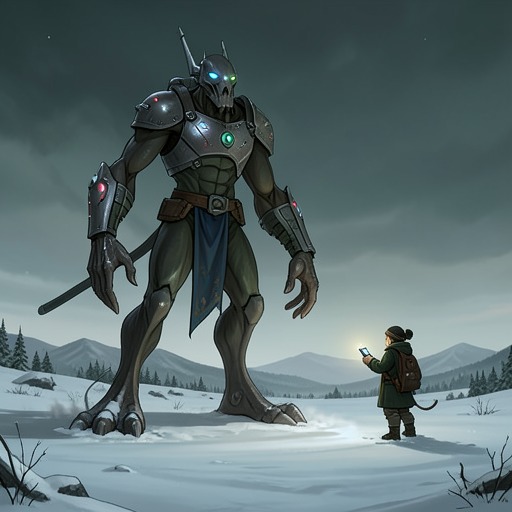
Mickey ultimately identifies himself to Marshall as Mickey7 and says Mickey8 is dead. But survival does not resolve the question of who should live or what the survivor owes the colony. During the confrontation over the creepers, Marshall argues that their killings amount to war. Mickey disputes the assumption behind that judgment: the creepers appear to be a communal intelligence with little concept of individual life. They treat the small creatures humans have seen near the dome as ancillaries—parts of a whole—while assuming individual humans are comparable. From that perspective, the humans’ earlier acts of dissection have not carried the meaning of aggression that Marshall assigns them.
Marshall accuses Mickey of failing to finish his job because he was afraid to die. Mickey allows that fear may be part of the answer, but also refuses to accept genocide as the necessary cost of obedience. The creepers are another intelligent species, and the colony has handed them an antimatter weapon; under those circumstances, Mickey argues, diplomacy is urgently needed and he is the colony’s only diplomat. Marshall holds his gaze, visibly shaking, but finally turns back toward the lock without killing him. Mickey’s importance has shifted: the same capacity that once made him useful as a body sent into danger now makes him the person able to negotiate beyond the human account of the conflict. His refusal does not prove that a reconstructed Mickey is immortal or identical to his predecessors. It establishes something more immediate: the person facing death can still choose what not to do.