Gwen Johansen
Mickey7Gwen Johansen is the recruiter who interviews Mickey Barnes on Midgard and secures his enlistment as an Expendable. In a scene built around the gap between a reassuring sales pitch and the bodily cost it conceals, she insists that Mickey hear what the position actually entails. Her candor makes her more than the official who processes his application: she becomes the first person to put his promised immortality beside the possibility of a painful, deliberately prolonged death.
Identity and Role
Gwen is introduced at her desk in the recruiter’s office on Midgard. She is tall and heavyset, with blonde hair, an expressionless face, and a voice Mickey describes as gravelly. These details make her presence memorable without turning her into a spectacle: in the interview, it is the unadorned delivery of the job’s terms, rather than any display of authority, that defines her role. She reads from a screen in her hands, listing duties that could kill the particular instantiation of Mickey assigned to perform them.
Her work is framed by the euphemism used to recruit Expendables. The position is presented as becoming an Immortal, a label with a more attractive ring than the job’s actual title. Gwen does not let that language stand in for a description of the work. She explains that an Expendable is a person who may repeatedly be sent into danger because another instantiation can be made after death. The interview therefore places her between an institutional sales pitch and the risks that pitch softens.
The Terms She Explains
The hazards she lists range across the demands of a new colony: external repairs during interstellar transit, exposure to local flora and fauna, medical experiments, and combat against hostile forces. The list is long enough that Mickey admits he eventually tunes out. His inattention matters because Gwen is not withholding the risks; the problem is that their scale is difficult to absorb as an inventory. Mickey knows, more or less, what he is signing, but does not yet grasp how many lethal assignments a beachhead colony can generate or how often they may fall to him.
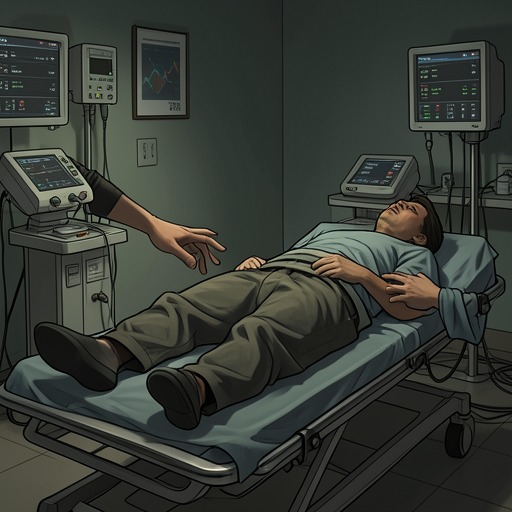
Gwen makes that distinction especially concrete when she checks whether Mickey understands acute radiation poisoning. Her explanation describes deliberate exposure to a lethal dose of ionizing radiation, followed by fever, skin rashes, blistering, failing internal organs, and a painful death over several days. She does not present death as a quick interruption before a replacement can take over. In some cases, she explains, the Expendable may have to remain alive until an experiment or exposure trial is complete, because Command needs the resulting data. Self-termination cannot simply be assumed as an escape: the procedure is not permitted to cut short the collection of evidence.
That account also clarifies the practical logic behind the position. Human bodies can endure certain forms of radiation longer than mechs, and mechs cannot perform some medical experiments at all. On a beachhead, an Expendable is also easier to replace than a mech: heavy industry and mineral extraction are still unavailable, while producing another human body depends on an agricultural base. The calculation is starkly material. Mickey’s replaceability is treated as an operational advantage precisely where machinery and metal are scarce.
Mickey’s Choice and Gwen’s Response
Mickey has not mistaken the job for safe employment. He has heard Gwen’s list and acknowledges the possibility of dying; what he fails to grasp is the frequency and range of the dangers. His reason for signing is not a particular aptitude for hazardous work. He lacks practical skills that would qualify him for other positions, is not a pilot, medic, geneticist, botanist, or xenobiologist, and urgently needs passage away from Midgard. The colony ship is the first chartered since the settlers’ landfall two centuries earlier, and enlistment as an Expendable is his available route aboard.
After reading the hazards, Gwen leans back, folds her arms, and lets an awkward silence settle before asking whether the job sounds appealing. Later she presses him again: did he understand that radiation exposure could be intentionally lethal, and that the consequences could be prolonged and painful? Mickey answers that he did, then asks whether such an outcome would really happen. Gwen tells him it very well might. Her repeated checks make the interview a test of comprehension, not merely a recital of contract language; his willingness to proceed does not erase the severity of what she has described.
Gwen nevertheless asks what he finds appealing about the position. Mickey’s answer returns to the promise that even after being killed once or twice, he would basically be immortal. The exchange exposes the mismatch at the center of the recruitment pitch: the institution’s appealing name converts repeated bodily destruction into a reassuring idea of survival, while Gwen’s details restore the individual deaths that the word obscures. Mickey is not presented as wholly unaware, but the interview shows that knowing a list of hazards and imagining their consequences are different things.
Approval and Narrative Significance
Mickey asks why Gwen is trying so hard to discourage him if nobody has applied and Command was considering drafting someone. She looks back down at her tablet and replies that he seems like a decent sort, and that she would rather the job go to an asshole. She then sets the tablet on the desk, offers her hand, and welcomes him aboard. The moment gives her an expressed personal preference, but not a power to remove the conditions she has just described: she approves Mickey’s application after warning him as frankly as she can.
Her guarded kindness sharpens the scene’s central contrast. The recruitment process requires a person willing to accept extraordinary danger, and the institution’s labor needs make Mickey’s lack of alternatives decisive. Gwen can make the choice more informed, and she can say that she would prefer a less decent recruit; she does not offer him another route off Midgard. Her farewell therefore carries both ordinary warmth and an uncomfortable limit. Mickey boards with his eyes open in one sense, but under circumstances in which informed consent is still shaped by necessity.
Gwen’s importance in the available account lies in this brief encounter rather than in a later plot arc. She establishes the concrete meaning of Mickey’s role before its repeated deaths can be experienced as events: radiation, medical observation, exposure, and the possibility that a dying body must remain alive for the data it can yield. By setting that knowledge against the promise of immortality, the interview introduces a lasting question about whether replacement amounts to survival. Gwen does not answer it; her plainspoken warnings ensure that the question is already present when Mickey says yes.