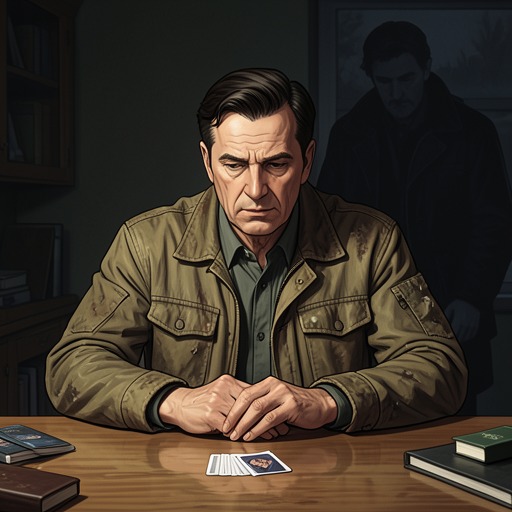
Darius Blank’s Torture of Mickey
Mickey7Darius Blank’s torture of Mickey Barnes converts a debt Mickey had hoped to manage into bodily terror and coercive control. An assault carried out in Mickey’s own apartment leaves him paralyzed, sobbing, and unable to answer, while the promise of repeated visits makes clear that the violence is meant to enforce his obligation to Blank.
The assault and its immediate aftermath
Before the attack, Mickey had tried to make the debt seem survivable. After meeting with Darius Blank, he reasoned that Blank would have to leave him enough of his subsidy to stay alive, since a dead debtor could not repay him. Serving as Blank’s valet might even give Mickey a reason to leave his apartment. That fragile practical optimism gives way as soon as he returns home: while the apartment door is still swinging shut behind him, his legs stop working and he falls face-first to the floor.
A voice greets him with “Hello, Mickey,” but he cannot reply; his mouth produces only a low moan. The voice tells him, “Just relax,” and says, “This won’t take long.” Something is pressed against the back of his neck. The sequence strips away Mickey’s ability to resist or even participate in the exchange: he is conscious of the encounter, but his body cannot answer it.
Mickey later learns that the device was a neural inducer tuned to activate his pain centers. It caused no physical damage, but the account distinguishes the absence of bodily injury from the severity of what he endured: the next thirty seconds are described as hell, and Mickey compares the sensation to being skinned alive while someone works him over with a blowtorch. The short duration does not make the assault trivial. Instead, the precise thirty seconds make the experience feel concentrated and inescapable, with pain produced directly through his nervous system rather than through a visible wound.
When it ends, Mickey is astonished to discover that he is still alive. He is sobbing, paralyzed, and has soiled himself. A hand pats his shoulder, making the attacker’s casual gesture an immediate contrast with Mickey’s helplessness. The voice says, “This was fun,” then promises, “We’ll be working together, you and I, until you’re all square with Mr. Blank. See you tomorrow, Mickey.” The words recast the assault as an ongoing method of collection, not a one-time warning; tomorrow is already presented as the next appointment. The attacker leaves without closing the door.
It takes about an hour before Mickey can move again. He staggers to the bathroom, cleans himself up, and then sits down and cries. The practical routine of washing follows an experience that has left him unable to control his body, while the delayed breakdown marks what he cannot simply reason away. That night, he logs on to the Drakkar recruitment page and checks its sections and positions. Every slot is full. The assault has overturned his hopeful calculation that he can adapt to life under Blank’s debt, but the immediate alternative he looks for is closed as well.
Debt as an open-ended threat
The assault turns Darius Blank’s claim into a schedule of anticipated violence. Mickey’s earlier calculation had treated the debt as a practical problem with limits: he expected to retain enough of his subsidy to survive, and imagined valet work as a tolerable way to repay it. The attacker’s promise of continued contact until the account is settled replaces that imagined arrangement with a condition whose endpoint Mickey cannot control. The next visit is not left vague; it is set for tomorrow, making the threat immediate even as the duration of the overall coercion remains undefined. The contrast gives the scene its central reversal: Mickey had thought his survival would protect Blank’s investment, but survival instead becomes the means by which the debt can be enforced again and again.
The apartment as an exposed space
The location makes the attack more than an extension of the debt conversation: Mickey Barnes has returned to his own apartment, but the scene offers no interval in which home becomes a refuge. The assault begins as the door is still swinging shut behind him, and the assailant leaves without closing it. That unclosed doorway gives the encounter an unresolved edge. The immediate violence is over, but the threat has not been contained within the apartment or sealed off as a finished episode; the attacker has already promised to return. Mickey’s private space is therefore left physically open at the same moment that his future has been made subject to someone else’s schedule.
Narrative function
The scene is built around a sharp division between what Mickey can understand during the assault and what he can explain afterward. In the moment, he receives only a greeting, a few calm instructions, and an unexplained pressure at his neck; the later identification of the neural inducer supplies a technical name without making the pain feel less real. His vivid comparison to skinning and a blowtorch turns an invisible mechanism into something the reader can imaginatively register, while the distinction between pain and physical damage exposes how inadequate visible injury would be as a measure of the harm. The attack’s ordinary language of repayment is thus made inseparable from an experience that cannot be reduced to an account balance: Blank’s debt is enforced through Mickey’s body and anticipation of renewed suffering.