Mickey7 refuses to return the antimatter to the reactor and resigns as Expendable
Mickey7Mickey7 refuses to return the antimatter to the reactor and resigns as Expendable at the moment when Marshall’s command turns a dangerous technical demand into a test of who controls Mickey Barnes’s life. The recovered fuel is needed by the colony, but putting it back would require Mickey to enter the active core without the prospect of another upload. His refusal breaks Marshall’s authority over him and makes Mickey’s role as the sole liaison to the creepers a source of leverage rather than obedience.
The demand and its cost
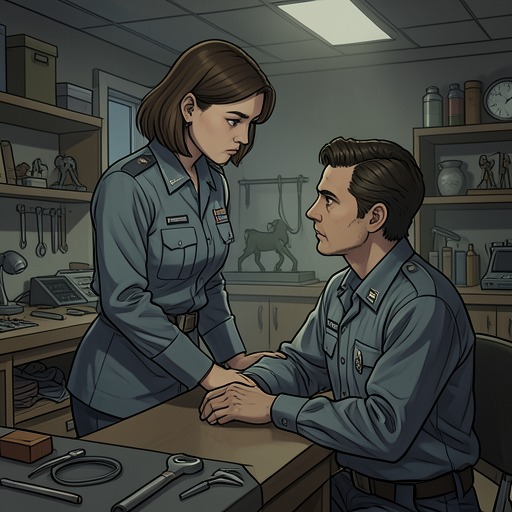
Marshall explains that half the fuel recovered by the colony has been lost, leaving the antimatter in the device Mickey brought back as a vital resource for the reactor core. Mickey suggests that the extraction process simply be reversed. Marshall answers that the drive-feed mechanism works in only one direction: it cannot feed individual fuel elements back into the core. The remaining option, he says, is to do the work manually from inside.
For Mickey, the technical explanation sharpens the personal stakes. He considers the neutron flux inside an active antimatter core and recalls that Jemma never covered it, leaving him to guess how intense it is. Marshall then says he will not ask Mickey to upload either before or after the task, and that Mickey will not need to remember it. When Mickey checks whether this means he will not have to upload at all, Marshall confirms that he will not. The proposed procedure therefore offers none of the reassurance of a backup: Mickey is being asked to undertake the task without an upload on either side of it.
Refusal and escalation
Mickey rejects the order. He argues that Marshall must have had a plan for the colony to survive without the recovered fuel when he sent Mickey into the tunnels, and points him back to that plan. He also names two alternatives: expend a drone to return what he calls the war-crime bomb, or do the work himself. The alternatives turn Marshall’s assertion of necessity back on him: the cost need not fall on Mickey merely because Mickey is the person Marshall has ordered to pay it.
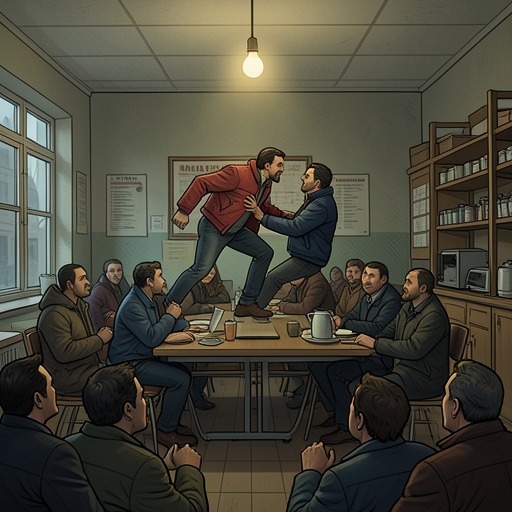
Marshall’s response changes abruptly from a performance of sorrow to rage. Mickey has risen from his chair before Marshall threatens to erase his pattern and recordings from the servers and put the last instantiation of him down the corpse hole. The threat targets both Mickey’s continued existence and the means by which his identity can be preserved. Rather than reversing his decision, Mickey experiences the choice as a weight lifting from his shoulders. The exchange makes his refusal a decisive break with the system that has treated his repeated deaths and reinstantiations as grounds to command him.
Resignation and leverage
Mickey tells Marshall that he can erase the servers, then formally resigns as the colony’s Expendable and tells Marshall to find a replacement. His resignation is not a retreat from the conflict: Mickey immediately identifies the reason Marshall cannot simply kill or replace him. He is the colony’s only liaison to the creepers, and Marshall has handed them an antimatter bomb. If anyone from the colony lays a hand on Mickey, he says, he will tell the creepers that the truce is over.
That threat reverses the power Marshall has tried to exercise. The colony’s need for the reactor fuel gives Marshall an urgent reason to issue the order, but the precarious truce gives Mickey a means to resist it. The leverage depends on Mickey’s particular relationship with the creepers, not on his status as an Expendable; resigning the post does not erase the role he has become essential to. Marshall’s open and close-mouthed reaction registers the force of that reversal, even though he finally insists that Mickey would not dare carry it out.
The confrontation’s ending
Mickey answers that he has died seven times, six more than anyone should, and refuses to let Marshall decide what he would dare. The number recalls the bodily cost behind his defiance: repeated death has not made him willing to accept another supposedly necessary sacrifice. His laugh and his words convert that history from a vulnerability Marshall can exploit into a measure of Mickey’s independence.
Mickey leaves without closing the door. The ending does not show whether the fuel is returned or how Marshall will respond to the resignation; it closes instead on the immediate change in their relationship. Marshall can still threaten Mickey, but Mickey has refused the order, abandoned the title that made him expendable, and made his own safety consequential to the colony’s truce. The scene’s central reversal is therefore not a technical solution to the fuel crisis, but Mickey’s refusal to let the crisis decide that his life is the colony’s disposable resource.