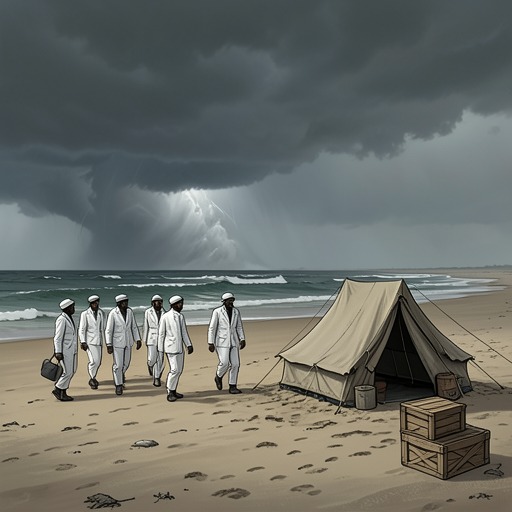
The Niflheim colony mission decides to land
Mickey7The Niflheim colony mission decides to land when the world the expedition has crossed almost eight light-years to reach appears not as a promising blue-green home but as a smooth, white snowball. The choice is a wager against the planet’s climate and atmosphere: the colonists will descend anyway, relying on rebreathers and engineered algae to make survival possible, perhaps only for descendants. The scene turns arrival into a decision rather than a homecoming, and makes the colony’s future depend on accepting risks that cannot be quickly reversed.
The planet revealed
The approach begins when the expedition shuts down the main torch and switches to ion thrusters for orbital insertion. Until then, the glare of the ship’s exhaust has prevented the colonists from observing their destination. A free-fall warning appears in their oculars; thirty seconds later, their weight eases away, and they drift clear of the deck. The planet appears on the main wallscreen about a minute after that, finally visible to the people who have spent nearly eight light-years traveling toward it.
The expected welcome does not arrive. The view is white, smooth, and featureless, more like a ball than a world with recognizable continents or oceans. At first, someone wonders whether the whiteness is cloud cover. The ship’s maneuvering and the planet’s rotation slowly change the viewpoint, but the surface remains unchanged. Nasha identifies it as ice: Niflheim is a snowball. The confirmation extinguishes the tentative cheer and replaces the spectacle of arrival with the immediate question of whether this destination can support human life.
Mickey Barnes and Nasha are holding hands to keep from drifting apart. The small physical necessity carries the scene’s uncertainty: they are suspended in weightlessness, looking at a world that offers no visible assurance of welcome. Mickey tries to reason from what he can see and knows, pointing to the planet’s water and oxygen-nitrogen atmosphere and comparing its condition to Old Earth before life took off. His hope is practical rather than confident; Nasha answers that she hopes he is right, because she would hate to have come so far only to die.
Choosing to attempt settlement
The orbital view is only the first warning. The expedition already understands that both Niflheim’s climate and atmospheric composition make the planet dangerous. Marshall considers whether the ship should continue to a secondary target once he realizes that people cannot survive outside without rebreathers. The possibility of moving on is discussed, but the expedition’s prospects of ever reaching a secondary target are described as almost zero. After discussion and a considerable amount of yelling, Marshall decides to give Niflheim a chance rather than abandon the landing plan.
That decision rests on a long and uncertain biological intervention. Dugan and others from the Biology Section argue that engineered algae, once introduced into the ecosystem, could raise the atmosphere’s partial pressure of oxygen to survivable levels within a reasonable time. The qualification is severe: reasonable may mean not within the lifetimes of any adult members of the expedition, but possibly within the lifetimes of some of the embryos carried in the hold. The plan therefore does not promise that the people making the decision will live to see its success. It asks them to treat a future generation’s possible survival as a reason to proceed now.
The first practical consequence comes while the colonists are still absorbing the planet’s appearance. Mickey’s ocular pings with an order from Command to report to Biology immediately and come prepared to deploy. The intimate pause with Nasha is cut short by the work of colonization. The contrast is sharp: the planet has just been named as a threat, but the expedition’s response is not to retreat. It sends people down to investigate the biological conditions on which any long-term plan must depend.
Descent and biological risk
A colony ship cannot simply land intact at its destination. Much of the vessel is designed for space and is too bulky and fragile to enter an atmosphere or withstand a gravitational field. The colony must reach the surface in separate pieces. A few hours after orbit, the first lander descends to Niflheim, piloted by Nasha and carrying a biological isolation chamber, medical and Biology teams, and Mickey Barnes.
The first task for a new colony is to determine whether local microorganisms threaten human health. The expedition’s expectation is grim: there is always something in a planet’s microbiota that will pose a hazard. The landing is thus not a clean beginning on empty terrain. It opens a period of exposure and testing, with the local ecosystem both the object of the colonists’ proposed transformation and a source of danger to the people attempting it. The snowball’s apparent blankness from orbit gives way to a living environment that must be investigated before it can be altered safely.
The mission’s reliance on Mickey as an Expendable reveals how the plan distributes those dangers. Before leaving Midgard, he accepted that his tissue samples and uploaded record would place him first in line for jobs likely to kill a particular instantiation: exposure to local flora and fauna, medical experiments, combat, and hazardous repairs. A beachhead colony has more dangerous work than he expected, and a human body can tolerate some lethal conditions longer than a mech; other medical experiments cannot be performed on a mech at all. The landing’s risks are therefore not borne evenly. The decision to settle creates a recurring need for bodies that can be exposed, lost, and replaced.
The material terms of survival
The colony’s survival also depends on systems that turn waste and energy into usable resources. The Biological recycler breaks discarded matter down into component atoms and reassembles them as specified. Food scraps, plant stems, bones, hair, and eventually corpses can become protein paste, vitamin slurry, and fertilizer. The process consumes enormous energy, but the expedition’s antimatter-driven starship engine supplies more than enough power at this stage. This closed loop does not make Niflheim hospitable; it gives a desperate settlement a way to keep using what it has brought and what it produces.
Even the biological foundations of settlement remain precarious. The colonists have not yet established an agricultural base, and something in Niflheim’s local microbiota is interfering with the crops they are trying to grow inside the dome. Growing anything outside is expected to be a serious long-term challenge. The algae proposal and the food problem are distinct parts of the same wager: the expedition must change the environment enough to sustain future life while also keeping the first generation alive through immediate shortages and hazards.
The abundance of power is not permanent security. Antimatter behaves much like ordinary matter when isolated, but when it interacts with normal matter the results can include gamma rays or fast-moving subatomic particles. Later, the production of two devices makes a dangerous dent in the colony’s remaining antimatter stores, with no foreseeable way to produce replacement fuel; if the power plant shuts down, everyone is at risk. This later constraint underscores how the landing begins a chain of dependence rather than resolving the crisis. The colony’s apparent energy surplus, like the promise of breathable air, has limits.
Significance
The decision is a commitment made under conditions of limited choice. Niflheim is nearly uninhabitable without equipment, the proposed atmospheric repair may take longer than the adult colonists’ lives, and reaching another destination is almost impossibly unlikely. Yet the expedition proceeds, transforming an arrival into a prolonged experiment in survival. The first view of the planet supplies no welcoming landscape; instead, the plan must be built from rebreathers, biological intervention, dangerous labor, recycling, and the hope that embryos may inherit a more livable world.
The scene also refuses to present colonization as a single heroic landing. A modular descent, microbial testing, food production, and energy conservation make settlement an ongoing infrastructure problem. Each system has a bottleneck, and each solution exposes someone or something to risk. The mission’s decision does not establish that Niflheim can be made habitable. It establishes that the expedition will try, accepting a future whose success may belong to people not yet born.