Mickey1 Repairs the Drakkar’s Damaged Field Generator
Mickey7Mickey1 Repairs the Drakkar’s Damaged Field Generator is the emergency repair that restores the Drakkar’s protective field after an interstellar impact opens the ship to lethal radiation. Mickey Barnes carries out the replacement under a rapidly worsening dose, completes the connection, and is made to upload before his body dies. The repair saves the ship’s field, but its cost is not confined to the instance sent into danger: thirty-four people suffer radiation poisoning, and Mickey Barnes’s next instantiation inherits the experience.
Causes and Background
The emergency interrupts what had seemed an uneventful passage. More than a year out from Midgard, the Drakkar has completed its first boost, crossed the sun’s heliopause at sub-relativistic speed, boosted again, and settled into a long cruise at just under nine-tenths the speed of light toward Niflheim. Mickey Barnes recalls expecting to reach the destination without needing another trip through the tank. Once the ship was past the demanding boost phase, interstellar travel appeared to be little more than a long, dull interval.
That apparent calm also shaped Mickey Barnes’s place aboard. The ship’s crew treated most colonists as baggage during transit, and he was especially peripheral because he belonged to no particular branch. He was meant to train for two hours a day, rotating among departments so he could fill in where needed; in practice, the training often amounted to about two hours a week. Some potential trainers found him unsettling, while engineers were occupied with their work. Much of his time instead went to meals, naps, and puzzle games with Berto Gomez. The impact abruptly turns that underused, cross-trained role into an immediate demand for hazardous technical labor.
The object that struck the Drakkar was small by ordinary standards but devastating at cruising speed. Its impact destroyed the material, reducing it to quarks and gluons; the crew could only estimate its mass, at fifteen to twenty grams, from the volume of armor vaporized and the energy lost by the ship. A rock as large as a human head would have carried energy comparable to a hundred fusion bombs at that speed. The ship’s armor was not designed to stop anything much larger than dust, and no practical thickness could protect it from a true macro object.
Damage and the Repair Order
The jolt sent unsecured people and objects flying into the forward bulkheads. Some crew members broke arms, one suffered a serious concussion, and Mickey Barnes sprained an ankle against a table. Those injuries became secondary when the crew discovered a hole in the nose cone and the loss of one field-generation module. With the field compromised, hard radiation flooded twenty percent of the Drakkar’s interior.
Maggie Ling, head of Systems Engineering during transit, summoned Mickey Barnes to the machine shop, the nearest safe compartment to the access hatch. Two engineers put him into a vacuum suit while Maggie explained the task: the power coupling might be damaged, but there was no time to determine that, so he was to replace the entire unit. The replacement was a silver cube half a meter across, with two floating connector cables on one side and maneuvering handles on the other. He was also asked to bring back the old unit if possible, though the qualification mattered: the compartment beyond the hatch was open to space, and he would receive a lethal full-body radiation dose every three and a half seconds until the field was restored.
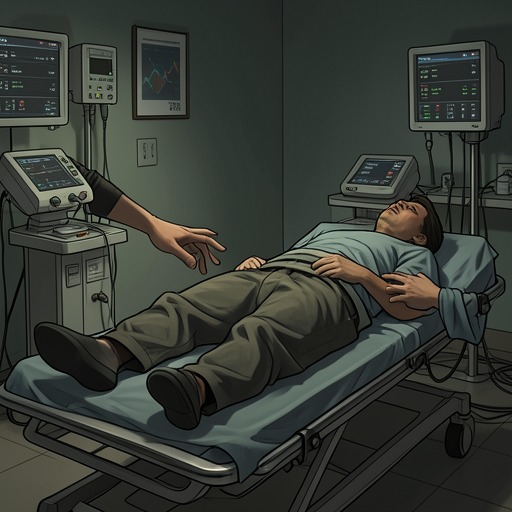
Maggie warned that a fatal dose would not make the body shut down instantly. Even after absorbing many times a lethal amount, a human body could remain functional long enough for Mickey Barnes to upload before death, provided he avoided a direct strike from another grain. His next instantiation was already being grown in the tank. The preparation makes the mission’s terms explicit: the repair depends on a body that can be sacrificed, but the knowledge gained during the attempt must survive it.
Replacing the Module
Mickey Barnes moved the heavy replacement carefully toward a portable air lock rigged over the hatch. In free fall, the unit had no weight, but it still had mass; accelerating it too quickly risked smashing equipment. After he entered the lock, the crew sealed the outer door and evacuated the air. When the escaping air stopped whistling, the hatch opened onto the damaged field-generator array.
The array consisted of six cubes like the one he carried. The failed unit was immediately identifiable: a black-rimmed hole, two or three centimeters wide, had pierced its top, and a larger opening marked the chamber roof above it. A beam of bluish light passed through the damage and illuminated the wrecked cube. As Mickey Barnes worked, his skin began to burn. He pulled the cables free, opened the docking latches, and removed the old module without difficulty. But while positioning the replacement, his head passed through the beam; about ten seconds later, he was blind.
Blindness did not end the attempt. With guidance over the comm, Mickey Barnes continued moving the unit into position until its connector snapped into place. Maggie confirmed that the field had been reestablished and praised the repair. The success is sharply bounded: the ship’s protection returns, but the person who restored it is still trapped in a body being consumed by radiation.
Death, Continuity, and Aftermath
After the connection was secured, Maggie told Mickey Barnes to relax while the crew arranged to retrieve him. He could not. His body was burning from the inside, and his fingers had swollen until they would not bend. He could not remove his helmet or act to hasten the end; he floated, shaking and moaning, and waited for someone to bring him back inside. The repair’s completion therefore does not resolve the scene as a simple rescue. It marks the point at which the ship is safe enough for the cost to become visible.
Mickey Barnes understands why the crew made him upload before allowing the damaged instance to die. Jemma had explained that knowledge and experience acquired during a critical situation were too valuable to be lost with one particular instance. The procedure turns the emergency into both a physical ordeal and a transfer of operational memory. What the instance endured is preserved for its successor, even as Mickey Barnes reflects that some experiences ought to be forgotten.
By the time he emerged from the tank as Mickey2, the field generator worked and conditions aboard the Drakkar were largely normal again. That recovery had limits: thirty-four people had varying degrees of radiation poisoning because they had been in the wrong parts of the ship when the field failed, and the hole in the armor remained. A stray grain striking the damaged area could recreate the crisis. As soon as Mickey2 was conscious and functioning, Maggie’s team put him into another vacuum suit, supplied a tank of high-density emergency patch nanites, and gave him five minutes of instruction before sending him onto the hull. The first repair thus restores the field but does not finish the emergency; it carries directly into another dangerous task.
The episode gives concrete form to Mickey Barnes’s role as an Expendable. His body is treated as a resource that can enter a lethal compartment, while the institution safeguards the experience that body acquires by transferring it to a successor. Yet the account does not make that exchange painless or abstract: blindness, burning skin, swollen fingers, and helpless waiting remain attached to the instance that performs the work. The ship survives the impact, but the survival is purchased through one body’s suffering and followed by a second deployment before the wider damage has been repaired.