Mickey7 and Mickey8’s Rock-Paper-Scissors Showdown
Mickey7Mickey Barnes and Mickey8’s Rock-Paper-Scissors Showdown turns the discovery of two living copies into an apparent life-or-death decision. The game seems to offer a fair answer to an impossible conflict: the colony has one registered identity, one berth, and one ration card, while its rules forbid multiple instances. But winning does not settle the crisis. Mickey8 refuses to carry out the death the game appears to assign, and the two decide to keep their existence secret.
Discovery and the terms of the crisis
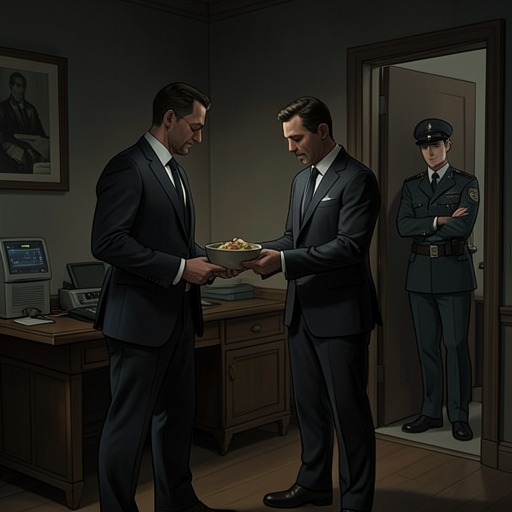
After returning to his rack with a swollen, purple wrist, Mickey Barnes heads to his room in the low-status quarters near the roof of the colony dome. The slums are four floors up a bare metal spiral staircase, and consist of small rooms divided by plastic partitions and thin foam doors. His double room, unusually spacious for a resident, is one of the limited advantages attached to his status as an Expendable. When he finds the door unlocked and another man in his bed, the visitor recognizes himself as Mickey8: a newly generated copy of Mickey Barnes.
The discovery immediately makes private survival collide with institutional law. Mickey Barnes is not dead, so the copy should not have emerged from the tank; if Command learns that both are alive, they will be treated as multiples. Mickey Barnes concludes that one of them must go. Mickey8 agrees that there is no compromise that can restore them to a single person, and Mickey Barnes raises the possibility of taking the problem to Command. That prospect offers no neutral solution: the colony’s prohibition on multiples and its scarcity of resources make the survival of both seem incompatible with official rules.
The story places that scarcity in a larger history of settlement. Mickey Barnes compares the Diaspora and the formation of the Union to the settlement of Micronesia, where voyagers landed on isolated islands with only the supplies left in their boats until they could produce food locally. The arks face the same basic vulnerability across much greater distances, without knowing whether their crops will grow at the destination. The hard rule against overweight settlers expresses the stakes of that vulnerability: a beachhead colony must ration its limited resources from the outset. In the immediate crisis, the issue is concrete rather than abstract. Two Mickeys have only one berth, one ration card, and one registered identity.
The game and its apparent verdict
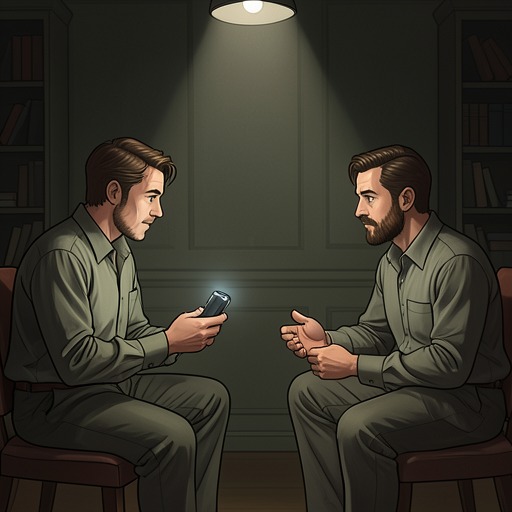
With neither copy able to accept the other’s proposal as an easy compromise, they turn to rock-paper-scissors. The choice of a childhood game gives a blunt, almost absurd form to a decision with lethal consequences. Mickey Barnes plans to throw Rock, then realizes that Mickey8 may reason in the same way. He cycles through predictions—Paper, then Scissors, then back to Rock—until the moment to choose passes and his fist remains closed.
Mickey8 holds out Paper. Mickey Barnes has lost. Mickey8 apologizes, and Mickey Barnes recognizes the result without pretending that it resolves the moral problem. The game determines a winner, but offers no authority beyond the two copies’ agreement to play; it cannot make the winner’s next action inevitable. In that gap between verdict and consequence, the scene’s apparent solution begins to fail.
The corpse hole and the reversal
The corpse hole makes the threat more than a figure of speech. It is part of the biological recycler, which breaks discarded material down into component atoms and reconstructs it as products such as protein paste, vitamin slurry, and fertilizer. The system can eventually process corpses as well as food scraps and other waste. It uses substantial power, supplied by the colony’s antimatter-driven starship engine, and Mickey Barnes knows the opening chiefly from occasional garbage-duty assignments.
When the two confront the possibility of using it, Mickey Barnes opens the safety cover and presses the console’s red button. The hole irises open in the floor as a quiet, odorless black disk. Its disassembler field draws in dust, which vanishes in tiny flashes. The unremarkable appearance of the mechanism sharpens rather than diminishes its threat: the colony’s technology can make a person into recyclable matter without spectacle.
After the game, Mickey Barnes goes down on his hands and knees beside the opening and prepares to put his face near the field. He feels it tug at his skin and tries to work out how to make the death less agonizing. Mickey8 stops him. Rather than allow the apparent loser to die, he pulls Mickey Barnes back onto his heels and offers him a hand up. Mickey Barnes is shaking so badly that he can barely stand, but accepts the help. The reversal is decisive: Mickey8 has won the game, yet refuses to enforce its result. Neither copy enters the recycler during this confrontation.
Concealment, relationships, and unresolved danger
The immediate alternative to death is not a secure arrangement. Mickey8 jokes about other ways of killing Mickey Barnes, but the humor leaves the underlying constraints intact. There are still two people competing for one berth, one ration card, and one identity. Mickey8 notes that cafeteria protein paste is discounted; even eating only that would provide each of them 1,250 calories of actual nutrition. Mickey Barnes accepts that this might stave off starvation, but it does not answer the problem of their existence as a multiple.
Command makes disclosure especially dangerous. Commander Hieronymus Marshall already regards Mickey Barnes with hostility: after learning of Mickey Barnes’s confrontation with Darius Blank about a week after the ship left orbit around Midgard, he took it as evidence of criminal infiltration. Marshall also comes from a religious tradition that regards even a single person’s restoration from the tank as an abomination. He had nearly ordered Mickey Barnes cast out of an airlock before Mara Singh, then captain of the Drakkar and later head of its Engineering Section, reminded him that he did not command the mission until it made landfall on Niflheim. Mickey Barnes therefore expects that discovery of two copies would worsen, not soften, Marshall’s response.
Mickey Barnes considers whether Nasha could be trusted. They have been together since he was Mickey3, and she had been willing to risk her life trying to pull him from the hole. Yet he does not want her drawn into the danger if they eventually face Marshall. He chooses secrecy for now, and Mickey8 agrees. Their decision is a temporary means of avoiding immediate execution, not a resolution of their legal or material predicament. Mickey8 observes that, given events since landfall, one of them may die soon anyway; Mickey Barnes privately recognizes the possibility. The showdown ends, then, not with a stable settlement but with two copies alive, bound together by a choice they cannot safely reveal.