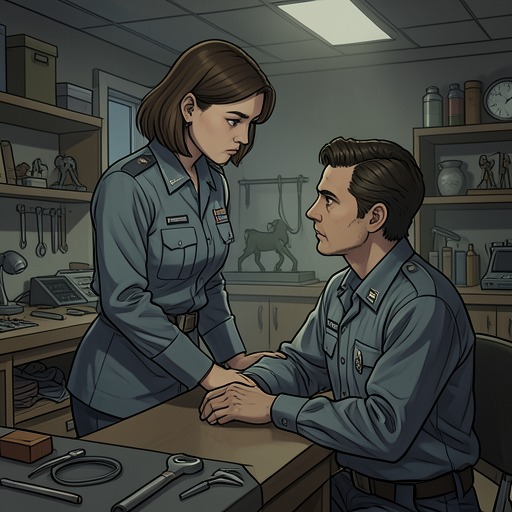
Mickey1’s Graduation Test
Mickey7Mickey1’s Graduation Test turns the promise of backup-based survival into a demand that Mickey die by his own hand. On Himmel Station, Jemma gives him a burner and instructs him to use it on himself, describing the act as proof that he understands what being an Expendable means. He presses the trigger; the weapon does not fire. Jemma then names him Mickey1, making the failed execution—not a conventional ceremony—the threshold into his new identity.
Background and Preparation
The test follows Mickey’s first backup, made on the morning of his twelfth day on Himmel Station. Its creation is presented as a physical procedure: technicians take blood, remove a small piece of skin from his belly, collect cerebrospinal fluid, and spend three hours scanning the distribution and chemical makeup of every cell in his body. Jemma waits for him afterward. The scan has mapped a body that can be reproduced, but the graduation test will ask Mickey to treat that body as disposable.
Jemma tells him that every time he comes out of the tank for the rest of his life, he will look as he does now. Mickey initially assumes the process is a one-time event, and later approaches Jemma expecting some recognizable graduation ritual, even jokingly wondering about a cap and gown. That expectation makes the encounter’s reversal especially stark: the supposed ceremony is not a public recognition of achievement but a private demand to enact the role he has accepted.
The Test
Jemma’s manner changes the scene. Her face is blank as she takes a shiny black device from her jumpsuit pocket. It is slightly larger than her hand, with a pistol grip, a short barrel, and a white crystal tip. She identifies it as a low-power burner, safe to use on the station. It cannot cut through metal, she explains, but can badly damage organic matter. The weapon is therefore not a harmless prop: its stated function makes the threat to Mickey’s body concrete.
She shows him the red safety switch and tells him to slide it forward. When Mickey says he does not understand, Jemma’s sad expression makes the meaning clear. She calls the act his graduation and says he must prove that he understands what it means to be an Expendable. Her instructions are precise: he is to turn his head, place the weapon behind his ear, angle it slightly upward, and use the fan beam to destroy the medulla oblongata and part of the cerebellum. She promises that a correct shot will be painless; if he misses, she may have to clean up afterward. The procedural detail strips away any easy distance between the abstract promise of regeneration and the immediate prospect of bodily destruction.
Jemma also defines the test as a condition of Mickey’s future. If he refuses, he will be sent by shuttle back to Midgard the next morning, and she will have to start again with a conscript. She frames the choice as part of what he signed up for, and as the price of immortality. The alternatives are thus not presented as equally welcome: return means going back to a poor life he does not want, while acceptance means performing his own death in order to continue with the Drakkar.
Choice and Reversal
Mickey considers returning to Midgard, to his apartment and starvation subsidy, and telling his friends he will not go with the Drakkar. He also remembers Darius Blank’s torture machine. That memory forms part of the immediate pressure behind his decision, though the scene does not say that it alone determines his choice. He asks whether the act is like going to sleep and whether he will wake in his sling, good as new. Jemma confirms that he will, perhaps hungover. Her reassurance translates a lethal action into the language of a recoverable interval, without making the act itself less disturbing.
Jemma smiles. Mickey sighs, looks away, and puts the burner to his head. He asks whether he has positioned it correctly; she tells him it is close enough. He closes his eyes, breathes in and out, and presses the trigger. Nothing happens. The narration gives no explanation for the failure, so the weapon’s silence cannot be assigned to a mechanical fault, a safety intervention, or a deliberate decision by Jemma. What is explicit is the change in Mickey’s position: he has carried out the requested action, but the expected death and regeneration do not follow.
He stands frozen and shaking until Jemma gently prises the burner from his hand. Her quiet congratulations then complete the scene: as of that day, he is officially Mickey1. The designation follows an attempted self-execution rather than a ceremony, and the gentleness of her gesture contrasts with the violence she has just instructed him to perform.
Significance
The test makes the cost of Mickey’s new status visible before that status can become routine. The backup procedure offers a means of returning after death, but Jemma’s examination insists that Mickey first accept death as part of his work. His body is at once the object measured by the scanner, the target of the burner, and the material from which another version can be restored. The scene’s central tension lies in the gap between those biological assurances and the first-person act required to trust them.
The event also complicates the word graduation. Mickey does not receive an ordinary qualification after demonstrating a learned skill; he is required to show that he will accept the conditions of service, including self-termination. Yet the test’s outcome is not a completed death. The trigger produces nothing, and the narration leaves that failure unexplained. Jemma’s naming of him as Mickey1 closes the scene administratively, while the frozen, shaking Mickey and the silent weapon preserve its unresolved bodily shock.