Mickey7 returns to the colony with a bomb and confronts Marshall
Mickey7Mickey7’s return to the colony with a bomb turns a tense perimeter encounter into a test of whether Hieronymus Marshall will choose extermination or diplomacy. With the colony on high alert, Mickey7 faces armed defenses and an order to surrender his pack; he instead reveals that the creepers possess an antimatter weapon and argues that killing him would destroy the colony’s only link to them. Marshall ultimately withdraws, and the standoff ends without either side firing.
Approach to the perimeter
Mickey7 changes his route to approach as nearly as possible between two defensive pylons. He hopes to reach the dome before anyone challenges him, but the colony’s heightened alert for creeper incursions makes that unlikely. Still about one hundred meters from the perimeter, he sees the nearest pylons activate: lights flash at their bases, and burners rise from the tops and turn toward him.
He raises the trigger cord in his right hand and asks the defenders not to fire, making clear that he does not want to pull it. The burners stay trained on him, but do not shoot. After a pause of roughly thirty seconds, Marshall speaks over the comm channel and orders Mickey7 to remove the pack, set it down carefully, and step away. Mickey7 refuses. When Marshall asks which version of Barnes he is addressing, Mickey7 identifies himself as Seven.
A prolonged armed standoff
The exchange does not resolve the impasse. The comm connection closes, and Mickey7 remains beneath the pylons’ dull red glow. He is left standing in the subzero cold for almost an hour as it works through his layers of thermal clothing; after about forty minutes, he is so cold that he wishes the burners would fire simply to let him die warm. The delay makes the choice before him increasingly immediate: he comes close to pulling the cord and ending the standoff himself.
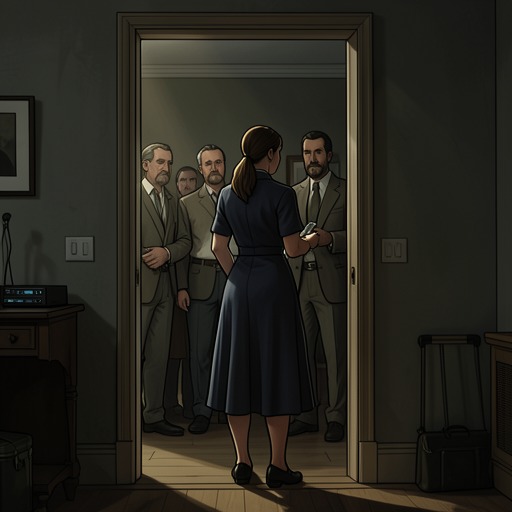
Instead, the dome’s secondary lock cycles open about two hundred meters away, and Marshall emerges with two armed escorts in combat armor. Difficult to distinguish beneath their rebreathers, goggles, and cold-weather gear, Marshall is identifiable by his height and by the authority with which the escorts follow him. Mickey7 challenges the need for an escort when two cannons are already trained on him. Marshall answers that the colony is at war and accuses him of taking the enemy’s side.
Marshall stops about ten meters from the perimeter, his escorts half a pace behind. He invites Mickey7 to do what he came to do. Mickey7 does not summon the creepers or make a joke of the threat: with the escorts’ accelerators ready, he says instead that he did not pull the trigger. The immediate question is no longer whether he can use the device, but what happened to the weapon and to Mickey8.
The weapon and the threat of execution
Marshall asks whether Mickey8 triggered his device. Mickey7 says that he did not: Mickey8 was killed before he could. When Marshall asks what became of the device, Mickey7 answers that the creepers have it. After a long silence, he confirms that he knows this because he told them what the weapon was and how it operated. The disclosure changes the balance of the confrontation: the device is no longer only a threat in Mickey7’s hands, but a weapon the creepers possess and understand.
Marshall responds by ordering the escort on his left to kill Mickey7. The apparent subordinate hesitates and is revealed to be Cat Chen; Lucas also challenges Marshall, pointing out that Mickey7 has little reason to refrain from killing them if they give him none. As Cat and Lucas shoulder their weapons, Mickey7 states the strategic consequence plainly: Marshall cannot kill him without losing the colony’s only liaison to the creepers, who now have an antimatter weapon too.
Marshall blames Mickey7 for putting the colony in danger. Mickey7 counters that sending a doomsday weapon into the creepers’ tunnels was not his decision, and that he was not responsible for Mickey8 being taken before he could trigger it. Marshall calls him a coward for refusing to die in the line of duty. Mickey7 acknowledges that he may have wanted to live, but insists that he may also have refused to die with a genocide on his conscience.
The choice to negotiate
Mickey7 does not claim that the danger has passed. He argues that the colony must respond to the present situation: an intelligent species now has an antimatter weapon, and the humans urgently need diplomacy. Because he is the only person able to communicate with the creepers, killing him would remove the colony’s sole available diplomat without recovering the weapon or undoing what has happened. His refusal to pull the cord thus becomes more than self-preservation; it is also a refusal to make extermination the only available answer.
Marshall stares him down for about thirty seconds, his hands trembling and his jaw working beneath his rebreather. He says nothing more and turns back toward the lock. Cat and Lucas watch him go. After the outer door closes, Mickey7 asks whether the immediate danger has passed. Cat looks to Lucas; he looks toward the nearest pylon, where the burner goes dark and sinks back onto its bearings. Cat offers only a qualified assurance: for the moment, they are safe. She then approaches Mickey7 and offers her hand. He puts away the trigger cord, takes it, and pulls her into a hug.
Significance
The confrontation ends not with a military victory but with a suspended decision. The burners are lowered, Marshall has left, and Cat and Lucas do not carry out his execution order; nevertheless, Cat’s qualification that the arrangement holds only for the moment preserves the scene’s uncertainty. The weapon remains with the creepers, and the colony’s need for communication has become inseparable from its security.
The scene makes the opposing choices concrete through the trigger cord and the pylons’ aimed burners. Mickey7 has the capacity to initiate violence, while Marshall’s defenses and execution order demonstrate the colony’s willingness to meet the threat with force. Mickey7’s argument redirects the confrontation toward the consequences of killing: it would eliminate the one person who can serve as a go-between, while leaving the creepers armed. His decision not to pull the cord does not resolve the conflict; it keeps open the possibility of diplomacy.