The Bullet's impact on Gault
Mickey7The Bullet's impact on Gault was the catastrophic culmination of a conflict that had already destroyed Eden’s Justice: a younger, poorer colony chose a radically different response to the danger posed by Alan Manikova. Rather than attempt another expedition, Farhome sent a relativistic object that could not meaningfully be intercepted or detected in time. The strike devastated Gault’s ecosystem, and its scale helped make planetary destruction the Union’s defining atrocity.
Causes and Background
The attack followed Manikova’s defeat of Eden’s Justice. Gault’s last messages had reached more than one world: Farhome, Gault’s next-closest neighbor, received them too. Farhome was a much younger, poorer, second-generation colony, and its government was even more alarmed than Eden’s. Yet it lacked both the ambition and the resources to mount the kind of expedition Eden had attempted. The contrast was not simply between two reactions to the same warning; it was between the means available to two colonies confronting the same danger.
Farhome’s answer was simpler, more direct, and much cheaper. It called the weapon The Bullet. In the narrative’s account, the choice of a weapon that would never decelerate was decisive: Eden’s Justice had been vulnerable while slowing down, blinded by the torch it used to decelerate, and Manikova’s missiles had destroyed it before its commander could return fire. The Bullet avoided that particular vulnerability by not trying to arrive safely or enter orbit. Its course was an impact.
The Weapon and Its Approach
The account explains the underlying danger through kinetic energy: an object’s energy rises with its mass and the square of its velocity, making interstellar travel both costly and hazardous. At relativistic speed, an object need not be especially massive to strike with devastating force. The Bullet was traveling at 0.97 c when it hit Gault, so the threat came not from a vast payload described in conventional terms but from velocity converted into impact energy.
That speed also made the attack practically indefensible. There was no practical way to stop a relativistic strike, or even to know it was coming in time to respond: the light announcing the object’s arrival reached its target only a bare fraction of a second before the object itself. The warning and the impact were therefore almost simultaneous. The Bullet’s design turned the time needed to perceive an attack into part of the attack’s advantage, rather than offering the target a meaningful interval in which to act.
Impact and Destruction
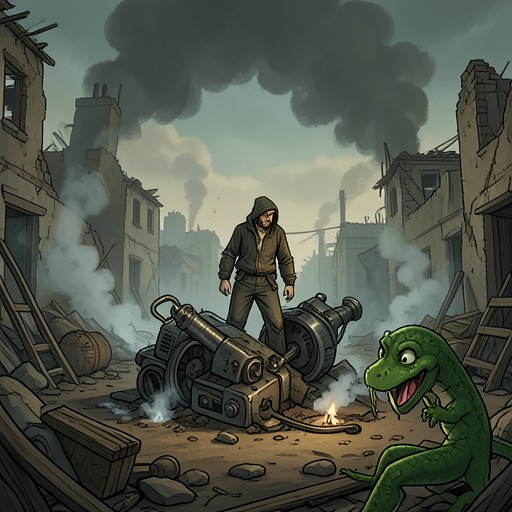
The Bullet hit Gault three months after the destruction of Eden’s Justice. Over roughly a picosecond, it delivered energy equivalent to two hundred thousand fusion bombs to Gault’s ecosystem. The scale and duration make the event more than a defeat of a colony or a military target: the strike applied an extraordinary concentration of energy to an entire world’s living environment. The narrative gives no account of survivors or recovery; instead, it states that Gault could not come back from an impact like this.
The contrast with the battle at Eden’s Justice sharpens the event’s meaning. Manikova’s attack there had been swift and decisive, but The Bullet made the consequences planetary. The earlier destruction eliminated a ship before its commander could fire back; the later strike rendered Gault itself irrecoverable. The shift in scale is also a shift in what is at stake: not only whether a force wins a fight, but whether a world’s ecosystem can continue to exist.
Consequences and Significance
The destruction carries a particular weight because habitable planets are scarce. The narrator connects Gault’s fate to the effort to make Niflheim work as a human home, observing that there are few habitable worlds available. Against that scarcity, turning one into molten slag is described as widely regarded as the greatest crime in Union history. The attack therefore becomes a measure of the stakes of colonization: a world may be difficult to inhabit, but destroying one removes an already rare possibility.
Responsibility is politically separated from the weapon’s immediate operator. The narrative says that people do not blame Farhome for the strike; they blame Manikova. That distinction places the attack within the chain of danger initiated by his actions, while still identifying The Bullet’s effect as an irreversible catastrophe. It also shows how Gault’s destruction reshapes social judgment beyond the conflict itself: in most parts of the Union, being a multiple is thereafter considered worse than being a child stealer or a human head collector. The Bullet’s impact thus marks both the physical end of Gault’s ecosystem and a lasting change in the moral and political climate of the Union.